
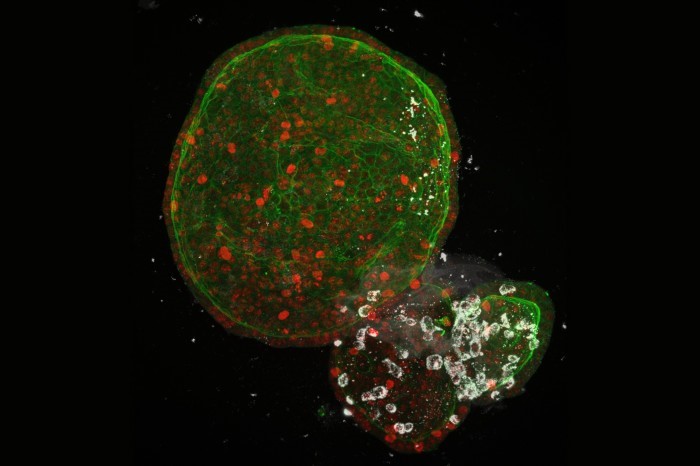
Human gut organoids infected with SARS-CoV-2 (Credit: Joep Beumer/Hubrecht Institute)
“Virologists have infected millions of miniature organs with SARS-CoV-2, to learn how the virus wreaks havoc and how to stop it,” writes Smriti Mallapaty in the latest issue of Nature. In one study, published in Science Immunology in 2020, researchers used CRISPR in gut organoids to identify two proteins (TMPRSS2 and TMPRSS4) that facilitate the virus entry into human cells, together with the ACE2 receptor. “Other labs are knocking out ACE2 entirely, to see whether the virus can still get in”. Here the full text of the news feature.

 “Wow! Badass. 13,200 crispr base edits in a single cell! On the way to ‘recoded’ human cells,” tweeted Antonio Regalado before covering the news in
  Time will tell if it is going to become the preferred enzyme for genome editing or just another useful tool in the expanding CRISPR kit. But the future of CasX looks bright. It is much smaller than the nucleases that have provided a foundation for this technology. Being fewer than a thousand amino acids, it offers clear advantages for delivery in comparison with Cas9, that is over 1,300 Aa.



 CRISPeR FRENZY