According to Fyodor Urnov, she should be added to “the pantheon of names inscribed in golden letters in the history of biomedicine.” That list includes other pioneering patients such as James Phipps (the boy vaccinated by Edward Jenner), Albert Alexander (the first human treated with penicillin), Louise Brown (the first test tube baby) and Emily Whitehead (the first recipient of CAR-T cells). Now the CRISPR Journal made the unusual decision to put her on the cover.
My feature on the dark genome published in the Italian edition of Scientific American won the journalism prize on rare diseases. Wondering if CRISPR is useful for studying the function of dark genes? Of course it is!
The first is a CRISPR innovator (base editing and prime editing came out of his lab). The second has a genetic disease that causes him to age prematurely (progeria) and has taken his destiny into his own hands by becoming a biologist. They are each other’s inspiration and in this video they tell us why.
“In the animal world there are species naturally capable of bringing forth new life from an unfertilized egg cell, always or under exceptional circumstances (a case was recently discovered in a female crocodile). But with the help of biotechnology, it has become possible to bypass the male contribution even in species that have always relied on sexual reproduction. By manipulating oocytes in vitro, Chinese researchers succeeded in mice. The latest breakthrough was announced in Current Biology: using CRISPR to turn on and off different combinations of genes, a Cambridge team was able to identify the molecular basis of parthenogenesis in the fruit fly and artificially transfer this trait into a strain that did not have it. After being equipped with the right genetic makeup, some females gave birth to other females, which were also able to reproduce in the absence of males. Of course, we are far from any application on the human species, for both technical and ethical reasons, but there are no risks in exploring with imagination the theoretical possibility that women might be able to procreate on their own.” And this is precisely what I write about in my column today in magazine 7/Corriere della sera.
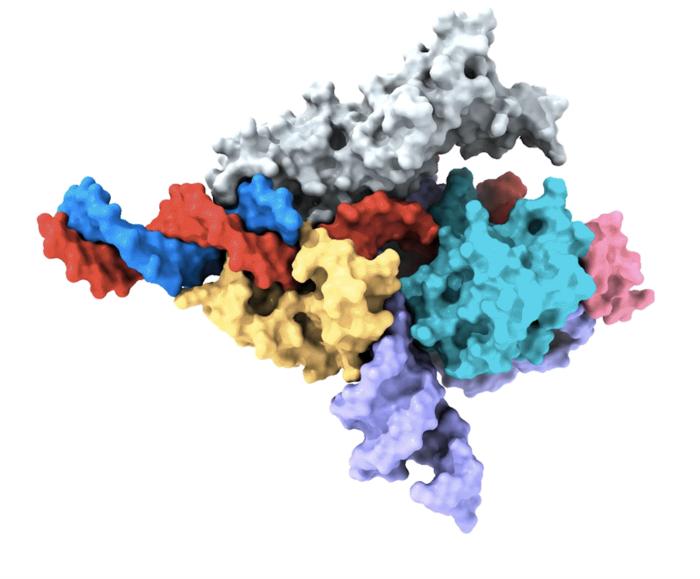
Credit: Courtesy of the Zhang lab Cryo-EM map of a Fanzor protein in complex with ωRNA and its target DNA.
Treasure hunting in fungi and clams has led to the discovery of CRISPR-like proteins that can be RNA-programmed to edit human DNA.
“Nature doesn’t make jumps,” claimed many thinkers of the past, but modern-day geneticists can point to many exceptions to the rule. Transposons are mobile genes par excellence jumping from one point to another in the genome. In particular those associated with the OMEGA system, discovered two years ago in bacteria, head for chosen landing spots thanks to a kind of programmable GPS similar to CRISPR.
The news is that now such a phenomenon has also been detected in organisms with nucleated cells, so-called eukaryotes which include fungi, plants and animals. Feng Zhang’s group has already started engineering these programmable proteins, known as Fanzor, to turn them into efficient editing tools. Please see the paper in Nature, the article posted on the Broad Institute website and Zhang’s tweets.
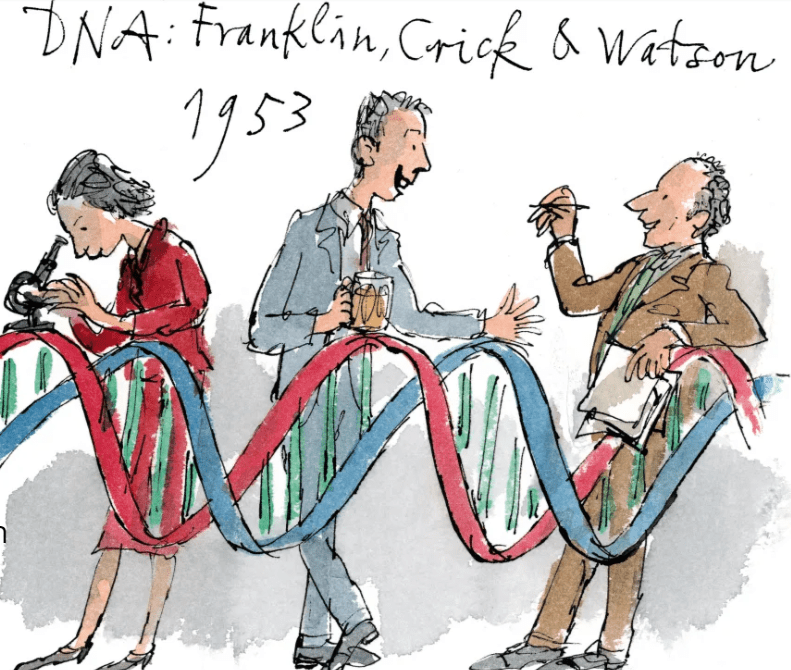
The DNA double helix is about to turn 70 years old. I wrote about it in my column in the Italian magazine 7-Sette. But as a tribute, it still seemed a bit short. So I asked artificial intelligence for help: ‘Dear Chat, can you improvise a rap from the double helix to CRISPR?’ Said, done.
CRISPR past, present, and future according to the review by Jennifer Doudna and Joy Y. Wang just published in Science. This is the original caption: “The past decade of CRISPR technology has focused on building the platforms for generating gene knockouts, creating knockout mice and other animal models, genetic screening, and multiplexed editing. CRISPR’s applications in medicine and agriculture are already beginning and will serve as the focus for the next decade as society’s demands drive further innovation in CRISPR technology.”











 CRISPeR FRENZY