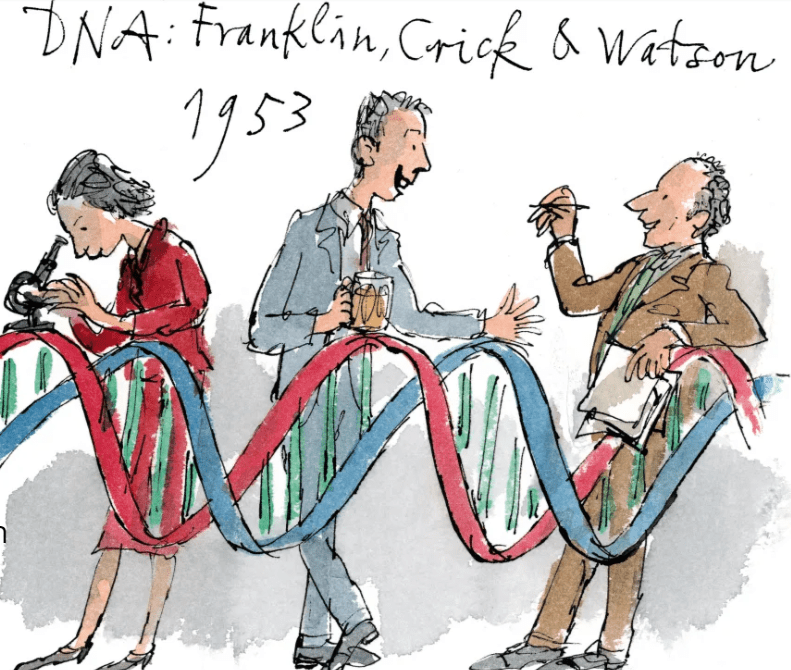
The DNA double helix is about to turn 70 years old. I wrote about it in my column in the Italian magazine 7-Sette. But as a tribute, it still seemed a bit short. So I asked artificial intelligence for help: ‘Dear Chat, can you improvise a rap from the double helix to CRISPR?’ Said, done.
CRISPR past, present, and future according to the review by Jennifer Doudna and Joy Y. Wang just published in Science. This is the original caption: “The past decade of CRISPR technology has focused on building the platforms for generating gene knockouts, creating knockout mice and other animal models, genetic screening, and multiplexed editing. CRISPR’s applications in medicine and agriculture are already beginning and will serve as the focus for the next decade as society’s demands drive further innovation in CRISPR technology.”
Emmanuelle Charpentier and Jennifer Doudna visiting the art work un|fold (Nobel Week Lights 2022, Stockholm). The sound and light sculpture is inspired by their research on genome editing.
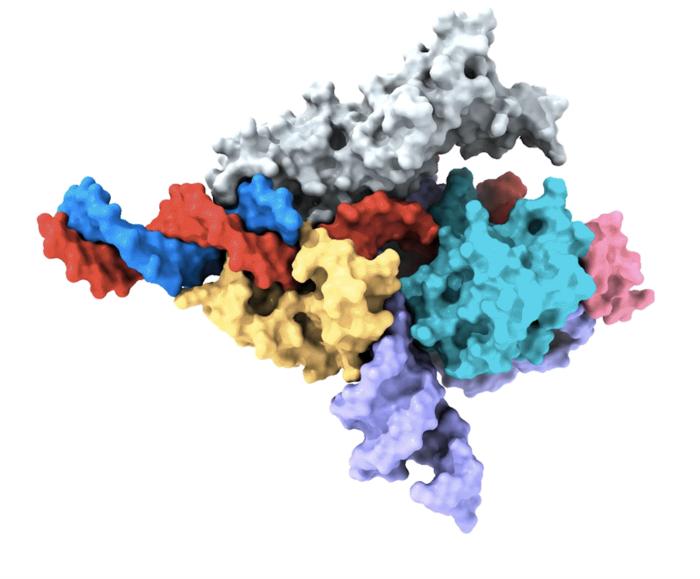
PASTE is a three-part CRISPR tool invented at the MIT McGovern Institute for Brain Research. It’s composed of a modified CRISPR-Cas9 (it’s called nickase because it nicks a single DNA strand instead of cutting both) and two effectors: RT stands for reverse transcriptase (just like in prime editing) while LSR means large serine recombinase.
This brand-new molecular machine writes the genome in three steps. Step 1: the nickase finds the desired site. Step 2: the reverse transcriptase inserts a landing pad. Step 3: the recombinase lands there and delivers its large DNA cargo. The aim is to replace whole genes, when fixing mutations is not enough (one example is cystic fibrosis). Here are the links to learn more:
CRISPR inventors Emmanuelle Charpentier and Jennifer Doudna won the Nobel Prize in Chemistry in 2020, a pandemic year, so they had to wait until today, 10 December 2022, to experience the Nobel ceremony. Watch the video!
Phages first, Borgs then. Jennifer Doudna and Jill Banfield published surprising new findings in Cell, suggesting that thousands of phages have stolen CRISPR from bacteria to deploy it against rivals. “CRISPR is so popular even viruses may use it,” Science jokes. Nature puts it seriously “CRISPR tools found in thousands of viruses could boost gene editing.”
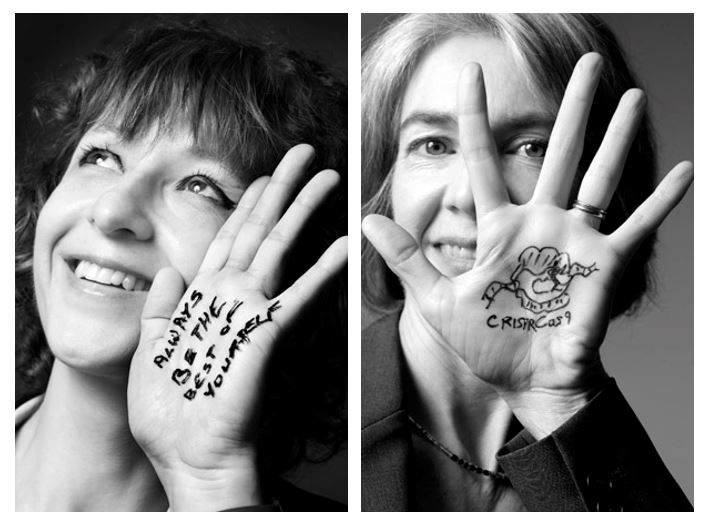
CRISPR inventors Emmanuelle Charpentier and Jennifer Doudna, portrayed by Herlinde Koelbl for the book Fascination of Science, which the photographer (famous for her work on Angela Merkel) dedicated to leading scientists. The photos, currently on display at the Koch Institute, capture “the connection between the personal & the pursuit of knowledge—between mind & hand—of pioneering scientists across the globe.”
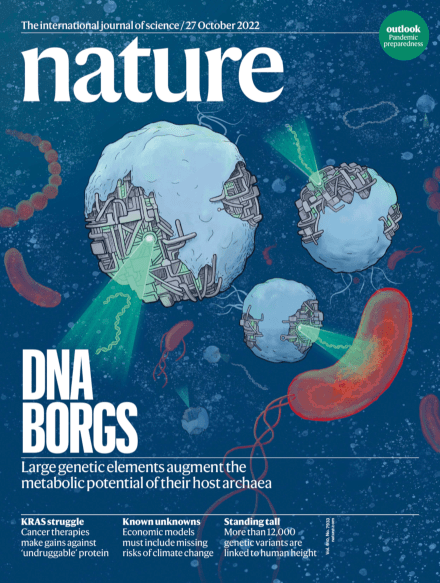
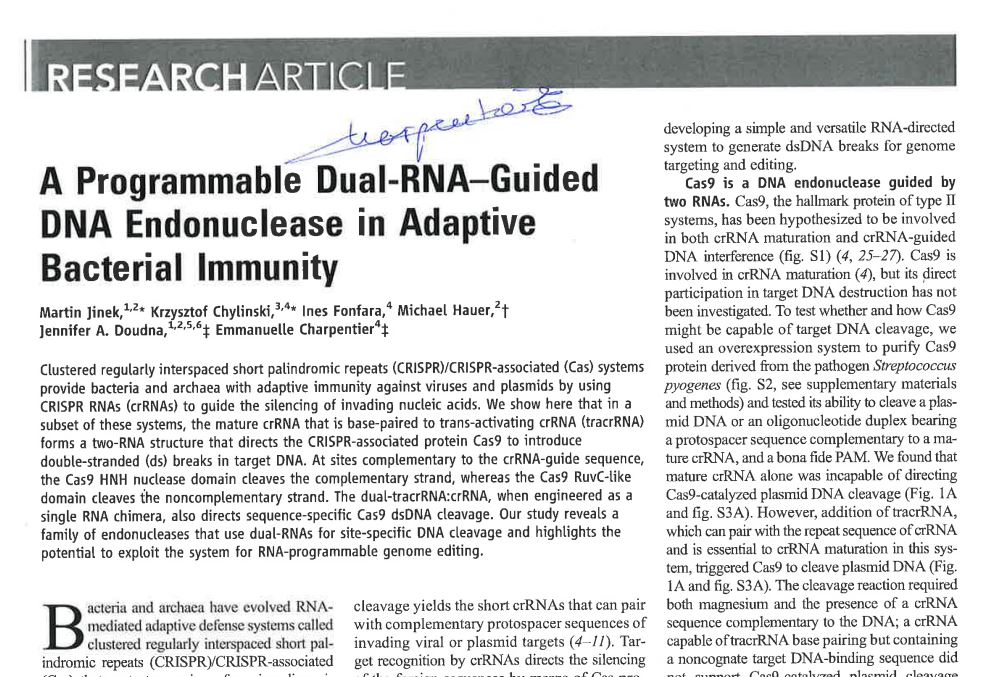
Here is my little haul from Vico Equense, where I coordinated Emmanuelle Charpentier’s award ceremony: the founding paper in Science and the most iconic cover of Nature, both autographed by the French side of CRISPR. Will I ever get the signature of the other half, Jennifer Doudna?
Pictured in the cake photo in order: Carla Ferreri, Anna Meldolesi, Enrico Alleva, CRISPR inventor Emmanuelle Charpentier and Umberto Celentano of the Capo d’Orlando Prize, awarded in Vico Equense on October 7, 2022.
Today is World CRISPR Day, let’s feel a bit of genomic vertigo by exploring CRISPR’s orders of magnitude with the help of the CRISPR Journal. The latest editorial (“Extreme Genome Editing”) goes from micro to macro, from phages to forests. Let’s give some numbers.
The size of edits spans from a single nucleotide to the removal of genomic islands greater than 100 kb (almost six orders of magnitude). The size of edited organisms varies between 10−7 m for submicroscopic viruses to over 10 m for trees (more than eight orders of magnitude). The range of genomes is tens of kilobases to tens of gigabases (seven orders of magnitude).
“Some of these theoretical combinations thus reach frightening orders of magnitude, from the modification of a single base in a 30 kb bacteriophage administered in a single 1 ml dose to 1 kb inserted in a 30 Gb tree genome scaled up to 100,000 hectares of a commercial forest” (here is the full text for more enjoyment of CRISPR vertigo).