
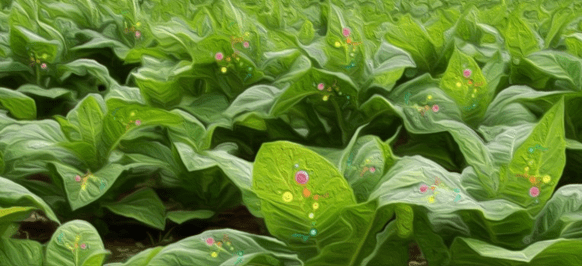
 Smoking is an addiction; tobacco, however, is a model plant full of virtues. Docile to biotech interventions, metabolically exuberant, able to churn out plenty of proteins. Now it has attracted 7.2 million euros through an EU research project aiming to harvest biopharmaceuticals by harnessing the power of photosynthesis and new plant breeding techniques. Continue reading
Editing tobacco for drugs rather than cigs
Reply
 Up and down, following the excitement for the latest scientific exploit or frustration for disappointing results. CRISPR is young but already knows how volatile is the market. “Preprint wipes millions off CRISPR companies’ stocks,” cries the March issue of
  CRISPR needs to anchor itself near a short sequence called PAM to do its job. In the book “Modern Prometheus” (Cambridge University Press) James Kozubek says a PAM is like a shoehorn, where the Cas9 nuclease begins to clasp down to recognize the right site and cut. In order to fit every gene, a super-adjustable shoehorn would be needed. Think of it as the equivalent of a bump key that can open any door. A Broad Institute group led by David Liu has almost reached the goal with xCas9, the new super-adjustable Cas9 variant described in
 It is Science but it could be mistaken for The CRISPR Journal. The latest issue indeed runs three papers by three CRISPR aces – David Liu, Jennifer Doudna, and Feng Zhang – about the cutting-edge fields of
 ![crispr-latest-edition[8047]](https://mycrispr.blog/wp-content/uploads/2018/02/crispr-latest-edition8047.jpg?w=584) There is hardly any day without CRISPR news. February starts with researchers correcting abnormalities associated with Duchenne muscular dystrophy (
There is hardly any day without CRISPR news. February starts with researchers correcting abnormalities associated with Duchenne muscular dystrophy (
 Agbiotech supporters and opponents have been waiting for months for the
  The US Department of Agriculture has given the green light to five CRISPR-edited plants in the last couple of years. See the table below, published by
