Attending New breeding techniques: CRISPR/Cas9 in plants, the first theoretical-practical course on genome editing organized by SIGA (Italian Society of Agricultural Sciences) in Turin, 3-6 July 2018.
Summer School of Genome Editing
Reply

Attending New breeding techniques: CRISPR/Cas9 in plants, the first theoretical-practical course on genome editing organized by SIGA (Italian Society of Agricultural Sciences) in Turin, 3-6 July 2018.
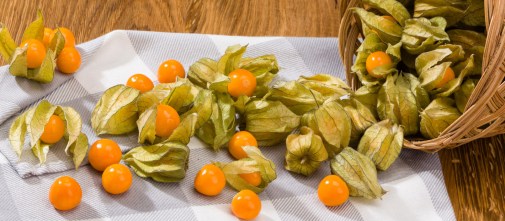
Physalis fruits look like golden marbles, larger than a blueberry, smaller than a grape. Carl Zimmer tried one, liked the rich pineapple-orange taste and wrote about their crispy future in his new book (“She Has Her Mother’s Laugh: The Powers, Perversions, and Potential of Heredity”). Ground-cherries, as they are called, belong to the same family as tomatoes but are an impossible challenge for traditional breeding because they have four copies of each chromosome rather than two. Continue reading

Sapiens vs Neanderthalized brain organoids (credit A. Muotri)
Taking a peek into the brain of a Neanderthal specimen would be a dream for whoever is interested in the evolution of human intelligence. To get an idea of the cognitive abilities of our closest relatives, so far, anthropologists and neuroscientists could only study the fossil and archaeological record, but a new exciting frontier is opening up where paleogenetics meets organoids and CRISPR technologies. By combining these approaches, two labs are independently developing mini-brains from human pluripotent stem cells edited to carry Neanderthal mutations. Alysson Muotri did it at UC San Diego, as Jon Cohen reported in Science last week. Svante Pääbo is doing it at the Max Planck Institute in Leipzig, as revealed by The Guardian in May. Forget George Church’s adventurous thoughts on cloning Neanderthals. The purpose here is to answer one of the most captivating questions ever asked: did the mind of these ancient men and women, who interbred with our sapiens ancestors before going extinct, work differently from ours? Last but not least, with respect to the ethics of experimenting with mini-brains, don’t miss the perspective published in Nature.
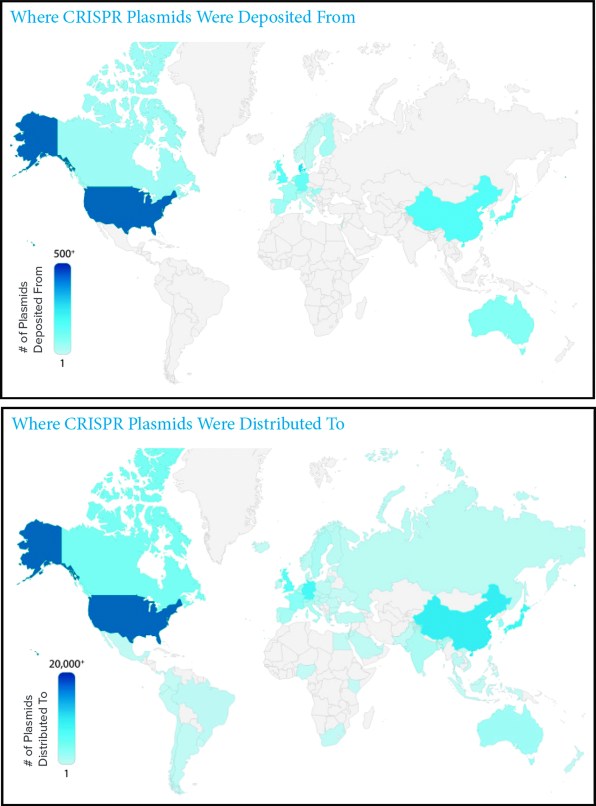
“As of January 2018 Addgene has distributed more than 100,000 CRISPR plasmids to 3,400 laboratories worldwide. More than 6,300 CRISPR-related plasmids have been developed by over 330 academic labs and deposited into Addgene’s collection. Geographically, new CRISPR plasmids have been developed and deposited to Addgene’s collection from the Americas (led by the United States), Europe (led by Denmark), Asia (led by China), and Oceania (led by Australia), and shipped to some 75 countries.” [Reference: Enabling the Rise of a CRISPR World, Caroline M. LaManna and Rodolphe Barrangou, The CRISPR Journal, Vol. 1, n. 3, 2018]

Credit: Ernesto del Aguila III, National Human Genome Research Institute, NIH
A pair of papers published in Nature Medicine have caused a stir about CRISPR-edited cells lacking a well-known tumor suppressor gene. STAT is doing an online chat next week to follow up the news. In the meantime, this is a sample of how the CRISPR community is commenting the story. Continue reading
Spanish microbiologist Francisco Mojica is credited with coining the name CRISPR, but crisper definitions are possible, as @KevinADavies tweeted some time ago. What does CRISPR “actually” stand for?

Dr Ed Wild at the Vatican with co-discoverer of the HD gene – Nancy Wexler
Ed Wild of University College London is a leading scientist and the international coordinator (with Sarah Tabrizi) in a very promising trial using antisense oligonucleotide technology in Huntington patients. This is the interview he gave me before attending the Huntington’s Days 2018 meeting in Turin, Italy. Continue reading

Jian-Kang Zhu (courtesy of Purdue University)
Around 30% more grain. This is the result announced in PNAS by Chinese researchers that have made the most of CRISPR’s multiplexability in rice. By simultaneously targeting multiple genes, the editing technique is a boon for scientists struggling with plants’ genetic redundancies. Continue reading

Credit: Keegan Houser/UC Berkeley
Interview given to Anna Meldolesi (Corriere della sera, 15 May 2018)
The CRISPR biomedical duel between China and the US has been called “Sputnik 2.0”. Is Europe being left behind?
JD: As with any disruptive technology, there is intense competition to lead. However, unlike the space race, the CRISPR research effort is global and more collaborative. We consistently see key advances in CRISPR technology shared through scientific papers, written and read by research teams around the world. This collective approach has helped to democratize the technology. However, differing regulations across countries may impact how we ultimately translate research into real-world applications that can benefit the most number of people with the most need. Researchers in Europe have made valuable contributions to the development and application of CRISPR and will continue to play a role in establishing global standards. Continue reading

As far as we know, the passing of controversial DIY-bioentrepreneur Aaron Traywick has nothing to do with CRISPR. The cause of death is still unknown, and there is not even much information about the alleged herpes vaccine he self-injected a few months ago. According to media reports, it consisted of “live attenuated virus with a missing protein” or maybe contained “engineered copies of the virus DNA code.” Injecting yourself with an unproven concoction is obviously a bad idea, with or without CRISPR. The death news indeed puts biohacking at a crossroads, according to the Atlantic. But even more worrying is the MIT Technology Review scoop that Traywick has been planning human tests of a CRISPR therapy for lung cancer at a wellness center in Tijuana, Mexico. Stem cells researchers have raised the alarm over and over again in the past on unregulated clinics preying on desperate patients in lenient countries. The specter of nascent CRISPR-medical tourism in search of unproven treatments is an urgent issue to tackle.
 CRISPeR FRENZY