
The rising star of base editing shadowed classic genome editing last week. I’m sure you heard about the ground-breaking papers respectively published by David Liu and Feng Zhang in Nature and Science. CRISPR enthusiasts have probably already enjoyed the piece by Jon Cohen on the new approach, i.e., the rearrangement of atoms in individual DNA letters to switch their identity without even cutting the DNA strands. But let’s take a look also at The Scientist, which runs two must-read articles about the details of the experiments. The first take-home message is the latest achievements are exciting, but base editors are not better than CRISPR, they’re just different. The second one, there is still room for improvement with base editing, and the best is yet to come.

 It is Science but it could be mistaken for The CRISPR Journal. The latest issue indeed runs three papers by three CRISPR aces – David Liu, Jennifer Doudna, and Feng Zhang – about the cutting-edge fields of biological recorders and advanced diagnostic tests. Continue reading
 ![crispr-latest-edition[8047]](https://mycrispr.blog/wp-content/uploads/2018/02/crispr-latest-edition8047.jpg?w=584) There is hardly any day without CRISPR news. February starts with researchers correcting abnormalities associated with Duchenne muscular dystrophy (
There is hardly any day without CRISPR news. February starts with researchers correcting abnormalities associated with Duchenne muscular dystrophy (
 “Uh Oh. CRISPR might not work on people”. A title like this on the


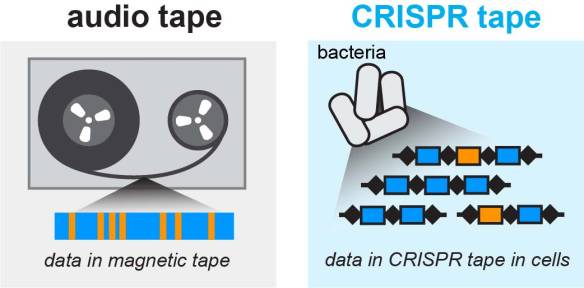 When using a standard tape recorder you just have to press the buttons. Now a Columbia University team has devised a system for doing the same in living systems, recording changes taking place inside the cells. How does it work? This biological recorder, described in a
 ![nanoparticle MIT[1423]](https://mycrispr.blog/wp-content/uploads/2017/11/nanoparticle-mit1423.jpg?w=584) Suppose you have developed the winning weapon to defeat certain genetic diseases by reliably correcting pathogenic mutations. There is still a problem: how do you march onto the battlefield, inside sick cells? The weapon is the genome-editing machinery, and the most efficient vessel ever tested are lipid nanoparticles. With this approach, described in a study published in
Suppose you have developed the winning weapon to defeat certain genetic diseases by reliably correcting pathogenic mutations. There is still a problem: how do you march onto the battlefield, inside sick cells? The weapon is the genome-editing machinery, and the most efficient vessel ever tested are lipid nanoparticles. With this approach, described in a study published in 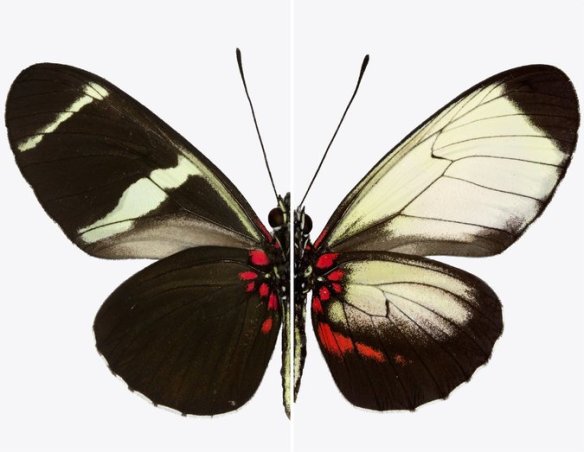 Biodiversity is a wonderful interplay between genetics and evolution, and butterflies are a fascinating example with their variety of patterns and colors. Understanding how the same gene networks engender visual effects so diverse in thousands of Lepidoptera species is a longtime ambition for many entomologists and evolutionary biologists. The good news is that scientists nowadays have a straightforward technique working with organisms that were difficult to manipulate with conventional biotech tools. Obviously, we are talking about CRISPR. Two papers published in PNAS last week describe how genome editing was used to alter the genetic palette of colors in butterflies and how their wings changed as a result. We’ve asked the entomologist Alessio Vovlas, from the Polyxena association, to comment these stunning experiments.
  CRISPeR FRENZY