The FDA charts a new route for bespoke therapies

Inspired by the Baby KJ case, the agency proposes a flexible framework allowing personalized treatments for individual patients to contribute to shared, platform-based approvals.

The announcement appeared on November 12 in the New England Journal of Medicine under a seemingly cautious title: “The FDA’s New Plausible Pathway.” Yet the article, written by two senior figures at the Food and Drug Administration, reveals vision and leadership. For once, it is worth starting from the end, which reads like a strong statement of intent: “Nearly 30 years after the sequencing of the human genome, bespoke therapies are close to reality. The FDA will work as a partner and guide in ushering these therapies to market, and our regulatory strategies will evolve to match the pace of scientific advances.”

Continue reading

Evolving a new CRISPR system to insert genes

evoCAST (credit: George Lampe)

Recently, David Liu won the Breakthrough Prize for inventing two tools for precise, small-scale genome editing (base editing and prime editing). However, in some cases, rather than correcting a mutation within a defective gene, it may be more practical to insert a fully functional copy of the gene. That’s the mission of evoCAST, the latest invention from the Broad Institute near Boston, a hub for next-generation CRISPR tools.

Continue reading

Breakthrough Prize 2025: Jodie Foster explaining gene editing and more

Gene editing pioneer David Liu received the Breakthrough Prize from the hands of Jodie Foster and Lily Collins — but the biggest applause went to young CAR-T patient Alyssa Tapley.

The movie stars in the audience in Santa Monica on April 12 were easy to spot: Brad Pitt, Margot Robbie, Sean Penn, and others. But it’s rare for a scientist to become a celebrity beyond academic circles. This role reversal happens just one day a year, when the Breakthrough Prize is celebrated in California. Richer than the Nobel (the prizes are worth three times as much) and steeped in glamour, the event honors the stars of science with the help of Hollywood and technofinance.

Continue reading

The rare story of Sonia and Eric: pioneers by force and by love

A scientific adventure whose ingredients include the looming threat of a fatal disease, the decision to reinvent themselves as biologists, and the goal of silencing prions.

The clinical trial with antisense oligonucleotides, born of their efforts, is considered one of the most interesting trials of 2025, but this is only a part of the story. This married couple is also pursuing other avenues to halt the onset of prion diseases. In the summer of 2024, they published a study in Science using epigenetic editing in mice. Then, in January 2025, their experiments with base editing were published in Nature Medicine. Yet Sonia Vallabh was a newly graduated jurist, and her husband, Eric Minikel, was working in urban planning, when they discovered that she carried a mutation that would condemn her to die of fatal familial insomnia within two or three decades.

Continue reading

Prime editing set to enter human trials

Credit: Microsoft/Bing

Recently David Liu announced that Prime Medicine will likely submit the first human trial application in 2024. The standard version of CRISPR uses an RNA guide to find the editing site in the genome. Prime editing, on the other hand, also uses the same RNA molecule to direct the correction, in short, to specify what to do as well as where to go.

This insight blossomed in Andrew Anzalone’s mind a few years ago during his PhD at Columbia University. The first practical demonstration came with a paper published in Nature in 2019 after joining the Liu’s Lab at the Broad Institute. Since then, this platform has been used in hundreds of experiments to fix all kinds of mutations in vitro and in animal models.

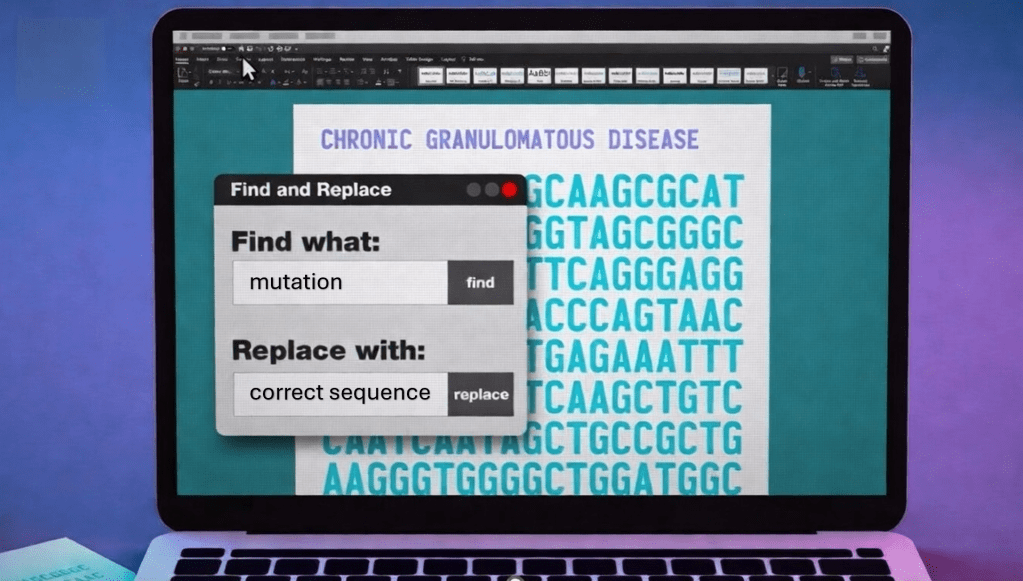
Meanwhile, the company co-founded by Anzalone and Liu has begun work on 18 treatments, the most advanced for chronic granulomatous disease. To learn more, from the eureka moment to the latest developments, we suggest listening to the Close to the Edge podcast and reading Alex Philippidis’ article in GEN.

Brilliant Minds: David Liu & Sammy Basso

The first is a CRISPR innovator (base editing and prime editing came out of his lab). The second has a genetic disease that causes him to age prematurely (progeria) and has taken his destiny into his own hands by becoming a biologist. They are each other’s inspiration and in this video they tell us why.

Would you buy a CRISPR salad from these men?

The company which developed the new vegetable (and is working on new varieties of cherries and berries) was founded by CRISPR top scientists David Liu, Keith Joung and Feng Zhang

By now it seems official. The first CRISPR plant to debut in the US market will not be a commodity for industry or intensive livestock farming, as was the case with classic GMOs in the 1990s. This time genetic innovation enters on tiptoe, with a food product designed for discerning consumers. A new type of salad, as nutrient-rich as a wild misticanza but without the bitter notes that usually relegate brassicas to foods to be eaten cooked (see here).

Continue reading

Next-Gen CRISPR – pasting whole genes without cutting

PASTE is a three-part CRISPR tool invented at the MIT McGovern Institute for Brain Research. It’s composed of a modified CRISPR-Cas9 (it’s called nickase because it nicks a single DNA strand instead of cutting both) and two effectors: RT stands for reverse transcriptase (just like in prime editing) while LSR means large serine recombinase.

This brand-new molecular machine writes the genome in three steps. Step 1: the nickase finds the desired site. Step 2: the reverse transcriptase inserts a landing pad. Step 3: the recombinase lands there and delivers its large DNA cargo. The aim is to replace whole genes, when fixing mutations is not enough (one example is cystic fibrosis). Here are the links to learn more:

Continue reading

Crispy salads are here!

Berkeley professor Patrick Hsu on twitter: “Delighted to try out the world’s first CRISPR-edited salad”

I must say that I’m a bit envious and eager to taste this kind of Brassica juncea with the “mustard bomb” mechanism prevented by knocking-out multiple copies of the gene responsible for the bitter taste.

Continue reading