CRISPR draws the first genomic map of cancer vulnerabilities

If you know the enemy and know yourself, you need not fear the result of a hundred battles. The military strategist Sun Tzu wrote it over two thousand years ago, but this quote could also apply to oncology research in the CRISPR era. Identifying the weak points of cancer cells is the first step to hit new molecular targets with the next generation of drugs.

The good news is that the Wellcome Sanger Institute has taken a giant leap toward this goal, drawing up a list of 600 candidate genes. The study just published in Nature by Mathew Garnett’s team comes with a twin paper by the Broad Institute, confirming the results by following an alternative approach. In a four-year tour de force of functional genomics, Sanger’s researchers used CRISPR to disrupt every gene in over 300 cancer models from 30 cancer types. From this amount of data, they developed a prioritization system which will guide big pharma’s hunt for new drugs.

Blood stem cells getting ready for editing

editing genomicoDo you remember the alarm about the cancer risks of CRISPR? According to a study published in Cell Stem Cell by Italian researchers, the DNA-damage response is not such a big problem in edited cells. At least not in hematopoietic stem cells edited with highly specific nucleases. Continue reading

Editing Duchenne. Where are we now?

Duchenne CRISPR

© STEVE GRAEPEL (“Infographic: Treating Duchenne Muscular Dystrophy with CRISPR“, The Scientist, September 2018)

In 2013, multiple labs sharpened CRISPR molecular scissors against Duchenne muscular dystrophy, using cells from patients in vitro. In 2016, the dystrophin gene was successfully edited in mice. Then last summer, Eric Olson did it in dogs . Where are we now in the struggle to cure this severe type of myopathy afflicting 300,000 boys in the world? What is still needed to move into a clinical trial? Continue reading

CRISPR meets machine learning

If a donor template is not provided when CRISPR cuts the DNA, broken ends are fixed by natural repairing mechanisms in a way that is considered stochastic and heterogeneous. This makes template-free editing impractical beyond gene disruption, right? Wrong, according to a study published in Nature by Richard Sherwood and colleagues. Continue reading

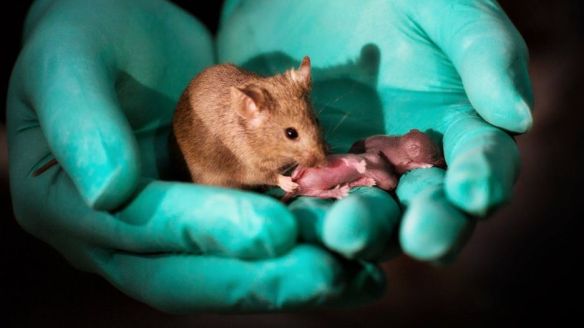
Picture of the week

bimaternal pups

Healthy adult bimaternal mouse (born to two mothers) with offspring of her own.
Credit: Leyun Wang

Single-gender worlds will remain a sci-fi fantasy. Gay and lesbian couples won’t become parents this way for the foreseeable future. This kind of manipulation is just too risky for humans. But unisexually reproducing mice are an impressive accomplishment, and CRISPR stands out again as a powerful research tool, opening up brand new possibilities for the study of genomic imprinting. For further details, please see the STAT News article about the Cell Stem Cell paper by Zhi-Kun Li.

CRISPRing in the womb

pregnant-2640994_960_720It’s another CRISPR first: fixing a hereditary disease in utero. Scientists from Pennsylvania University and the Children’s Hospital of Philadelphia used a base editor to rescue tyrosinemia in fetal mice. “The results of this proof-of-concept work demonstrate the possibility of efficiently performing gene editing before birth, pointing to a potential new therapeutic approach for selected congenital disorders,” Avery C. Rossidis and colleagues write in Nature MedicineContinue reading

Gene drives & the trolley dilemma

malaria kills

The trolley problem is a classic philosophical dilemma, and its variants have been used extensively to test moral intuitions. Scanning the brain of human subjects with functional MRI during task performance has proven useful to understand how emotion and reason interact when we ponder bioethical issues. It would be interesting to adopt those approaches to study the psychological barriers towards controversial innovations such as gene drives. Just imagine you alone are responsible for pressing a button and switching on gene drives in malaria-spreading mosquitoes. Someone is going to die, and you must decide whom to save. Continue reading

Cutting off Duchenne in dogs. How excited should we be

dogs-muscular-dystrophy

credit: Royal Veterinary College, University of London

“Exciting news! Our partner, Dr. Eric Olson and his team at Exonics published their research on increasing dystrophin restoration of 92% in the hearts of dogs. While they have a long way to go, their dramatic research gives hope to all families affected by Duchenne!”. This is how the patient advocacy group CureDuchenne announced the CRISPR breakthrough just published in Science. Continue reading

Another CRISPR havoc? That’s science, baby

keep-calm-and-sequence-dna

A paper published in Nature Biotechnology by Allan Bradley and colleagues from the Wellcome Sanger Institute in Hinxton, UK, shows that classical CRISPR editing can cause large rearrangements of DNA near the target site in actively dividing cells. We may think of it as the latest CRISPR alarm, but also as a demonstration of how biomedical research works. Firstly: no technology is perfect, but the best ones are perfectible. CRISPR belongs to this category because it is an extraordinarily versatile and fast-evolving biotech platform. When reading news like “CRISPR causes this or that problem,” the first question to ask is: which CRISPR variant are we talking about? Continue reading

CRISPR and the cancer link. Who said what?

41124064215_2984b6abeb_h

Credit: Ernesto del Aguila III, National Human Genome Research Institute, NIH

A pair of papers published in Nature Medicine have caused a stir about CRISPR-edited cells lacking a well-known tumor suppressor gene. STAT is doing an online chat next week to follow up the news. In the meantime, this is a sample of how the CRISPR community is commenting the story. Continue reading