Two years after Casgevy received commercial approval, only around sixty people with sickle cell disease or thalassemia have been able to benefit from it, due to a technical hurdle that the next generation of treatments will attempt to overcome
Gene editing pioneer David Liu received the Breakthrough Prize from the hands of Jodie Foster and Lily Collins — but the biggest applause went to young CAR-T patient Alyssa Tapley.
The movie stars in the audience in Santa Monica on April 12 were easy to spot: Brad Pitt, Margot Robbie, Sean Penn, and others. But it’s rare for a scientist to become a celebrity beyond academic circles. This role reversal happens just one day a year, when the Breakthrough Prize is celebrated in California. Richer than the Nobel (the prizes are worth three times as much) and steeped in glamour, the event honors the stars of science with the help of Hollywood and technofinance.
Many interesting papers have been published recently; here are our top three picks. They cover an innovative gene therapy trial, a new experimental approach for oncology, and the development of novel tools to map gene enhancers.
A scientific adventure whose ingredients include the looming threat of a fatal disease, the decision to reinvent themselves as biologists, and the goal of silencing prions.
The clinical trial with antisense oligonucleotides, born of their efforts, is considered one of the most interesting trials of 2025, but this is only a part of the story. This married couple is also pursuing other avenues to halt the onset of prion diseases. In the summer of 2024, they published a study in Science using epigenetic editing in mice. Then, in January 2025, their experiments with base editing were published in Nature Medicine. Yet Sonia Vallabh was a newly graduated jurist, and her husband, Eric Minikel, was working in urban planning, when they discovered that she carried a mutation that would condemn her to die of fatal familial insomnia within two or three decades.
The news of the week is definitely this: the first clinical trial with base editing (the CRISPR platform used to chemically change single DNA letters without double-strand breaks) hit the goal of lowering cholesterol in patients but raised questions about the risks (with two serious adverse events, including one death), as Nature reports.
But we also recommend reading two other articles. Nature Biotechnology takes a look at experiments using CRISPR to eliminate viruses that manage to hide from the immune system, such as HIV and hepatitis. While Genetic Literacy Project publishes an analysis of the problems that could cripple the new regulation on edited plants proposed by the European Commission and delay (even until 2030) the arrival of the first products on the EU market.
Four questions to Luigi Naldini (San Raffaele Telethon Institute for Gene Therapy, Milan) about the Nature Biotechnology study that revealed limitations and risks of gene and prime editing.
The latest challenge is protecting damaged tissue immediately after a heart attack with the help of base editing (see the paper published in Science by Eric Olson’s group at the University of Texas Southwestern Medical Center). But there are hundreds of devastating diseases that affect the heart or other muscles and are caused by mutations that could be fixed by CRISPR-based tools (see this paper in Science Trsnslational Medicine for example). From Duchenne dystrophy to cardiomyopathies, some preliminary results are very encouraging. Learn more reading the article on the Science paper published by El Pais and watching this video with Olson explaining his studies, especially on Duchenne muscular dystrophy.
From the base-editing idea first sketched out via email in 2013, to the invention of prime-editing in 2019. From the progeria mutation fixed in mice in 2021 to the upcoming clinical trial for coronary heart disease. The updated story of the most advanced CRISPR tools told by Harvard’s David Liu is not to be missed (here’s the link to the Life Itself conference organized by CNN).
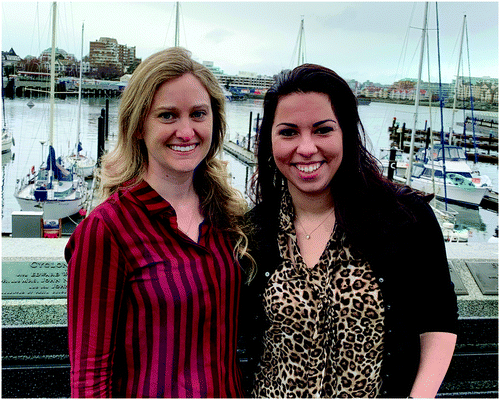
Alexis Komor and Nicole Gaudelli developed based editing when they were postdoc in David Liu’s laboratory at Harvard. Credit: The CRISPR Journal
The first Investigational New Drug (IND) application for base-editing technology has been cleared by the Food and Drug Administration. BEAM-101, developed by Beam Therapeutics, is an ex vivo base-editing product candidate, meaning that it uses a modified form of CRISPR capable of making single base changes without double-stranded DNA cleavage.
A paper published in Nature by CRISPR innovator David Liu and a giant in medical genetics, Francis Collins, raises great hopes for treating a rare, devastating pediatric disease causing premature-aging (Hutchinson-Gilford progeria syndrome). “The outcome is incredible,” according to gene-therapy researcher Guangping Gao. “Dance on the lab bench” amazing, according to editing pioneer Fyodor Urnov. Let’s be clear: the CRISPR variant called a base-editor has helped only progeria mice so far, but results are beyond anyone’s wildest expectations. One injection is enough to fix the single-letter mutation in several tissues, doubling mice’s lifespan. To learn more, see David Liu’s tweets and the NIH Director’s Blog.





 CRISPeR FRENZY