Doudna meets GSK: University of California CRISPR researchers form drug discovery alliance with pharma giant (source Science) From transposons to gene therapy: Hijack of CRISPR defences by selfish genes holds clinical promise, according to Fyodor Urnov (NatureNews&Views) Disaster waiting to happen: Russian biologist plans more CRISPR-edited babies (Nature’s editorial and news)
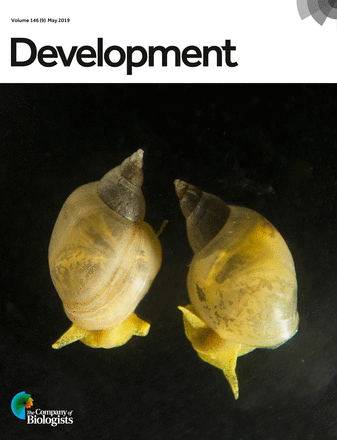
Most snails live in right-coiled shells, and the general rarity of sinistral gastropods has long attracted comment and wonder, according to the late Stephen Jay Gould. “Aristotle declared them impossible, but d’ Argentville called them uniques, while Geoffroy dubbed them nonpareilles. Since no one has ever developed an even vaguely plausible argument for dextral advantage, the overwhelming predominance of right-handed coiling among gastropods has been a persistent puzzle.” Continue reading →
CRISPR gets a mention in the latest IPCC report as a potentially useful tool to cope with climate change. However, some people believe that biotech crops are safe and that climate change is not real (let’s call them libertarian capitalists, for convenience). Many ecological activists conversely think that genetically modified plants are evil and global warming threatens life on the planet. These stances could not be more different, yet they have something in common: they are both half right and half wrong. They are both examples of “selective science denial.” Continue reading →
We talk of cryptic mutations when genes are changed in a way that remains hidden until they interact with other mutations. As a result, combining beneficial traits can have negative consequences hindering agricultural production (watch this video from Cold Spring Harbor Laboratory on unexpected negative interactions). Classic breeders have been dealing with this problem for decades, but researchers from CSHL are finally working on a solution suitable for the genomic era. Zach Lippman and colleagues have studied one infamous cryptic mutation affecting a tomato variety developed by the Campbell Soup Company in the 1960s and discuss an anti-negative-interaction strategy for the future. Please see their paper in Nature Plants and watch the video below offering a cautionary tale for crop gene editing.
Content analysis of the articles published in North America from 2012 to 2017 shows, overall, a strong promotion of CRISPR. See the paper by Alessandro Marcon et al. in Genetics in Medicine.
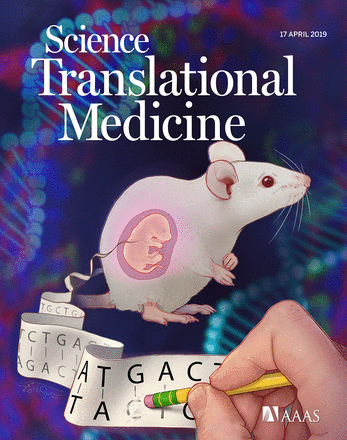
Researchers from Penn Medicine and Children’s Hospital of Philadelphia have fixed a lethal mutation in the prenatal mouse models of a rare pulmonary disease. The hope is that the approach of in utero editing described in Science Translational Medicine will work for other congenital lung diseases as well.
I asked one of the corresponding authors, Edward Morrison, scientific director of the Penn’s Institute for Regenerative Medicine, to explain what they have done and what to expect next. See Q&A below. Continue reading →
If you know the enemy and know yourself, you need not fear the result of a hundred battles. The military strategist Sun Tzu wrote it over two thousand years ago, but this quote could also apply to oncology research in the CRISPR era. Identifying the weak points of cancer cells is the first step to hit new molecular targets with the next generation of drugs.
The good news is that the Wellcome Sanger Institute has taken a giant leap toward this goal, drawing up a list of 600 candidate genes. The study just published in Nature by Mathew Garnett’s team comes with a twin paper by the Broad Institute, confirming the results by following an alternative approach. In a four-year tour de force of functional genomics, Sanger’s researchers used CRISPR to disrupt every gene in over 300 cancer models from 30 cancer types. From this amount of data, they developed a prioritization system which will guide big pharma’s hunt for new drugs.
“Wow! Badass. 13,200 crispr base edits in a single cell! On the way to ‘recoded’ human cells,” tweeted Antonio Regalado before covering the news in MIT Technology Review. To be honest, the radical redesign of species is still sci-fi dystopia, but the paper preprinted by Cory J. Smith et al. in bioRxivis impressive anyway. Continue reading →

 Doudna meets GSK: University of California CRISPR researchers form drug discovery alliance with pharma giant (source Science)
 CRISPR gets a mention in the latest

 “Wow! Badass. 13,200 crispr base edits in a single cell! On the way to ‘recoded’ human cells,” tweeted Antonio Regalado before covering the news in
  CRISPeR FRENZY