
CRISPR-pioneer Rodolphe Barrangou offers ten bold (and rosy) predictions for the next 12 months in his editorial for The CRISPR Journal. We fervently hope he is right! Please see our summary below.
Continue reading
CRISPR-pioneer Rodolphe Barrangou offers ten bold (and rosy) predictions for the next 12 months in his editorial for The CRISPR Journal. We fervently hope he is right! Please see our summary below.
Continue reading
The year 2019 ended with three years in jail sentenced to He Jiankui for illegal medical practice. The CRISPR-baby scandal’s epilogue was applauded on twitter by a few leading scientists such as Craig Venter and Fyodor Urnov and decried on STAT News by the controversial biohacker Josiah Zayner. Most experts, however, stayed silent.
As stressed by the Washington Post, “the judicial proceedings were not public, and outside experts said it is hard to know what to make of the punishment without the release of the full investigative report or extensive knowledge of Chinese law and the conditions under which He will be incarcerated.”

Danielle Nierenberg is President of Food Tank and an influential voice on food issues. She interviewed hundreds and hundreds of farmers, researchers, government leaders, NGOs and journalists in 50 plus countries in sub-Saharan Africa, Asia, and Latin America over the last several years. We asked her three questions for an article on sustainable innovations to be published in Italy.
Continue reading
The following is an excerpt from the news section of the Leopoldina website. Please note that DFG stands for the German research funding organization.
The Leopoldina, the Union of German Academies and the DFG have drafted recommendations for ensuring science-based regulation of genome edited plants in the EU. These recommendations include the amendment of European genetic engineering legislation.
Continue reading
Exactly one year ago, AP News went public with the CRISPR-babies story. What happened to He Jiankui then? His trace was lost after the picture of him sequestered in a university guesthouse in Shenzhen.
How are Lulu&Nana? Nobody knows, but at least the study suggesting they might die early has been retracted.
What became of the global governance of germline editing? Waiting for the Science academies and the WHO reports in 2020.
What about the next baby-editing? Denis Rebrikov says he plans to do extensive safety checks before seeking approval to implant an edited embryo.
Last but not least, how many couples are interested in germline editing? Very few, according to calculations published in The CRISPR Journal.

The picture shows a moment in the sample-collecting effort leading to this Pnas paper about a novel heat-tolerant CRISPR enzyme called IgnaviCas9. Exploring nature’s molecular diversity in extreme environmental conditions such as Yellowstone hot springs can yield exciting discoveries and applications.
Continue reading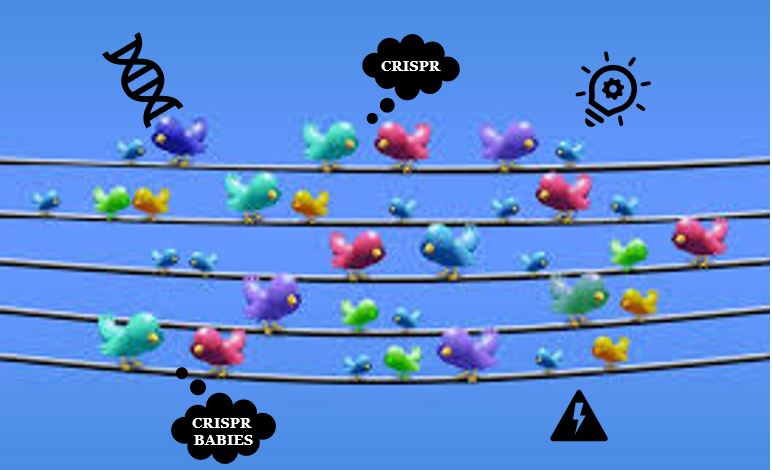
The analysis of tweets discussing CRISPR from 2013 to 2019 shows that public enthusiasm for genome editing has cooled a bit, and that’s physiological. As you can see below, a bioRxiv paper associates peaks of strong negative sentiments with specific events.
Continue reading
China is the “Innovation Nation” and “The next biotech superpower”, according to the November issue of Nature Biotechnology. Beijing is “set to challenge the pre-eminence of the US drug market. If it can address gaps in its R&D ecosystem and clinical infrastructure, it may even become a home for biotech innovators”, says the editorial.
Continue reading CRISPeR FRENZY