Once upon a time there was a field of research that had been dormant for over a century, well now it has awakened. Approved clinical trials are in dozens, scientific journals are publishing reviews of the state of the art, the first books are coming out, chronicling unexpected individual successes, and even the first inquiries from major publications such as the Economist are popping up.
After half a century of experimentation, biotech tools have advanced to the point that many treatments capable of changing the lives of people with rare and ultrarare diseases would be achievable, at least in theory. However, the harsh reality is that, in the vast majority of cases, the costs of research and production are too high, while the number of beneficiaries of each treatment is too small, to attract and then maintain the interest of the pharmaceutical industry.
After the first biomedical “valley of death” in which flawed drugs fatally strand, a second economic “valley of death” is looming for treatments that work but are not profitable enough, ss Michele De Luca and Giulio Cossu wrote in EMBO Reports. It is in this context that the Italian charity Fondazione Telethon last week announced the transfer of the marketing authorization for Strimvelis, a gene therapy for the immunodeficiency ADA-SCID developed by their reserachers (at SR-Tiget in Milan) and then abandoned by the manufacturer (Orchard Therapeutics) despite the excellent results.
“We are the first non-profit organization to take on the commercialization of a gene therapy. This step is necessary to remain true to our mission and continue ensuring access to this important therapy,” said Telethon’s general manager Francesca Pasinelli. Will others follow suit? To learn more about the background of this decision you can read our post from a year ago; for an updated insight we recommend Telethon’s press release.
Four questions to Luigi Naldini (San Raffaele Telethon Institute for Gene Therapy, Milan) about the Nature Biotechnology study that revealed limitations and risks of gene and prime editing.
The first is a CRISPR innovator (base editing and prime editing came out of his lab). The second has a genetic disease that causes him to age prematurely (progeria) and has taken his destiny into his own hands by becoming a biologist. They are each other’s inspiration and in this video they tell us why.
“In the animal world there are species naturally capable of bringing forth new life from an unfertilized egg cell, always or under exceptional circumstances (a case was recently discovered in a female crocodile). But with the help of biotechnology, it has become possible to bypass the male contribution even in species that have always relied on sexual reproduction. By manipulating oocytes in vitro, Chinese researchers succeeded in mice. The latest breakthrough was announced in Current Biology: using CRISPR to turn on and off different combinations of genes, a Cambridge team was able to identify the molecular basis of parthenogenesis in the fruit fly and artificially transfer this trait into a strain that did not have it. After being equipped with the right genetic makeup, some females gave birth to other females, which were also able to reproduce in the absence of males. Of course, we are far from any application on the human species, for both technical and ethical reasons, but there are no risks in exploring with imagination the theoretical possibility that women might be able to procreate on their own.” And this is precisely what I write about in my column today in magazine 7/Corriere della sera.
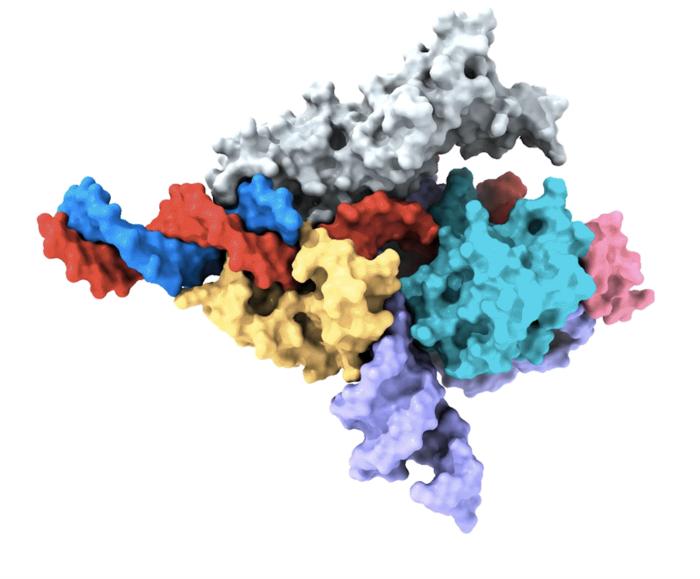
Credit: Courtesy of the Zhang lab Cryo-EM map of a Fanzor protein in complex with ωRNA and its target DNA.
Treasure hunting in fungi and clams has led to the discovery of CRISPR-like proteins that can be RNA-programmed to edit human DNA.
“Nature doesn’t make jumps,” claimed many thinkers of the past, but modern-day geneticists can point to many exceptions to the rule. Transposons are mobile genes par excellence jumping from one point to another in the genome. In particular those associated with the OMEGA system, discovered two years ago in bacteria, head for chosen landing spots thanks to a kind of programmable GPS similar to CRISPR.
The news is that now such a phenomenon has also been detected in organisms with nucleated cells, so-called eukaryotes which include fungi, plants and animals. Feng Zhang’s group has already started engineering these programmable proteins, known as Fanzor, to turn them into efficient editing tools. Please see the paper in Nature, the article posted on the Broad Institute website and Zhang’s tweets.
The European Commission is collecting comments on the proposed regulation on New Genomic Techniques (NGTs) presented on 5 July. On this page you will find all the documents you need to form an opinion: from the criteria for establishing when a NGT plant is comparable to a conventional plant, to calculations on the costs of coexistence for organic producers (see in particular the Impact assessment report). The feedback received during the consultation period (8 weeks, extendable) will be summarised by the European Commission and presented to the European Parliament and the Council to feed into the legislative debate. In general, CRISPeR Frenzy appreciates the proposed regulation, especially for its focus on the promised benefits of NGTs in terms of environmental sustainability.
The European Commission’s proposal for an updated regulatory framework for New Genomic Techniques was presented today (see here the leaked confidential document circulating online, here the offical document and more)
Jennifer Doudna’s Innovative Genomic Institute has received $70 million to explore a bold idea: combating climate change and other emergencies by modifying the microbial communities that live outside and inside us.
Bacteria are the true masters of the planet, for better or worse. Besides affecting our health in many ways, they are responsible for much of the methane emissions. This gas traps heat far more than carbon dioxide and is produced in large quantities by microbes that proliferate in environments associated with human activities (farms, landfills, rice paddies). The good news is that methane is short-lived, so reducing its emissions would have a rapid and substantial effect on global warming. What tools do we have at our disposal to try to pursue such an ambitious goal?









 CRISPeR FRENZY