CRISPR plants – what the EU Parliament got right and wrong

There is no doubt that this is good news: on February 7, the European Parliament approved the Commission’s regulatory proposal on New Genomic Techniques, covering also CRISPR plants. Some of the approved amendments (particularly the one on genetic modification of polyploid plants) have the effect of improving the text, others risk being a problem and should be reconsidered during the trilogue with member states (particularly the requirement to label all final products, even if they do not contain foreign genes). The European Parliament also brought in the issue of non-patentability of NGT plants, which would deserve to be addressed elsewhere. For more information, this is the position expressed on February 14 by European Plant Science Organisation (EPSO).
A multiple sclerosis trial and more CRISPR news

Anyone interested in advanced therapies is familiar with the acronym CAR-T. These are T lymphocytes modified (also with the help of CRISPR) to better recognize and attack cancer cells, and they have already proven to be a successful strategy for blood tumors. Now hopes are high that a similar approach may also prove useful for multiple sclerosis, which is an autoimmune disease. The idea is to use CAR-Ts to prevent B lymphocytes from attacking nerve cells, including in the brain. The first clinical trial is recruiting patients in the U.S. Read more in Nature.

Let’s come to the use of New Genomic Techniques in crops. The European Commission’s regulatory proposal (approved by the EU Parliament on Feb. 7) excludes the use of edited plants in organic farming, but among organic producers not everyone is against NGTs and this may bode well for a possible peaceful coexistence between the different types of production in the years to come.

Finally, we point out the latest advance in animal editing: porcine virus-resistant pigs. The paper came out in the CRISPR Journal, but you can also read about it in GEN.

Patient-pioneer in the pantheon of medicine

According to Fyodor Urnov, she should be added to “the pantheon of names inscribed in golden letters in the history of biomedicine.” That list includes other pioneering patients such as James Phipps (the boy vaccinated by Edward Jenner), Albert Alexander (the first human treated with penicillin), Louise Brown (the first test tube baby) and Emily Whitehead (the first recipient of CAR-T cells). Now the CRISPR Journal made the unusual decision to put her on the cover.

Continue reading

Better than Casgevy? Three paths to explore

Credit: Bing Image Creator

Not only sickle cell anemia, now thalassemia as well. On January 16, the Food and Drug Administration completed the approval process for the second type of hemoglobinopathy too, while the European Medicines Agency is expected to give the green light in the coming months. It took just over a decade to go from the invention of the Cas9 genetic scissors to the first approved treatment, and the excitement over the milestone achieved in record time is more than justified. Yet an article in MIT Technology Review has already turned the spotlight on the next challenges. The title is, “Vertex developed a CRISPR cure. I’ts already on the hunt for something better”. Gentler conditioning for ex vivo gene editing, new vectors for in vivo delivery, and maybe even a pill mimicking the Casgevy mechanism without modifying DNA. This is how CRISPR researchers try to out-innovate themselves.

CRISPR crops – Italy fires the starting gun

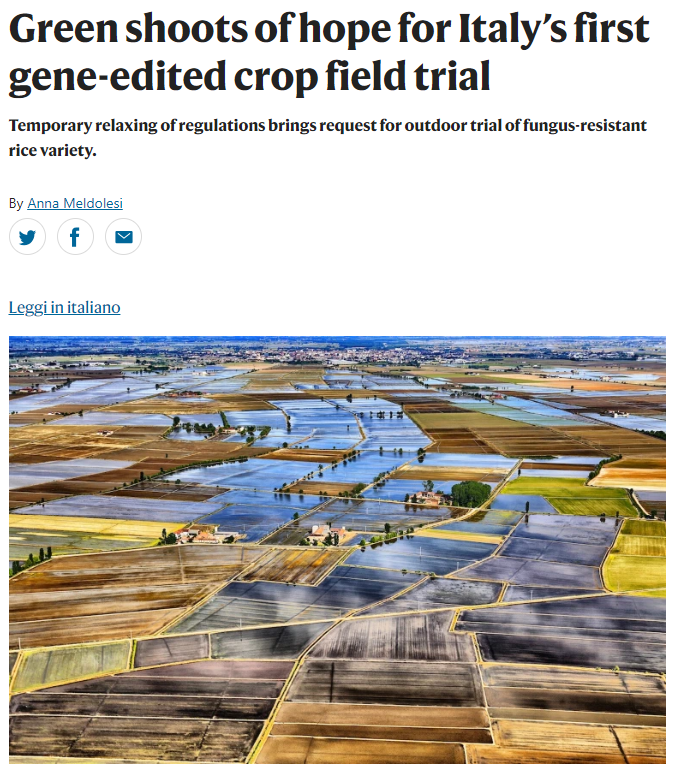
A CRISPR/Cas9-modified rice variety may be planted in a test field in northern Italy as soon as this spring after a government rule change introduced in 2023. A University of Milan team was the first research group in the country to apply for a field test under a law change that streamlines procedures for field trials of plants developed through genome editing or cisgenesis. With several other groups also planning proposals, a new wave of agricultural genetics in Italy could follow. [Please see the details in my article for Nature Italy]

CRISPR & cancer – small steps forward

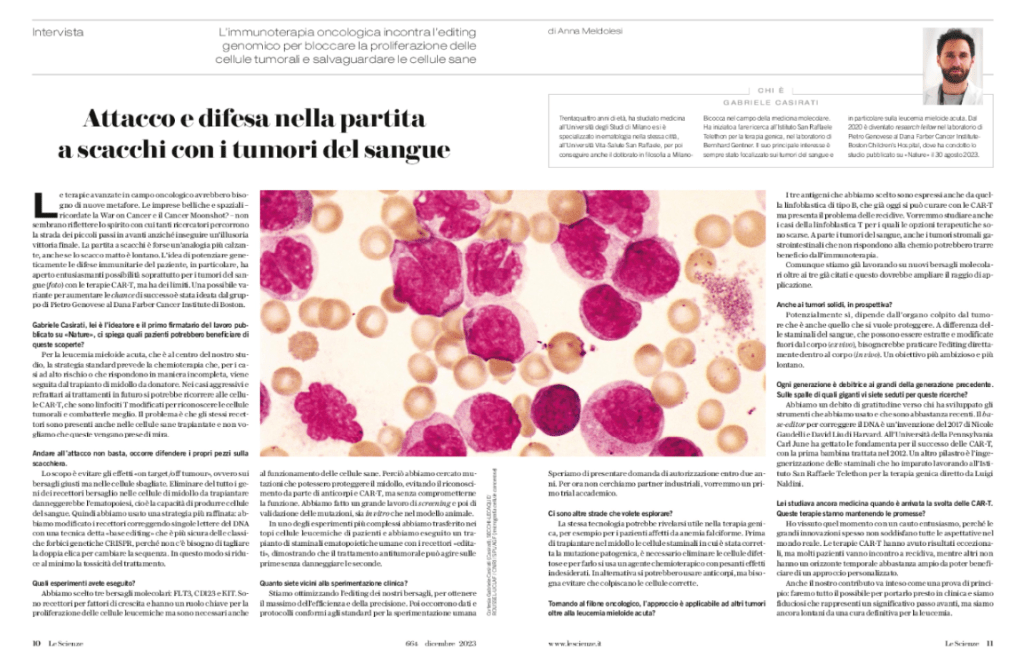
Advanced cancer therapies would need new metaphors. War and space efforts – do you remember the War on Cancer and the Cancer Moonshot? – do not seem to reflect the spirit with which so many researchers pursue the strategy of small steps forward rather than chasing an illusory ultimate victory. The game of chess is perhaps a more fitting analogy, although checkmate is a long way off. The idea of genetically enhancing a patient’s immune defenses, in particular, has opened up exciting new possibilities especially for blood cancers (Car-T therapies) but is not without its limitations. One possible variant to increase the chances of success has been devised by Pietro Genovese’s group at the Dana Farber Cancer Institute in Boston and described in Nature a few months ago. If you can read Italian, please see also the December 2023 issue of Le Scienze, with my interview to Gabriele Casirati, first author of the Nature’s paper.

A letter to Europe from CRISPR inventors and a thousand other scientists

Dear Members of the European Parliament, 

In these times of climate crisis, biodiversity loss and renewed food insecurity, a scientific and evidence-based approach is essential in every respect. Now more than ever, we must rise above ideology and dogmatism. That is why we the undersigned turn to you and urge you to carefully consider the benefits of embracing New Genomic Techniques (NGTs) in your upcoming parliamentary decisions. As concerned citizens who believe in the power of science to improve our lives and our relationship with the planet, we implore you to vote in favour of NGTs, aligning your decisions with the advancements in scientific understanding. Conventional breeding for climate resilient crops (with cross-breeding of certain traits, subsequent selection and then backcrossing to remove undesirable traits) is too time-consuming. It takes years, decades even. We do not have this time in an era of climate emergency.  

[Here you can read the full text of the letter and subscribe to it]

Make People Better – an imperfect job

The tale of the experiment behind the birth of the first gene-edited humans has historical significance but continues to resemble an incomplete puzzle. I had hoped to find a few more hints and answers about the He Jiankui affair in the 2022 docufilm “Make people better” directed by Cody Sheehy, but now that I finally got to see it I must confess to a bit of disappointment. The impression is of being faced with a bricolage job executed with several valuable elements (never-before-seen footage and audio recordings) and too many random materials. It must be said that the task was difficult, for at least two reasons.

Continue reading

Organic farming & CRISPR – the not so odd couple

The New Genomic Techniques (NGTs) such as CRISPR are slowly rearranging the ranks in the debate on plant genetics and GM food. A few stakeholders that have always been hostile to GMOs have decided to open the door to the new opportunities coming from gene editing (in Italy, for example, the powerful farmers’ association Coldiretti has changed its mind). Others (e.g., Greenpeace, despite some isolated and courageous vanguards) have confirmed an ideological/cultural opposition, even in cases where the genetic intervention is so soft that the plants are concretely indistinguishable from those developed by conventional techniques. As for the galaxy of organic farming, it is standing still, yet something is moving. Don’t miss the article published in EUobserver by Lone Andersen and other organic farmers, who are calling on European institutions not to ban the new breeding techniques from their fields in the ongoing regulatory revision. “By encouraging the use of a limited share of the new NGTs in organic agriculture while preserving the non-GM status, the EU can further promote sustainable practices and reinforce its commitment to a greener future,” they write.