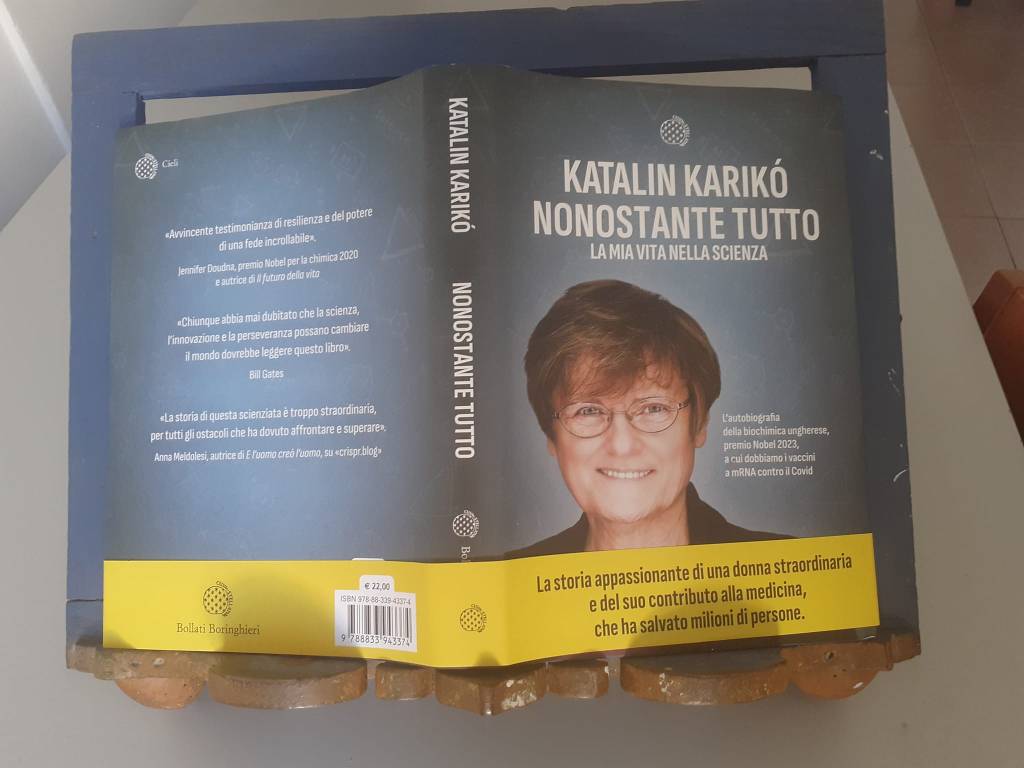
The Italian publisher did me the crazy honor of including a quote from me on the back cover of the best book of the year (IMHO), along with quotes from CRISPR inventor Jennifer Doudna and Bill Gates. The autobiography of Katalin Karikó, the mRNA vaccine scientist, is a must-read for those who love great science and great minds. We had already blogged about her in the aftermath of the Nobel Prize.
The recent approval of Casgevy represents the first official success of gene editing-based therapies. The treatment for sickle cell anemia and thalassemia came in record time, only 11 years after CRISPR was invented. “Two diseases down, 5,000 to go,” commented Fyodor Urnov, Director of Technology & Translation at the Innovative Genomics Institute. Among the many diseases awaiting a cure, what will be the next to benefit from CRISPR? At what rate can we expect new treatments to arrive? The periodic update published by IGI is a must-read to navigate through hope and hype, papers and press-releases. The picture is overwhelmingly positive, but there is also some cause for disappointment. Here is an excerpt from the introduction:
It could take a while to bring the first CRISPR products to our tables, but it is always a good time to see what progress is being made in the labs. Here are some novelties, reported by Isaaa: high-fiber barley, aromatic soy milk, extralong-grain wheat, TiGER strawberries, and my favorites: seedless, thornless, and higher-yielding blackberries and black raspberries.
If you are in Cambridge, Massachusetts, don’t miss the live dance performance to be held at the MIT Museum on March 16th. The Choreography of CRISPR is all about “twisting, cutting, inserting, copying, repeating, palindromes, and cluster”, “an intricate dance of spiraling and folding patterns” (you can watch a minute from the première on the facebook page of the NYC-based contemporary dance company Pigeonwing Dance; choreography by Gabrielle Lamb, original music by James Budinich).
The goal is to treat unborn children as early as possible, before their disease causes irreversible damage. But the ambition is to do so without heritable DNA changes, that is, by targeting only somatic tissues and avoiding sex cells. Fetal genome editing, then, differs from embryo editing, which has raised so much controversy in recent years. The best way to understand how far it has come and how much remains to be done is to tell the story of the scientist most committed to this challenge. The opportunity is provided by a longread published in STAT, where Tippi MacKenzie’s biography is interwoven with a review of the field.
There is no doubt that this is good news: on February 7, the European Parliament approved the Commission’s regulatory proposal on New Genomic Techniques, covering also CRISPR plants. Some of the approved amendments (particularly the one on genetic modification of polyploid plants) have the effect of improving the text, others risk being a problem and should be reconsidered during the trilogue with member states (particularly the requirement to label all final products, even if they do not contain foreign genes). The European Parliament also brought in the issue of non-patentability of NGT plants, which would deserve to be addressed elsewhere. For more information, this is the position expressed on February 14 by European Plant Science Organisation (EPSO).
Anyone interested in advanced therapies is familiar with the acronym CAR-T. These are T lymphocytes modified (also with the help of CRISPR) to better recognize and attack cancer cells, and they have already proven to be a successful strategy for blood tumors. Now hopes are high that a similar approach may also prove useful for multiple sclerosis, which is an autoimmune disease. The idea is to use CAR-Ts to prevent B lymphocytes from attacking nerve cells, including in the brain. The first clinical trial is recruiting patients in the U.S. Read more in Nature.
Let’s come to the use of New Genomic Techniques in crops. The European Commission’s regulatory proposal (approved by the EU Parliament on Feb. 7) excludes the use of edited plants in organic farming, but among organic producers not everyone is against NGTs and this may bode well for a possible peaceful coexistence between the different types of production in the years to come.
Finally, we point out the latest advance in animal editing: porcine virus-resistant pigs. The paper came out in the CRISPR Journal, but you can also read about it in GEN.








 CRISPeR FRENZY