Are you more excited, worried, or skeptical about the mammoth de-extinction project revived by George Church’s new start-up? Most people (me included) have mixed feelings. In any case, there is a must-read article in STAT that will help clear your mind.
The list of the latest additions since the beginning of September is impressive. They are called CasMINI (see Molecular Cell), Cas7-11 (see Nature), OMEGAs (see Science), and come respectively from Stanford University (Stanley Qi Lab), MIT (McGovern Institute), and the Broad Institute (Zhang Lab). CasMINI is half the size of Cas9 and could be much easier to deliver. Cas7-11 is the Cas9 of RNA. OMEGAs are a new class of widespread RNA-guided enzymes, thought to be the ancestors of CRISPR.
Frances Arnold (Nobel Prize for Chemistry 2018 for the directed evolution of enzymes) and Jennifer Doudna (Nobel Prize for Chemistry 2020 for the invention of CRISPR)
They are two of only seven women who have won the Nobel Prize for Chemistry. At the Spark 2021 conference, they chatted about ethics, being women in science, the future of research, and much more. Frances Arnold was the interviewer and Jennifer Doudna the interviewee. The following is an extract of their conversation, dealing with the challenge of starting companies while running a top academic lab.
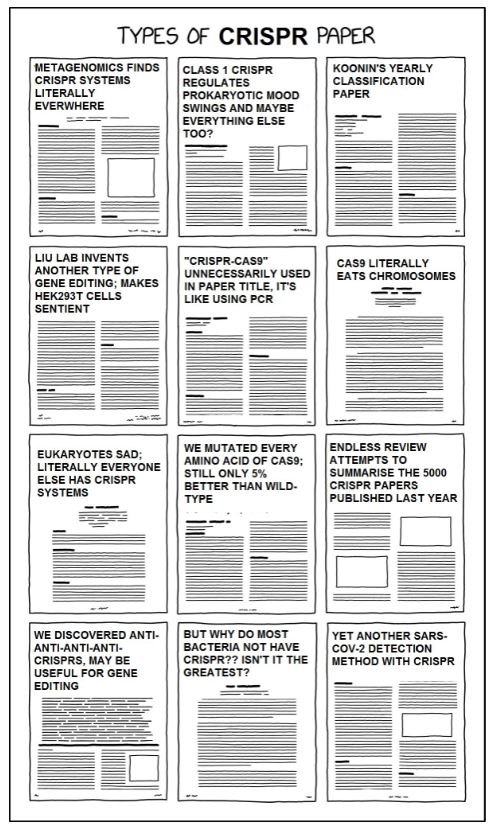
If you think science is boring, think again. The American cartoonist Randall Munroe drew a webcomic called Types of scientific paper and several scientists jumped on the bandwagon adapting the idea to their field. Here are “Types of genome editing paper” and “Types of CRISPR paper”. You can find more on Twitter (Types of bioethics/chemical biology/plant science/…).
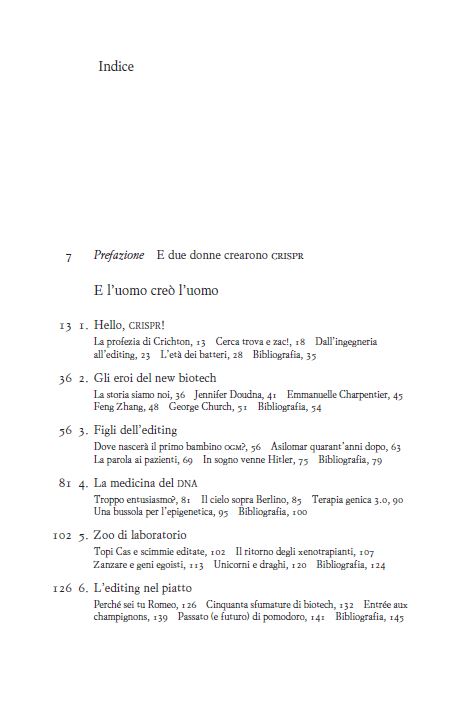
What should I be when I grow up? The DNA-tailor aka gene-editor is among the cool jobs of the future suggested by this book for children published in Italy. Explaining CRISPR to kids is fun. Wired did it in 2007, and the New York Timesfollowed soon (see below).
What’s unique about this book are the insights into the relationships between the main characters of the CRISPR saga. The loyal friendship linking Jennifer Doudna and George Church. The growing distrust between Doudna and Zhang. Doudna’s sorrow that she and Charpentier have drifted apart, personally as well as scientifically. The last point is indeed a melancholic note in the Nobel-ending tale. Why did their friendship fall apart?
After reading about the 2016 Canada Gairdner Awards in the book by Kevin Davies, I rushed online to listen to the walk-up music chosen by the CRISPR pioneers as they head to the stage to accept their award. Then I cut and pasted their songs and dance moves. So enjoy Jennifer Doudna dancing On the sunny side of the street, Rodolphe Barrangou pirouetting at the rhythm of Happy, Philippe Horvath going wild with Mission Impossible. And guess which is the song selected by Emmanuelle Charpentier? No spoiler, but the lyrics added at the end truly suits the CRISPR technological (r)evolution!
Modular design is the latest trend for developing new CRISPR tools. In The CRISPR Journal, Juan Carlos Collantes et al. present a base-editor system called Pin-point that recruits a DNA base-modifying enzyme through a hook (an RNA aptamer) within the guide-RNA molecule. In Nature Communicationsthe goal of Lacramioara Bintu and colleagues is not base editing but epigenomic editing, the effector is a chromatin regulator and the hook is an antibody. When the CRISPR-effector combo is big, delivery of individual modules is easier. Furthermore, if the effector is already present inside the cell it can be simply recruited by providing the right hook. One more potential advantage is the convenient reconfiguration of the system by the mix and match of individual components and simultaneous recruitment of different effectors to different target sites.