Drought research – persist to resist

Beating the heat is one of the goals most vigorously pursued by plant geneticists. A solution is not yet in sight, but after so many years of research, it is clear that there are several avenues worth exploring. The three most important things are testing, testing, testing.
The first consideration is that plants can adopt different strategies to survive when water is scarce. You can distinguish between drought resistance and water use efficiency, or go subtle by talking about drought avoidance, drought escape, and drought tolerance.
Another basic premise is that drought can vary in intensity and duration, so that a plant capable of tolerating moderate stress may still succumb under more extreme conditions. Further complicating matters is the fact that, to be adopted by farmers, future crops will have to prove not only more resilient but also as productive as the varieties they are intended to replace. Two strategies are being pursued at the University of Milan with the help of CRISPR.

Continue reading

A decade of CRISPR is only the beginning

CRISPR past, present, and future according to the review by Jennifer Doudna and Joy Y. Wang just published in Science. This is the original caption: “The past decade of CRISPR technology has focused on building the platforms for generating gene knockouts, creating knockout mice and other animal models, genetic screening, and multiplexed editing. CRISPR’s applications in medicine and agriculture are already beginning and will serve as the focus for the next decade as society’s demands drive further innovation in CRISPR technology.”

Continue reading

CRISPR aims straight for the heart

Photo credit Singularity Hub

The latest challenge is protecting damaged tissue immediately after a heart attack with the help of base editing (see the paper published in Science by Eric Olson’s group at the University of Texas Southwestern Medical Center). But there are hundreds of devastating diseases that affect the heart or other muscles and are caused by mutations that could be fixed by CRISPR-based tools (see this paper in Science Trsnslational Medicine for example). From Duchenne dystrophy to cardiomyopathies, some preliminary results are very encouraging.
Learn more reading the article on the Science paper published by El Pais and watching this video with Olson explaining his studies, especially on Duchenne muscular dystrophy.

Domesticaton in the CRISPR era

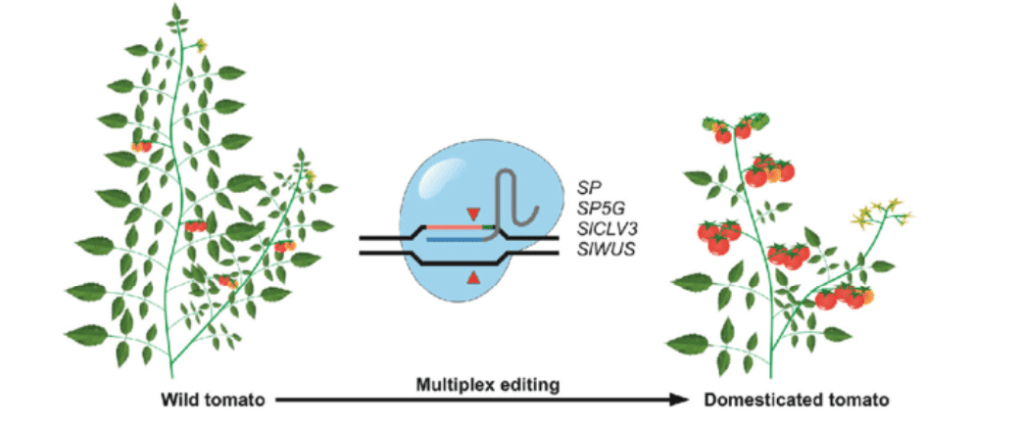
The world’s food supply depends on about 150 plant speciesbut this number could increase, even considerably. In fact, 250 species are considered to be fully domesticated, while 7,000 are semi-domesticated and 50,000 are edible. In the genomic era domestication may not require centuries and millennia, as was the case in the early days of agriculture. The process could happen at an accelerated pace, within a few years, taking advantage of modern knowledge about useful traits and new tecnologies such as gene editing. 

Continue reading

CRISPR good and bad news as 2023 starts

Nature suggests a number of science events to watch for in the new year. Among the developments set to shape biomedical research in 2023 we will hopefully welcome next-generation mRNA-based vaccines, the updated list of WHO priority pathogens and promising candidate drugs for Alzheimer’s. Gene editing is also not missing, with the the first approval of a CRISPR-based therapy a mere 10 years after the Doudna-Charpentier invention (more about exa-cel here).

Continue reading