Agrobiodiversity, pangenomes and the future of food

Comparing commonly grown species and native varieties is a winning strategy for making the former more resilient and the latter more productive.

You all know tomatoes and potatoes. African eggplants, maybe not—but when ripe, they turn red just like tomatoes. The lulo, for its part, is an orange fruit with citrusy notes, which is why in Ecuador it’s called naranjilla, or “little orange.” The Andean pepino, on the other hand, has juicy flesh that makes it resemble a melon. Their sizes, colors, and flavors may vary, but all of these plants belong to the same taxonomic group. In fact, they represent some of the species sequenced to produce a remarkable collection of related genomes—remarkable because it aims to span the entire Solanum genus.

Continue reading
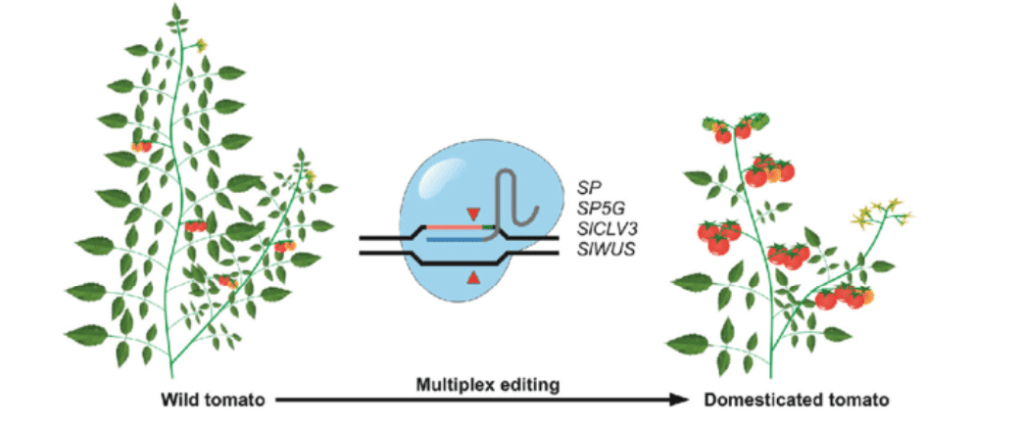
CRISPR hits tomato’s sweet spot

Recolored tomatoes, as in this cover. Enriched with vitamin D, such as those developed with the help of Italian scientists. Resistant to parasitic plants (broomrapes), like those being studied also in Italy. Redomesticated tomatoes, as if it were possible to rewind and restart the film of domestication at an accelerated speed. Even hot tomatoes. There is no doubt that CRISPR is making waves with this fruit so central to our cuisine and so important to the global economy (186 million tons are produced worldwide). The latest addition is the extra-sweet tomato, which had the honor of being featured in a paper in Nature.

Continue reading

Domesticaton in the CRISPR era

The world’s food supply depends on about 150 plant speciesbut this number could increase, even considerably. In fact, 250 species are considered to be fully domesticated, while 7,000 are semi-domesticated and 50,000 are edible. In the genomic era domestication may not require centuries and millennia, as was the case in the early days of agriculture. The process could happen at an accelerated pace, within a few years, taking advantage of modern knowledge about useful traits and new tecnologies such as gene editing. 

Continue reading

Neutralizing cryptic mutations in plant breeding

We talk of cryptic mutations when genes are changed in a way that remains hidden until they interact with other mutations. As a result, combining beneficial traits can have negative consequences hindering agricultural production (watch this video from Cold Spring Harbor Laboratory on unexpected negative interactions). Classic breeders have been dealing with this problem for decades, but researchers from CSHL are finally working on a solution suitable for the genomic era. Zach Lippman and colleagues have studied one infamous cryptic mutation affecting a tomato variety developed by the Campbell Soup Company in the 1960s and discuss an anti-negative-interaction strategy for the future. Please see their paper in Nature Plants and watch the video below offering a cautionary tale for crop gene editing.