Playing with Chromosomes: CRISPR’s New Frontier

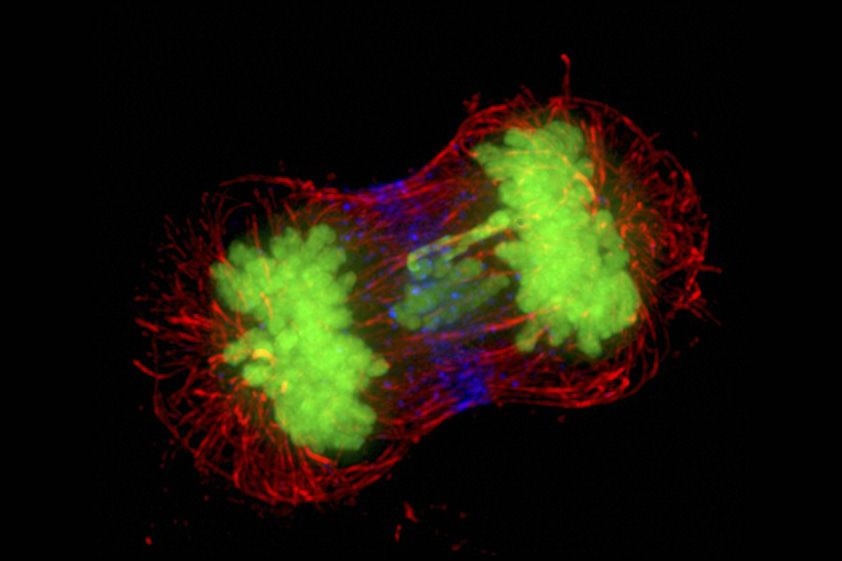
Humans have 23 pairs of chromosomes. The record-holder among animals (a butterfly called Polyommatus atlantica) can boast 229. Some plants have even more, but only because their genomes have undergone multiple rounds of duplication. We’re talking about chromosomes, of course. Their number is characteristic of each species and still shrouded in mystery. Why that number? And what would happen if we changed it?
In animals, the effects tend to be detrimental: mice with fused chromosomes, for instance, show abnormalities in behavior, growth, and fertility. Plants, however, appear surprisingly flexible, as demonstrated by a new experiment using CRISPR, recently published in Science.
Continue reading

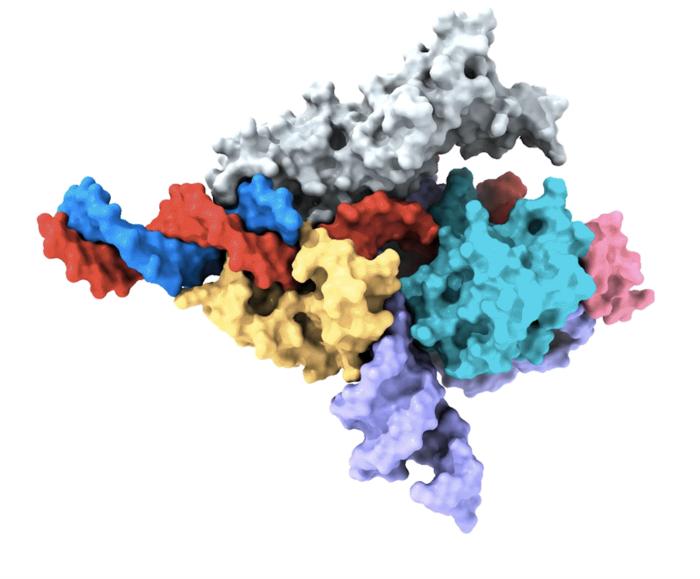
Meet Fanzor, the CRISPR-like tool from complex organisms

Credit: Courtesy of the Zhang lab
Cryo-EM map of a Fanzor protein in complex with ωRNA and its target DNA.

Treasure hunting in fungi and clams has led to the discovery of CRISPR-like proteins that can be RNA-programmed to edit human DNA.

“Nature doesn’t make jumps,” claimed many thinkers of the past, but modern-day geneticists can point to many exceptions to the rule. Transposons are mobile genes par excellence jumping from one point to another in the genome. In particular those associated with the OMEGA system, discovered two years ago in bacteria, head for chosen landing spots thanks to a kind of programmable GPS similar to CRISPR.

The news is that now such a phenomenon has also been detected in organisms with nucleated cells, so-called eukaryotes which include fungi, plants and animals. Feng Zhang’s group has already started engineering these programmable proteins, known as Fanzor, to turn them into efficient editing tools. Please see the paper in Nature, the article posted on the Broad Institute website and Zhang’s tweets.

Would you buy a CRISPR salad from these men?

The company which developed the new vegetable (and is working on new varieties of cherries and berries) was founded by CRISPR top scientists David Liu, Keith Joung and Feng Zhang

By now it seems official. The first CRISPR plant to debut in the US market will not be a commodity for industry or intensive livestock farming, as was the case with classic GMOs in the 1990s. This time genetic innovation enters on tiptoe, with a food product designed for discerning consumers. A new type of salad, as nutrient-rich as a wild misticanza but without the bitter notes that usually relegate brassicas to foods to be eaten cooked (see here).

Continue reading

Crispy salads are here!

Berkeley professor Patrick Hsu on twitter: “Delighted to try out the world’s first CRISPR-edited salad”

I must say that I’m a bit envious and eager to taste this kind of Brassica juncea with the “mustard bomb” mechanism prevented by knocking-out multiple copies of the gene responsible for the bitter taste.

Continue reading

Feng Zhang on how transposons hijacked CRISPR

CRISPR pioneer Feng Zhang walked through his current research projects at the national meeting of the Italian Genetics Association (AGI) on September 24. CRISPR associated transposases, retrovirus-like particles repurposed as delivery vehicles, the ancestry of CRISPR systems, and more. The first issue is probably the most fascinating. It’s actually amazing to see a new activity performed by some CRISPR systems: not to protect bacteria from viruses, but to help transposons jump into specific genome sites.

Continue reading

The ever-expanding CRISPR toolbox

Credit: Mon Oo Yee/Innovative Genomics Institute

The list of the latest additions since the beginning of September is impressive. They are called CasMINI (see Molecular Cell), Cas7-11 (see Nature), OMEGAs (see Science), and come respectively from Stanford University (Stanley Qi Lab), MIT (McGovern Institute), and the Broad Institute (Zhang Lab). CasMINI is half the size of Cas9 and could be much easier to deliver. Cas7-11 is the Cas9 of RNA. OMEGAs are a new class of widespread RNA-guided enzymes, thought to be the ancestors of CRISPR.

Continue reading

Three August news not to be missed

by Philippa Steinberg

The Innovative Genomics Institute presents CRISPR Made Simple – the new online primer on gene editing made for kids or anyone starting from scratch.

The Broad Institute unveils SEND, a new delivery system inspired to retrotransposons (see Feng Zhang’s paper in Science)

Genotoxicity concerns: Nature Biotechnology explains how a cancer-associated phenomenon called chromothripsis could affect CRISPR therapies.

Inside the CRISPR saga

What’s unique about this book are the insights into the relationships between the main characters of the CRISPR saga. The loyal friendship linking Jennifer Doudna and George Church. The growing distrust between Doudna and Zhang. Doudna’s sorrow that she and Charpentier have drifted apart, personally as well as scientifically. The last point is indeed a melancholic note in the Nobel-ending tale. Why did their friendship fall apart?

Continue reading

CRISPR-based Covid tests: what’s going on?

Doudna’s creature (Mammoth Biosciences) and Zhang’s company (Sherlock Biosciences) are developing CRISPR-based coronavirus tests similar to a home pregnancy test: portable, cheap, fast, and simple. Both will be easily adapted to detect any new emerging virus. Both received emergency use authorizations in the US in the fall of 2020 and hope to enter the market by the end of 2021. According to this piece by Walter Isaacson, competition is hot but all the intellectual property questions have been put aside for common good.

CRISPR crops in the news

Credit Pairwise Plants

European scientists must wait for the EC to carry out targeted consultations with Member States and EU-level stakeholders. Then the Commission study on new genomic techniques will be delivered by 30 April 2021. In the meantime, the United States has decided to relax the rules for biotech crops.

Continue reading