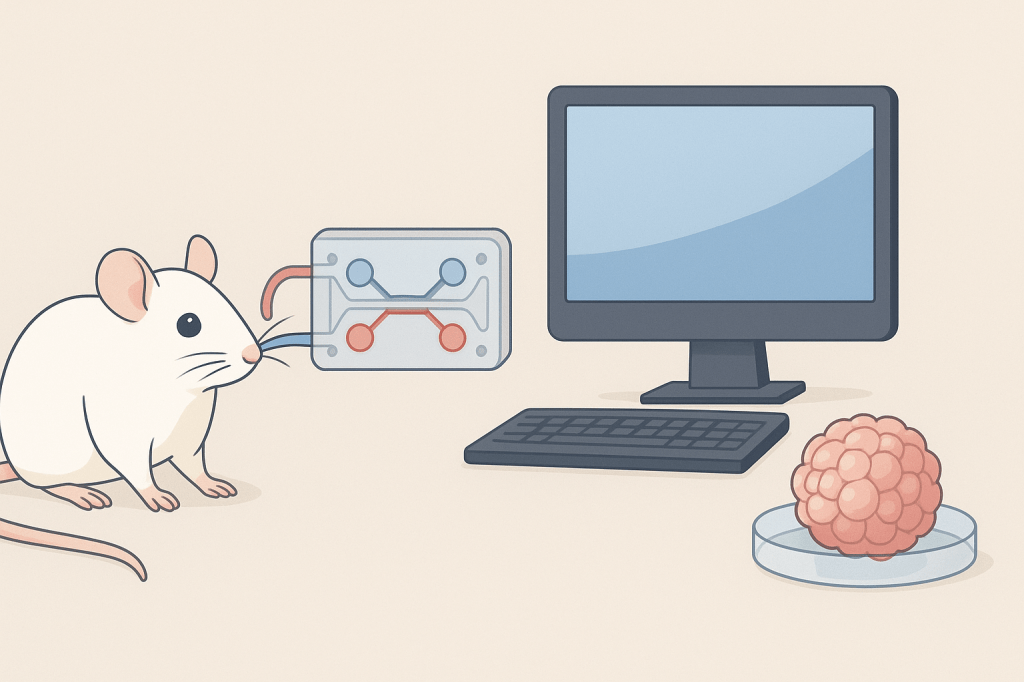
Can technology replace animal testing?

New Approach Methodologies (NAMs) have a bright future ahead, but they should be seen as complementary rather than alternative to classical experimentation.

Regulatory and funding agencies in the U.S. and Europe are promoting ambitious initiatives to foster the development and adoption of advanced systems capable of testing the effects of drugs and other substances without using animal models. The hope is that biomedical research can become more ethical, safer, and cheaper. But the challenge is complex, and the requirements vary depending on the application. As a result, some voices urge a faster “transition,” while others warn that rushing the process could be risky. Recently published articles in leading scientific journals capture this polarized debate, but they also hint at a possible middle ground.

Continue reading
Baby KJ Effect: the new horizon of bespoke CRISPR therapies

The FDA is set to authorize “umbrella” clinical trials for rare diseases; the new approach will make the process faster and more sustainable by combining data from similar protocols, cutting redundant procedures, and reducing animal testing.

Continue reading

CRISPR revolution on hold?

It’s been about a year since the first CRISPR-based treatment was approved in the United States and Europe. However, those expecting a surge in approvals of new gene-editing therapies may be disappointed. Next in line will likely be another approach to treating sickle cell disease, followed by therapies for TTR amyloidosis and hereditary angioedema around 2026-27. According to The CRISPR Journal, that’s all we can expect over the next 3-5 years. Is Casgevy destined to stand out like a cathedral in the desert? We have a super-versatile platform capable of fixing a myriad of genetic defects, so why is the CRISPR revolution slowing down? To understand the looming crisis and the countermeasures needed, don’t miss Fyodor Urnov’s in-depth editorial entitled “Give Cas a Chance: An Actionable Path to a Platform for CRISPR Cures.”

CRISPR trials: the 2024 update

The recent approval of Casgevy represents the first official success of gene editing-based therapies. The treatment for sickle cell anemia and thalassemia came in record time, only 11 years after CRISPR was invented. “Two diseases down, 5,000 to go,” commented Fyodor Urnov, Director of Technology & Translation at the Innovative Genomics Institute. Among the many diseases awaiting a cure, what will be the next to benefit from CRISPR? At what rate can we expect new treatments to arrive? The periodic update published by IGI is a must-read to navigate through hope and hype, papers and press-releases. The picture is overwhelmingly positive, but there is also some cause for disappointment. Here is an excerpt from the introduction:

Continue reading

Base-editing comes of age and more SCD news

Alexis Komor and Nicole Gaudelli developed based editing when they were postdoc in David Liu’s laboratory at Harvard. Credit: The CRISPR Journal

The first Investigational New Drug (IND) application for base-editing technology has been cleared by the Food and Drug Administration. BEAM-101, developed by Beam Therapeutics, is an ex vivo base-editing product candidate, meaning that it uses a modified form of CRISPR capable of making single base changes without double-stranded DNA cleavage.

Continue reading

CRISPR patients, 3 reasons for hope

Patrick Doherty, Carlene Knight, and Victoria Gray (credit NPR)

There is one more hopeful story from NPR. It involves a woman with a congenital eye disorder who volunteered to have her retina edited. A few months ago, it was a man suffering from a rare liver disease. The first of all, as you probably know, was a woman struggling with sickle cell disease. Don’t miss their CRISPR stories!

China vs USA: who leads the CRISPR race?

China vs US

The first human CRISPR trial approved in the United States is finally recruiting the first patient. In the meantime trials have grown to a dozen in China, considering those revealed by the Wall Street Journal inquiry besides the NIH database (check also this npr article for further details). Over 80 Chinese patients are already receiving a CRISPR-based treatment, while US researchers cautiously plan to test the safety of their experimental therapy on a single subject, and, if everything goes right, two more patients will be treated a month later. Is the West losing its genome-editing edge to Beijing? Continue reading