CRISPR crops and the EU law. A wise proposal from Germany

2016-berlin-reichstag-politik_0_1

When the European Court of Justice ruled that CRISPR products must obey the same cumbersome rules as GMOs, European ag scientists were shocked. After complaining, it’s time to advance new proposals. A German council advising the Federal Government has just released its recommendations, calling for new EU legislation. According to the 17 members panel, named Bioökonomierat, we should adopt a differentiated approach to the genome-editing technology and its applications, ranging from single letter mutations to complex genome modifications. For example, graduated licensing and approval procedures for different classes of risk. Please see the main points below. Continue reading

Inviting you for a CRISPR snack in Rome

crispr snack

credit: The Atlantic

It won’t be a candy bar like the one in the picture, but it will be the first CRISPR snack ever eaten in Italy and among the first in the world. A taste of rice edited in Milan, according to rumors. The initiative, organized by The Luca Coscioni Association for freedom of scientific research, will take place on September 18 at 10 am, in front of the Italian Parliament. The first CRISPR meal ever served was a tête-à-tête between a scientist and a journalist in Sweden in September 2016. A month later Calyxt hosted a dinner made with food edited with a different biotech tool in a famous restaurant in Manhattan. The Italian snack is different, however, because of its public nature and political aim. It’s a call to politicians, journalists and scientists to engage in the regulatory debate about genome editing after the EU Court of Justice ruled that edited plants are GMOs. GM field trials are banned in Italy and CRISPR represents a much-needed second chance for geneticists to get out of the impasse.

Anti-CRISPR and the Red Queen

red queen

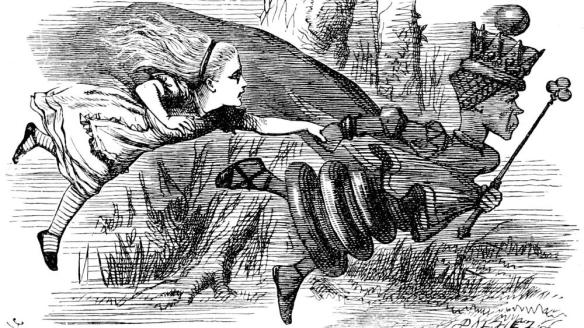
The battle for survival between bacteria and bacteriophages can be framed according to the Red Queen hypothesis. To avoid extinction bacteria must evolve new mechanisms of resistance, such as CRISPR immunity. Viruses, in turn, must evolve countermeasures to inactivate these resistance mechanisms, such as anti-CRISPR proteins. These natural inhibitors may well become biotech tools useful to keep genome-editing in check and are a minefield waiting to be explored. Jennifer Doudna and Joseph Bondy-Denomy used bioinformatics to find some of them, and have just published their findings in Science. Paraphrasing Dobzhansky’s famous dictum, nothing in biotechnology makes sense except in the light of evolution.

Cutting off Duchenne in dogs. How excited should we be

dogs-muscular-dystrophy

credit: Royal Veterinary College, University of London

“Exciting news! Our partner, Dr. Eric Olson and his team at Exonics published their research on increasing dystrophin restoration of 92% in the hearts of dogs. While they have a long way to go, their dramatic research gives hope to all families affected by Duchenne!”. This is how the patient advocacy group CureDuchenne announced the CRISPR breakthrough just published in Science. Continue reading

Comments Roundup. A sad week for CRISPR crops in EU

CRISPR sad day

A shortlist of articles capturing ag scientists’ dismay at the recent EU verdict affecting the future of CRISPR crops:

Science Media Centre, Expert reaction to Court of Justice of the European Union ruling that GMO rules should cover plant genome editing techniques

Matt Ridley, EU’s anti-GMO crusade is unscientific and harmful

Mark Lynas, Scientific community defeated by green groups in European court ruling on gene edited crops

Carl Zimmer, What is a genetically modified crop? A European ruling sows confusion

The Observer view on Europe’s ban on gene-editing crops

Wired, European ruling could slow Africa’s push for CRISPR crops


How green is CRISPR future? The EU judgment is coming

sunflowers in Spain

Tomorrow, the European Court of Justice is set to pronounce a verdict on the legal status of organisms produced through mutagenesis. In January, the opinion of the Advocate General Michal Bobek was variously interpreted, but scientists are hopeful that the judgment of Case C 528/16 will help the European Commission to reasonably regulate new breeding technologies such as CRISPR. Continue reading

Another CRISPR havoc? That’s science, baby

keep-calm-and-sequence-dna

A paper published in Nature Biotechnology by Allan Bradley and colleagues from the Wellcome Sanger Institute in Hinxton, UK, shows that classical CRISPR editing can cause large rearrangements of DNA near the target site in actively dividing cells. We may think of it as the latest CRISPR alarm, but also as a demonstration of how biomedical research works. Firstly: no technology is perfect, but the best ones are perfectible. CRISPR belongs to this category because it is an extraordinarily versatile and fast-evolving biotech platform. When reading news like “CRISPR causes this or that problem,” the first question to ask is: which CRISPR variant are we talking about? Continue reading