A bold proposal and a cautious report

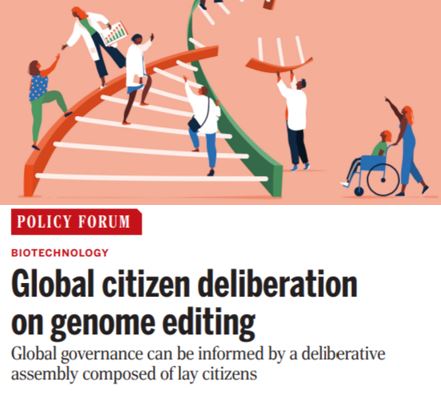
Let’s imagine a hundred or more citizens from all over the globe, selected to partecipate in a giant focus group aiming to represent world views. It would be an unprecedented social experiment, that’s for sure, but the call is worth considering. The bold proposal comes from a group of social scientists and a few geneticists (George Church included) writing today in Science. Fascinating as it is, this kind of assembly is probably easier said than done. However, the main problem, in my opinion, comes next: what should experts and politicians do with the assembly’s deliberations?

Continue reading

CRISPR & society, the dialogue resumes

CRISPRcon returns with a series of discussions exploring gene editing’s role in COVID-19 testing and treatment, racial disparities, strategies to address climate change, and more. The panel on gene editing and journalism opens the event, that is free and 100% virtual, on Sept 1. Speakers: Tamar Haspel (Washington Post Columnist), Antonio Regalado (Senior Editor for Biomedicine, MIT Technology Review), Elliot Kirschner (Executive Producer, Human Nature and the Wonder Collaborative). Moderator: Ting Wu (Professor of Genetics, Harvard Medical School).

Knocking out cholesterol

Consider this scenario, depicted in Nature a few years ago. “It’s 2037, and a middle-aged person can walk into a health centre to get a vaccination against cardiovascular disease. The injection targets cells in the liver, tweaking a gene that is involved in regulating cholesterol in the blood. The simple procedure trims cholesterol levels and dramatically reduces the person’s risk of a heart attack”.

Continue reading

Editing mitochondria

Click the links below to discover Ddda, the exceptional enzyme that allows mitochondrial editing, and celebrate curiosity-driven research.

The Nature paper by Joseph Mougous and David Liu: “A bacterial cytidine deaminase toxin enables CRISPR-free mitochondrial base editing”

The news: “Scientists make precise gene edits to mitochondrial DNA for first time”

The news and views: “Mitochondrial genome editing gets precise”

The editorial: “Mitochondrial genome editing: another win for curiosity-driven research”

About chromosomal mayhem in edited embryos

Luigi Naldini, SR-Tiget

CRISPeR Frenzy asked Luigi Naldini of the San Raffaele Telethon Institute for Gene Therapy in Milan for comment on three studies published in June on the preprint server bioRxiv. The experiments were carried out independently by the groups of Kathy Niakan of the Francis Crick Institute in London, Dieter Egli of Columbia University in New York City, and Shoukhrat Mitalipov of Oregon Health & Science University in Portland. These findings heighten safety concerns about heritable genome editing (see the news item by Heidi Ledford in Nature). Below you can read Naldini’s thoughts.

Continue reading

Flowering with CRISPR

Multiplexed heritable gene editing using RNA viruses and mobile single guide RNAs

FT (Flowering Locus T) is a small protein that helps plants know when to flower. Now it also allows geneticists to create heritable gene edits in the shoot apical meristem. The trick is a guide RNA augmented with an FT sequence that promotes cell-to-cell mobility. The result is a new approach to gain access to the germline.

Continue reading