Three hopes for CRISPR

easter eggs

Off-target paper retraction: Nature Methods has retracted a controversial study questioning CRISPR precision, after its authors admitted they were probably wrong. This blog’s wish is that future studies on CRISPR flaws and virtues are as reliable as the genome-editing technique.

Deregulation statement: US Secretary of Agriculture Sonny Perdue has announced that USDA will not regulate edited plants as long as they could have been created through conventional breeding. Let’s hope Europe will follow the example.

Gene therapy going “organic”: that’s the hope expressed by Merlin Crossley, when commenting his Nature Genetics paper on mutations beneficial to patients with β-thalassemia and sickle cell anemia. The word organic here means that fetal hemoglobin production can be boosted without inserting foreign DNA.
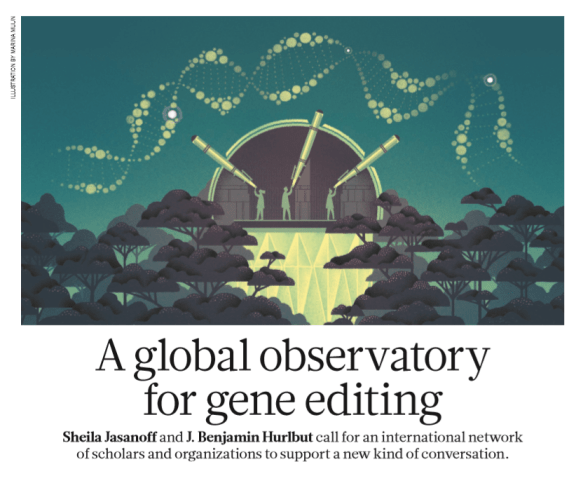
Do we need a Global Observatory for Gene Editing?

osservatorio globale NatureEveryone knows IPCC, the forum created under the auspices of the United Nations to review the state of knowledge on climate change, draw scenarios on its impact, and compare alternative policies. Does the world need a similar body for the biotech revolution ahead, as claimed by Sheila Jasanoff and J. Benjamin Hurlbut in Nature? Is a Global Observatory on Gene Editing the solution to our CRISPR troubles? We asked a pioneer of gene therapy and a pioneer of gene drives, but also a bioethicist, a political scientist, a social psychologist, a science historian. Continue reading

CRISPR at the EU Court

advocate-general-opinionAgbiotech supporters and opponents have been waiting for months for the opinion of the Advocate General of the European Court of Justice, hoping that it would settle the fateful question: do edited plants follow the same legislation as GMOs? The answer, however, does not appear to be conclusive and has been variously interpreted. Nature, The Scientist, and The Guardian are cautiously optimistic, but this Euractiv article is even more interesting. Uncertainty is the prevailing mood in this field. Continue reading

Gene drives: the experiment goes social

harvard-mag-pete-ryanChoose a word to fill the gap in the sentence. “Gene drives are an ambitious experiment in …”. Genetics? Ecology? Evolution? Obviously, gene drives are all this and more. They may also represent a significant social experiment in risk communication, public engagement, participatory processes. Potential applications of this technology include controlling the transmission of vector-borne diseases and eliminating invasive species from sensitive ecosystems. We do not yet know if these genetic elements, designed to foster the preferential inheritance of a gene of interest with CRISPR’s help, will work in field trials as hoped. To find out, a green light to test this technology out of the labs will have to be negotiated with the public, stakeholders, regulators, and governments of affected countries. A first step in this direction was taken last week with the commitment to respect shared guiding principles in gene drive research and communication published in Science by the technology main sponsors and supporters. Signatory organizations are scattered around the world, from the US to India, with the Bill & Melinda Gates Foundation at the forefront with its Target Malaria project. Continue reading

Testing the future of beer

birraThe Daily Beast has misunderstood, unfortunately, and the rose-scented CRISPR beer does not exist yet. But researchers are hopeful to try it in pilot-scale in the near future. A team from the University of Leuven in Belgium has identified two genes that could be used to generate novel flavor profiles in alcoholic beverages. They are called TOR1 and FAS2 and work by increasing the production of phenylethyl acetate in yeast (Saccharomyces cerevisiae). CRISPR helped to swap the scented alleles into standard strains, which suddenly began producing more floral aromas. Continue reading

Editing the celiac diet. Is it GM bread?

gluten-free

Wheat contains many genes coding for proteins that are toxic to people with celiac disease (gliadins), but CRISPR could edit them all out. Researchers at the Institute for Sustainable Agriculture (Córdoba, Spain) have managed to knockout up to 35 of these genes, reducing immunoreactivity by up to 85%. The 100% goal now seems to be at hand. But is biotech “gluten-free” bread tasty? And is it going to reach the market? We asked plant scientist Francisco Barro, corresponding author of the paper recently published in Plant Biotechnology Journal. Continue reading

Debating the rules for CRISPR crops in Brussels

bruxelles cattura

The European Commission is organising the high-level conference “Modern Biotechnologies in Agriculture – Paving the way for responsible innovation”. This one-day event takes place in the Charlemagne Building today, from 9.30 to 18.00. The aim is to stimulate an informed and open debate among all stakeholders on how the EU can benefit from modern biotechnologies and innovation in the food and agricultural sector while maintaining high safety standards. The participants are prominent European policy makers, relevant industry stakeholders, representatives of civil society, scientists, and government experts. Webstreaming is available. For further information, see the conference website


Germany debates CRISPR

leopoldina

Germany stands out as the European country most interested in fostering an informed debate on CRISPR many uses. Today an interdisciplinary group of experts from the German National Academy of Sciences (Leopoldina) has published a Discussion Paper entitled “Ethical and legal assessment of genome editing in research on human cells”.  Experiments involving human embryos are prohibited by law in the country but the document suggests a possible compromise. Research should be permitted on “orphaned” embryos created for reproductive purposes but no longer going to be used for reproduction. In February the German academy co-organized a meeting on edited plants, discussing what kind of regulation would be suitable. In 2005 they published a statement on “The opportunities and limits of genome editing” and another one on molecular plant breeding. According to a Leopoldina official press-release, the annual assembly “will be intensively addressing the topic of genome editing” later this year.