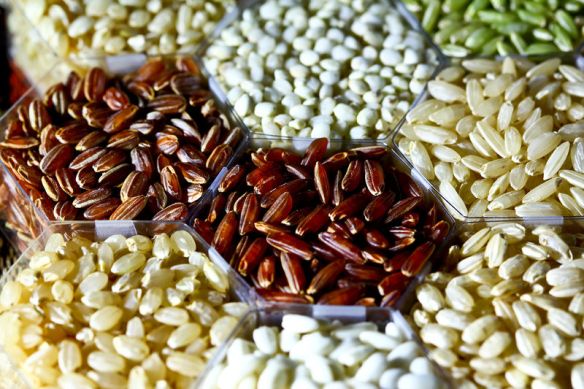
Just imagine you could find them all on the supermarket shelves, would you buy rice labeled as CRISPR or GMO, or stick to conventional non-genetically modified rice? And what price would you consider fair? Aaron Shew and colleagues from the University of Arkansas conducted a multi-country assessment of willingness-to-pay for and willingness-to-consume a hypothetical CRISPR-produced food and published their findings in Global Food Security. Continue reading
Category Archives: Regulation
EU science advisors on CRISPR and GMOs
The European Commission’s Group of Chief Scientific Advisors has published a statement on gene editing and the GMO directive, following the controversial judgment released last July by the EU Court of Justice. They state that new scientific knowledge and recent technical developments made Directive 2001/18 “no longer fit for purpose.” Therefore “there is a need to improve EU GMO legislation to be clear, evidence-based, implementable, proportionate and flexible.” The document was welcomed by Carlos Moedas, Commissioner for Research, Science and Innovation, and Vytenis Andriukaitis, Commissioner for Health and Food Safety. Let’s hope actions will follow, and laws keep up with labs.

The Netherlands are calling. Will the EU answer?
A proposal from the Netherlands Ministry of Infrastructure and the Environment points the way out of the GM regulatory impasse for most CRISPR crops in Europe. Rather than trying to clarify ambiguous definitions, the EU could simply amend Annex B1, that is the list of technologies that are excluded from regulation by the directive on GMOs (2001/18/EC). Continue reading
CRISPR crops and the EU law. A wise proposal from Germany

When the European Court of Justice ruled that CRISPR products must obey the same cumbersome rules as GMOs, European ag scientists were shocked. After complaining, it’s time to advance new proposals. A German council advising the Federal Government has just released its recommendations, calling for new EU legislation. According to the 17 members panel, named Bioökonomierat, we should adopt a differentiated approach to the genome-editing technology and its applications, ranging from single letter mutations to complex genome modifications. For example, graduated licensing and approval procedures for different classes of risk. Please see the main points below. Continue reading
Inviting you for a CRISPR snack in Rome

credit: The Atlantic
It won’t be a candy bar like the one in the picture, but it will be the first CRISPR snack ever eaten in Italy and among the first in the world. A taste of rice edited in Milan, according to rumors. The initiative, organized by The Luca Coscioni Association for freedom of scientific research, will take place on September 18 at 10 am, in front of the Italian Parliament. The first CRISPR meal ever served was a tête-à-tête between a scientist and a journalist in Sweden in September 2016. A month later Calyxt hosted a dinner made with food edited with a different biotech tool in a famous restaurant in Manhattan. The Italian snack is different, however, because of its public nature and political aim. It’s a call to politicians, journalists and scientists to engage in the regulatory debate about genome editing after the EU Court of Justice ruled that edited plants are GMOs. GM field trials are banned in Italy and CRISPR represents a much-needed second chance for geneticists to get out of the impasse.
Edited crops. The petition asking for science based rules in EU
Comments Roundup. A sad week for CRISPR crops in EU

A shortlist of articles capturing ag scientists’ dismay at the recent EU verdict affecting the future of CRISPR crops:
Science Media Centre, Expert reaction to Court of Justice of the European Union ruling that GMO rules should cover plant genome editing techniques
Matt Ridley, EU’s anti-GMO crusade is unscientific and harmful
Mark Lynas, Scientific community defeated by green groups in European court ruling on gene edited crops
Carl Zimmer, What is a genetically modified crop? A European ruling sows confusion
The Observer view on Europe’s ban on gene-editing crops
Wired, European ruling could slow Africa’s push for CRISPR crops
How green is CRISPR future? The EU judgment is coming

Tomorrow, the European Court of Justice is set to pronounce a verdict on the legal status of organisms produced through mutagenesis. In January, the opinion of the Advocate General Michal Bobek was variously interpreted, but scientists are hopeful that the judgment of Case C 528/16 will help the European Commission to reasonably regulate new breeding technologies such as CRISPR. Continue reading
Charting CRISPR ethical landscape
More than 60 germline ethics statements have been released by the international community so far (Italy is not included in the figure). Carolyn Brokowski, from the Yale School of Medicine, read and analyzed them all in The CRISPR Journal. A glance at her pie chart reveals a snapshot of the experts’ opinions on the moral permissibility of heritable genome editing. Continue reading
CRISPR animals knock on regulator’s door

When you hear the word GMOs, chances are high that you think of plants, not animals. In the last 20 years, indeed, the Frankenfood controversy has forestalled the use of genetic engineering in animal breeding. To date, only a single food animal can be eaten in a single country (the fast-growing AquAdvantage salmon approved in Canada), while transgenic plants are grown on more than 180 million hectares in over twenty countries. Genome editing is now knocking at animal farms, will the door open? Continue reading