While the number of studies on this topic is limited, they generally align in indicating that genome-edited plants are more appealing to the public than GMOs. Supporting this assertion is an analysis set to be published in the June issue of Current Opinion in Biotechnology. Hans De Steur and his colleagues at the University of Ghent in Belgium conducted a review of data collected from various countries worldwide, including Europe, Asia, and the Americas.
Marco Pasti grows corn, soybeans, wheat, barley, sugar beets, potatoes, some wine grapes and walnuts on his farm near Venice, in Italy. In addition to being a farmer, he is an advocate for science-based agriculture. Don’t miss his opinion piece written for the Global Farmer Network after the European Parliament vote on the New Genomic Techniques last February. After the EU elections next June, the path of the new regulatory framework will resume, which could mark a turning point “in favor of sound science – and possibly a major break from the mistakes of the past when Europeans treated crop innovation with skepticism and even fear.”
It could take a while to bring the first CRISPR products to our tables, but it is always a good time to see what progress is being made in the labs. Here are some novelties, reported by Isaaa: high-fiber barley, aromatic soy milk, extralong-grain wheat, TiGER strawberries, and my favorites: seedless, thornless, and higher-yielding blackberries and black raspberries.
There is no doubt that this is good news: on February 7, the European Parliament approved the Commission’s regulatory proposal on New Genomic Techniques, covering also CRISPR plants. Some of the approved amendments (particularly the one on genetic modification of polyploid plants) have the effect of improving the text, others risk being a problem and should be reconsidered during the trilogue with member states (particularly the requirement to label all final products, even if they do not contain foreign genes). The European Parliament also brought in the issue of non-patentability of NGT plants, which would deserve to be addressed elsewhere. For more information, this is the position expressed on February 14 by European Plant Science Organisation (EPSO).
Anyone interested in advanced therapies is familiar with the acronym CAR-T. These are T lymphocytes modified (also with the help of CRISPR) to better recognize and attack cancer cells, and they have already proven to be a successful strategy for blood tumors. Now hopes are high that a similar approach may also prove useful for multiple sclerosis, which is an autoimmune disease. The idea is to use CAR-Ts to prevent B lymphocytes from attacking nerve cells, including in the brain. The first clinical trial is recruiting patients in the U.S. Read more in Nature.
Let’s come to the use of New Genomic Techniques in crops. The European Commission’s regulatory proposal (approved by the EU Parliament on Feb. 7) excludes the use of edited plants in organic farming, but among organic producers not everyone is against NGTs and this may bode well for a possible peaceful coexistence between the different types of production in the years to come.
Finally, we point out the latest advance in animal editing: porcine virus-resistant pigs. The paper came out in the CRISPR Journal, but you can also read about it in GEN.
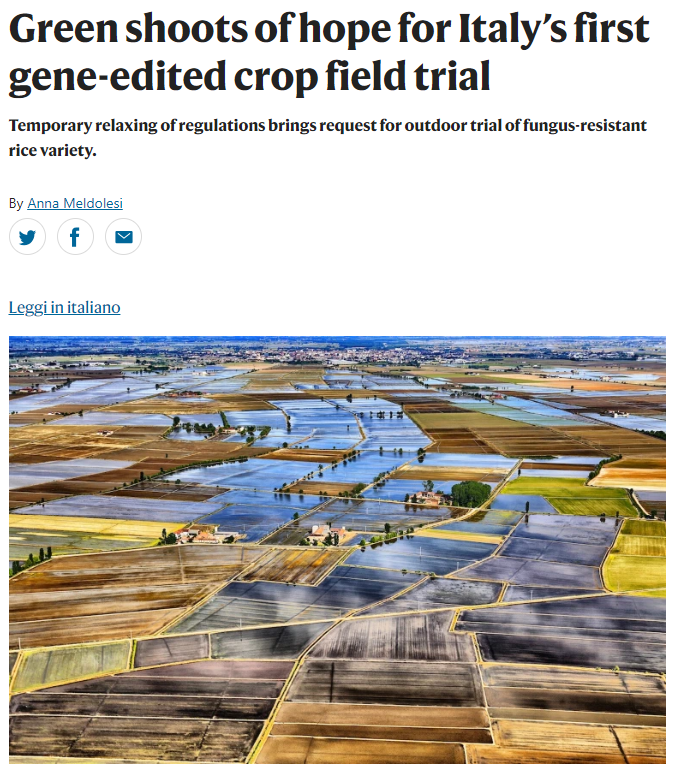
A CRISPR/Cas9-modified rice variety may be planted in a test field in northern Italy as soon as this spring after a government rule change introduced in 2023. A University of Milan team was the first research group in the country to apply for a field test under a law change that streamlines procedures for field trials of plants developed through genome editing or cisgenesis. With several other groups also planning proposals, a new wave of agricultural genetics in Italy could follow. [Please see the details in my article for Nature Italy]
In these times of climate crisis, biodiversity loss and renewed food insecurity, a scientific and evidence-based approach is essential in every respect. Now more than ever, we must rise above ideology and dogmatism. That is why we the undersigned turn to you and urge you to carefully consider the benefits of embracing New Genomic Techniques (NGTs) in your upcoming parliamentary decisions. As concerned citizens who believe in the power of science to improve our lives and our relationship with the planet, we implore you to vote in favour of NGTs, aligning your decisions with the advancements in scientific understanding. Conventional breeding for climate resilient crops (with cross-breeding of certain traits, subsequent selection and then backcrossing to remove undesirable traits) is too time-consuming. It takes years, decades even. We do not have this time in an era of climate emergency.
[Here you can read the full text of the letter and subscribe to it]
The New Genomic Techniques (NGTs) such as CRISPR are slowly rearranging the ranks in the debate on plant genetics and GM food. A few stakeholders that have always been hostile to GMOs have decided to open the door to the new opportunities coming from gene editing (in Italy, for example, the powerful farmers’ association Coldiretti has changed its mind). Others (e.g., Greenpeace, despite some isolated and courageous vanguards) have confirmed an ideological/cultural opposition, even in cases where the genetic intervention is so soft that the plants are concretely indistinguishable from those developed by conventional techniques. As for the galaxy of organic farming, it is standing still, yet something is moving. Don’t miss the article published in EUobserver by Lone Andersen and other organic farmers, who are calling on European institutions not to ban the new breeding techniques from their fields in the ongoing regulatory revision. “By encouraging the use of a limited share of the new NGTs in organic agriculture while preserving the non-GM status, the EU can further promote sustainable practices and reinforce its commitment to a greener future,” they write.
The news of the week is definitely this: the first clinical trial with base editing (the CRISPR platform used to chemically change single DNA letters without double-strand breaks) hit the goal of lowering cholesterol in patients but raised questions about the risks (with two serious adverse events, including one death), as Nature reports.
But we also recommend reading two other articles. Nature Biotechnology takes a look at experiments using CRISPR to eliminate viruses that manage to hide from the immune system, such as HIV and hepatitis. While Genetic Literacy Project publishes an analysis of the problems that could cripple the new regulation on edited plants proposed by the European Commission and delay (even until 2030) the arrival of the first products on the EU market.
The scientific community has warmly welcomed the proposal for partial deregulation of new genomic techniques put forward by the European Commission last July. Unfortunately, the legislative process will not be able to make significant progress before the next parliamentary term, which opens with the European elections in June 2024. However, this time will not be wasted if it serves to address a few problematic points and to finalise a few clarifying amendments. The devil is in the details: from the 20-nucleotide threshold proposed to delimit permissible interventions on the genome to the unknowns regarding coexistence with organic farming, not forgetting the stigma against herbicides. This article published in Nature Biotechnology by Belgian and German researchers is useful for going through the still unresolved issues.