
CRISPR & society, the dialogue resumes
Reply


Genome editing + optogenetics = very fast CRISPR (vfCRISPR). Two revolutionary techniques meet in the paper by Yang Liu and colleagues just published in Science. The Johns Hopkins University team developed a caged RNA strategy that allows Cas9 to bind DNA but needs light at wavelengths that are not phototoxic to activate cleavage. The cut is immediate upon light exposure, offering scientists a way to study DNA repair from its start. The process is so precise that one allele of a gene can be edited at a time, allowing the generation of heterozygous mutations for studying complex genetic traits. See also the perspective by Darpan Medhi and Maria Jasin in Science.

The DNA double helix as a metaphor for the relationship between genetics and SciFi – novels and movies on the one strand and scientific breakthroughs on the other strand. It’s courtesy of graduated student Kartik Lakshmi Rallapalli, who examines the science and fiction timelines in a post for the Addgene blog.
Continue readingFrom Meganucleases to Prime Editing, download the high resolution cards!
If you enjoyed “Bring me a gene” by Tim Blais and wished your friends “A Merry Little CRISPR”, be sure not to miss “The Patent” by Rob Nichols. It’s a parody of “Obedient Servant” from the musical Hamilton by Lin-Manuel Miranda, “based on the actual events of the CRISPR Revolutionary War”. For an IP update, please see this press-release announcing the 20th CRISPR patent awarded to UC Berkeley.

The new coronavirus spreading in China is one more reason to hear from the multi-talented geneticist how we could make our life virus-proof with DNA recoding and other exciting stuff coming from the Church Lab.
The Leapsmag video “Defeating nature’s deadliest killers with Harvard scientist George Church”
The CRISPR Journal podcast “George Church, triple threat (reader/writer/editor)”

CRISPR-pioneer Rodolphe Barrangou offers ten bold (and rosy) predictions for the next 12 months in his editorial for The CRISPR Journal. We fervently hope he is right! Please see our summary below.
Continue reading
The picture shows a moment in the sample-collecting effort leading to this Pnas paper about a novel heat-tolerant CRISPR enzyme called IgnaviCas9. Exploring nature’s molecular diversity in extreme environmental conditions such as Yellowstone hot springs can yield exciting discoveries and applications.
Continue reading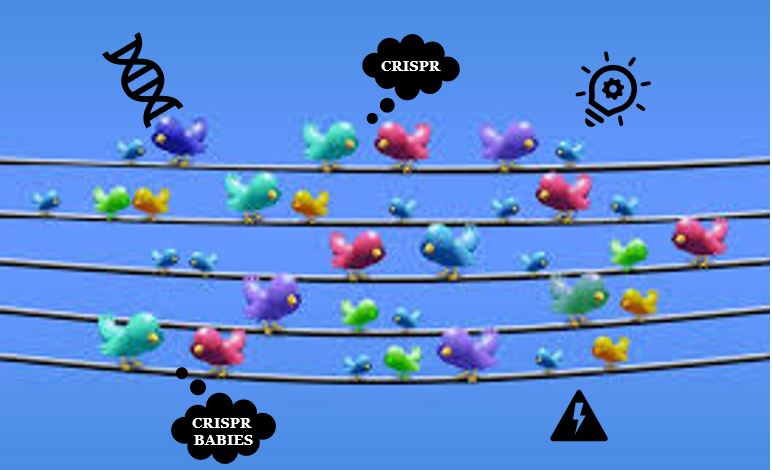
The analysis of tweets discussing CRISPR from 2013 to 2019 shows that public enthusiasm for genome editing has cooled a bit, and that’s physiological. As you can see below, a bioRxiv paper associates peaks of strong negative sentiments with specific events.
Continue reading



 CRISPeR FRENZY