CRISPR crops – Italy fires the starting gun

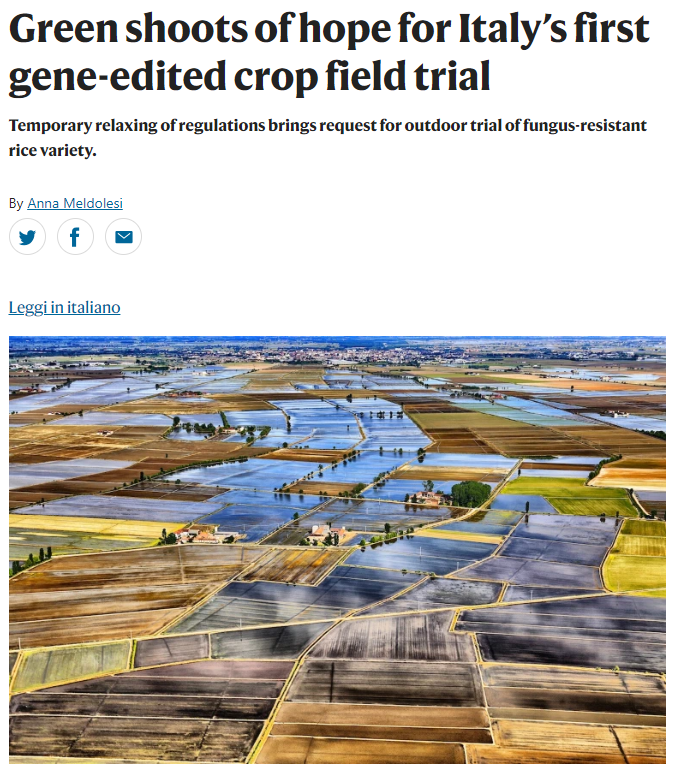
A CRISPR/Cas9-modified rice variety may be planted in a test field in northern Italy as soon as this spring after a government rule change introduced in 2023. A University of Milan team was the first research group in the country to apply for a field test under a law change that streamlines procedures for field trials of plants developed through genome editing or cisgenesis. With several other groups also planning proposals, a new wave of agricultural genetics in Italy could follow. [Please see the details in my article for Nature Italy]

A brief guide to the messy Italian debate on NGTs

There is great disorder under the heavens of new biotechnology. Judging by the Italian debate on genetic innovation in agriculture, it seems that we no longer know what to call what. We are waiting for the European Commission to present its proposal to regulate ‘new genomic techniques’ (NGTs) on 5 July (see the leaked draft here). But in the meantime, on 9 June, the Italian Parliament approved a regulation in favour of experimentation with ‘assisted evolution techniques’ (TEAs), which are the same thing. However, if you read the official wording (9 bis, drought decree law) this expression is missing: instead, it refers to the deliberate release into the environment for experimental purposes of ‘organisms produced by genome editing techniques through site-directed mutagenesis or by cisgenesis’.

Continue reading

Drought research – persist to resist

Beating the heat is one of the goals most vigorously pursued by plant geneticists. A solution is not yet in sight, but after so many years of research, it is clear that there are several avenues worth exploring. The three most important things are testing, testing, testing.
The first consideration is that plants can adopt different strategies to survive when water is scarce. You can distinguish between drought resistance and water use efficiency, or go subtle by talking about drought avoidance, drought escape, and drought tolerance.
Another basic premise is that drought can vary in intensity and duration, so that a plant capable of tolerating moderate stress may still succumb under more extreme conditions. Further complicating matters is the fact that, to be adopted by farmers, future crops will have to prove not only more resilient but also as productive as the varieties they are intended to replace. Two strategies are being pursued at the University of Milan with the help of CRISPR.

Continue reading

Meet the first CRISPR patients in Italy

Emanuele and Erika Guarini are brother and sister. They were treated for thalassemia respectively in November 2020 and August 2021 by the team of Franco Locatelli at Bambin Gesù hospital in Rome. Before the CRISPR-based treatment, they needed a blood transfusion every 15-20 days (source La Repubblica).

Editing grapevine in Italy

A vineyard in northeast Italy (from M. Morgante’s Ppt)

CRISPeR Frenzy is pleased to publish the full text of the presentation held on June 6 by Michele Morgante (Università degli Studi di Udine) at the Virtual Workshop on Innovative Biotechnologies and Regulatory Approaches organized by the US Embassy in Rome and USDA.

Continue reading

Field of CRISPR dreams in Italy

You may have heard of the recent European Commission report on the New Genomics Techniques. But you probably don’t know how member states answered the related questionnaire. ““Could NGT-related research bring opportunities/benefits to science, to society and to the agri-food, medicinal or industrial sector?”. This and more in my news feature for Nature Italy.

CRISPR & GMOs, vive la différence

What’s the right way to regulate edited-plants? The question still waits for an answer in Brussels, and debate goes on in Europe.

According to Reuters, France backs non-GMO regulation for crop gene-editing in the EU. Gene editing of crops and livestock may soon be permitted in England, says the Guardian. Parliamentary commissions divided on new breeding techniques, media report in Italy. For a comparative viewpoint of regulatory frameworks globally, see the recent “Genome editing for crop improvement” by All European Academies.

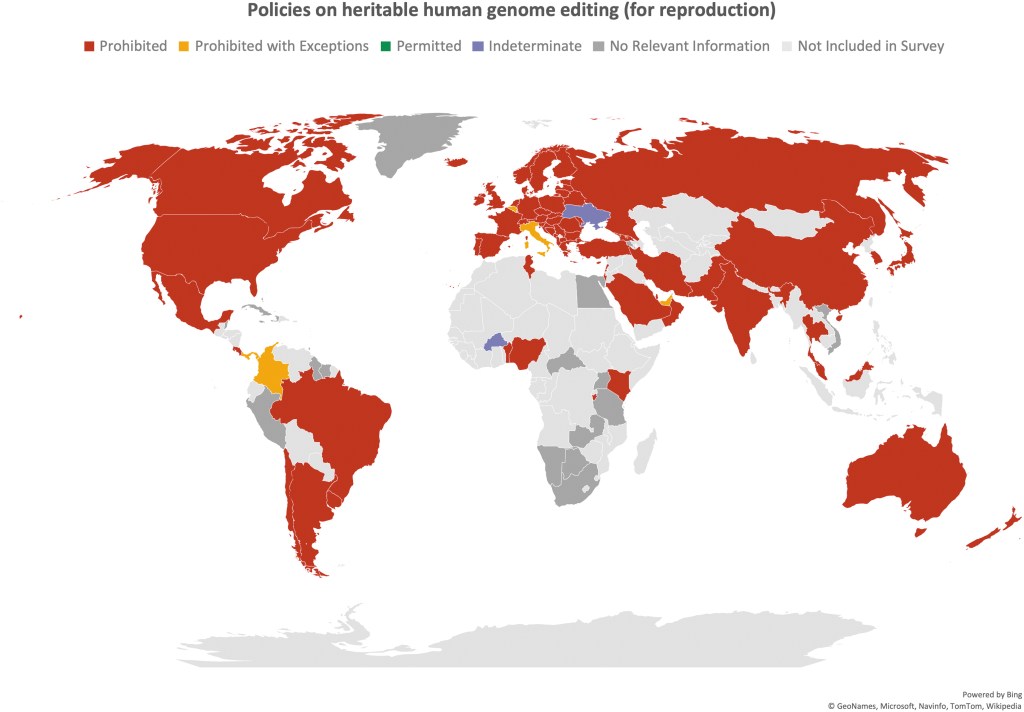
Italy is a yellow spot in the heritable editing map. Why?

Look at this map, from a detailed and up-to-date analysis published in the CRISPR Journal. It’s the global policy landscape on heritable human editing, i.e., modified embryos transferred to a uterus to initiate a pregnancy. Who would expect a catholic country like Italy to stand out as one of the very few countries not totally prohibiting such a controversial practice?

Continue reading

Italy to edit quality foods

spaghettiThe research institute CREA is experimenting with CRISPR to improve Italian typical products. The project called BIOTECH is funded with 6 million euros from the Italian ministry of agriculture. Wheat, tomatoes, vines, fruits and more are on the menu, as reported by me in a 6-pages feature published in Le Scienze, the national edition of Scientific American. Continue reading