Tired of illustrating articles and PowerPoint presentations on genome editing with the usual genetic scissors and Swiss Army knives? You might not know that the Innovative Genomics Institute, founded by CRISPR inventor Jennifer Doudna, offers images created by its graphic designers free of charge for educational and non-commercial use. Take a look at the Science × Art section of their website and their illustrated glossary.
Last May, the case of baby KJ made headlines: the child, suffering from a severe metabolic disorder, received a therapy developed specifically for him in just six months. The rapid improvement in his condition and his discharge from the hospital left the rare disease community with a pressing question: was this an unrepeatable one-off, or a replicable model of intervention? The right answer might be the latter, as demonstrated by the launch of the Center for Pediatric CRISPR Cures in California. This new center, to be led by Fyodor Urnov, begins with the mission of developing customized genome-editing treatments for eight young patients with congenital metabolic and immune system disorders.
The personalized editing therapy developed at record speed for the American newborn required preliminary studies, favorable circumstances, and a heroic collective effort.
After 307 days, little KJ Muldoon was discharged from the Children’s Hospital of Philadelphia (CHOP), wearing a tiny graduation outfit complete with a blue gown and cap. Born ten months ago with a severe metabolic disorder, the baby received a genome editing therapy developed exclusively for him, and his remarkable progress has been hailed by many as the dawn of a new era in precision medicine. A month after the publication of his case in the New England Journal of Medicine, we take a closer look at how researchers managed to develop the treatment in just six months—and whether this breakthrough could be replicated for other rare disease patients in need of life-saving therapies.
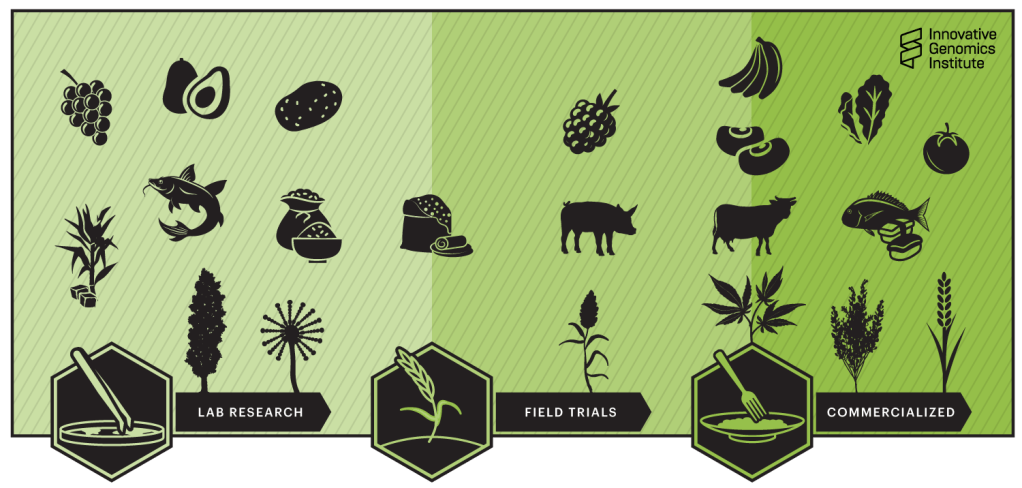
As 2025 starts, where does CRISPR stand in transforming agriculture? The Innovative Genomics Institute has provided a snapshot of the state of the art, and (despite the wait for new European regulations), things are moving forward. Let’s take a closer look.
CRISPRpedia is an online encyclopedia on CRISPR developed by the Innovative Genomics Institute. A new chapter, devoted entirely to the bioethics of gene editing, has recently been added to existing sections on CRISPR in nature, CRISPR technology, applications in medicine, and applications in agriculture. The ability to edit the genomes of people, embryos, plants and animals raises both old and new questions. How do we decide what uses are legitimate and desirable? Who gets to make these decisions? How can we ensure safety and fair access? Answers to these and other pressing questions have been compiled by UC Berkeley bioethicist Jodi Halpern, in collaboration with communications strategist Hope Henderson. Check it out!
We repost a video produced by the Innovative Genomics Institute on an ambitious line of research: editing the genomes of methane-producing microbes in cows to fight climate change
The recent approval of Casgevy represents the first official success of gene editing-based therapies. The treatment for sickle cell anemia and thalassemia came in record time, only 11 years after CRISPR was invented. “Two diseases down, 5,000 to go,” commented Fyodor Urnov, Director of Technology & Translation at the Innovative Genomics Institute. Among the many diseases awaiting a cure, what will be the next to benefit from CRISPR? At what rate can we expect new treatments to arrive? The periodic update published by IGI is a must-read to navigate through hope and hype, papers and press-releases. The picture is overwhelmingly positive, but there is also some cause for disappointment. Here is an excerpt from the introduction:
The Innovative Genomics Institute runs a program aiming to “supercharge plants and soils to remove carbon from the atmosphere” with the help of CRISPR and funding from the Chan Zuckerberg Iniziative. I asked Andy Murdock, communications director at IGI, three questions to update the picture. Please see his answers below.






 CRISPeR FRENZY