CRISPR contributed to Science’s Breakthrough of the Year and was also nominated for the Breakdown category by the same journal. The second nomination was an easy guess: He Jiankui and its baby-editing claim were also mentioned in Nature’s 10 for 2018. Much more interesting is the decision to celebrate cell-barcoding, the CRISPR-based technique used to track embryo development in stunning detail and over time. Continue reading
CRISPR babies, not so breaking news?

Never at the top of front pages (Nyt, 27 Nov. 2018)
Twenty days after the announcement, many questions remain. The one certainty seems to be that the first CRISPR babies are less breaking news than expected.
They will be in front pages again, probably, if and when the scientific paper gets published, if and when the baby-editor He Jiankui resurfaces, if and when the first photos of Lulu and Nana are circulated. But if the coverage of Dolly the sheep is considered in comparison, there’s no match. Why?
The media world has changed dramatically in the meantime, CRISPR is still unknown to many, China is perceived as a Wild East where anything can happen. But a sheep is always a sheep, and babies are babies. We should care about the first edited kids more than that. Maybe people are less troubled by human genome editing than most bioethicists. Perhaps the media have had enough of Gattaca, Frankenstein, and the likes. Did we cry wolf too often yesterday to get people interested today?
CRISPR seeds: the asexual revolution is now

Imtiyaz Khanday (left), Venkatesan Sundaresan (right) with their apomictic rice (credit: KARIN HIGGINS/UC DAVIS)
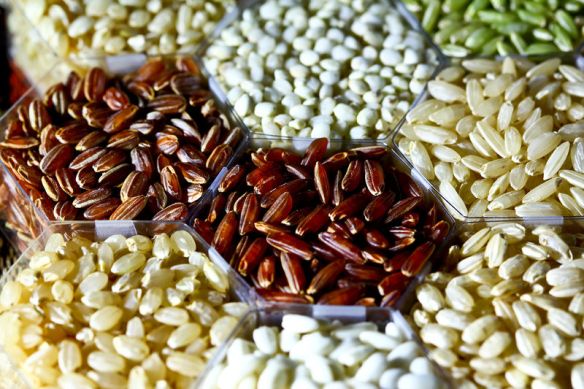
“To make a seed it takes a fruit,” pupils use to sing in Italy. Then students learn that there is an embryo inside seeds and it takes a pollen fertilized egg to make it. The dream of plant scientists, however, has always been to be able to produce seeds using only the cell egg. This dream has finally come true: a group led by Venkatesan Sundaresan, at UC Davis, has developed a rice variety capable of cloning its seed. Continue reading
Milan toasts with biotech wine

Assobiotec tasting event in Milan (photo credit: Marco Marazza)
When toasting during Christmas holidays, perhaps with a glass of Italian sparkling prosecco, think about it: viticulture in Europe occupies 3% of the cultivated area, but it accounts for 65% of all fungicides employed in agriculture. The adoption of new wine grape varieties resistant to powdery and downy mildew could significantly cut chemical use. If fairly regulated, advanced biotech tools such as CRISPR could help sustainability without losing anything of the genetic identity of iconic varieties. Continue reading
He Jiankui’s talk in Hong Kong

Here is the link for the streaming, from 1:08
He’s version

Don’t miss the “Draft Ethical Principles for Therapeutic Assisted Reproductive Technologies” just published by He Jiankui et al. in The CRISPR Journal. It seems the Lulu and Nana’s experiment is at odds even with their own guidelines. We are eager to hear more from He’s voice, his talk in Hong Kong is scheduled on Wednesday, 28 November 2018 (Second International Summit on Human Genome Editing-live broadcast)
CRISPR rice vs GM rice: which would you buy?
Just imagine you could find them all on the supermarket shelves, would you buy rice labeled as CRISPR or GMO, or stick to conventional non-genetically modified rice? And what price would you consider fair? Aaron Shew and colleagues from the University of Arkansas conducted a multi-country assessment of willingness-to-pay for and willingness-to-consume a hypothetical CRISPR-produced food and published their findings in Global Food Security. Continue reading
EU science advisors on CRISPR and GMOs
The European Commission’s Group of Chief Scientific Advisors has published a statement on gene editing and the GMO directive, following the controversial judgment released last July by the EU Court of Justice. They state that new scientific knowledge and recent technical developments made Directive 2001/18 “no longer fit for purpose.” Therefore “there is a need to improve EU GMO legislation to be clear, evidence-based, implementable, proportionate and flexible.” The document was welcomed by Carlos Moedas, Commissioner for Research, Science and Innovation, and Vytenis Andriukaitis, Commissioner for Health and Food Safety. Let’s hope actions will follow, and laws keep up with labs.

CRISPR meets machine learning

credit McKylan Mullins
If a donor template is not provided when CRISPR cuts the DNA, broken ends are fixed by natural repairing mechanisms in a way that is considered stochastic and heterogeneous. This makes template-free editing impractical beyond gene disruption, right? Wrong, according to a study published in Nature by Richard Sherwood and colleagues. Continue reading
CRISPR, that old dress and what Art is
BioArt is entering the genome-editing era. The first CRISPR artwork is a World War II dress, patched with silk and bacteria by British bioartist Anna Dumitriu. You can read more about its science and meaning in the CRISPR Journal and Labiotech. But where does the dress come from? And if this is art indeed, what about the galloping horse CRISPRed by George Church last year? I asked Dumitriu, please find the answers below. Continue reading