The best TED talks about gene editing, selected by The Bench blog

The best TED talks about gene editing, selected by The Bench blog


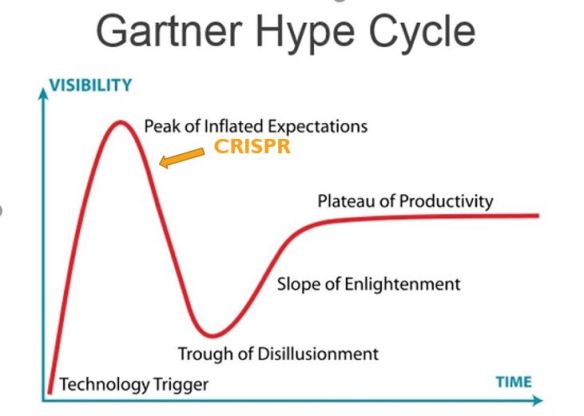
Content analysis of the articles published in North America from 2012 to 2017 shows, overall, a strong promotion of CRISPR. See the paper by Alessandro Marcon et al. in Genetics in Medicine.

Researchers from Penn Medicine and Children’s Hospital of Philadelphia have fixed a lethal mutation in the prenatal mouse models of a rare pulmonary disease. The hope is that the approach of in utero editing described in Science Translational Medicine will work for other congenital lung diseases as well.
I asked one of the corresponding authors, Edward Morrison, scientific director of the Penn’s Institute for Regenerative Medicine, to explain what they have done and what to expect next. See Q&A below. Continue reading
If you know the enemy and know yourself, you need not fear the result of a hundred battles. The military strategist Sun Tzu wrote it over two thousand years ago, but this quote could also apply to oncology research in the CRISPR era. Identifying the weak points of cancer cells is the first step to hit new molecular targets with the next generation of drugs.
The good news is that the Wellcome Sanger Institute has taken a giant leap toward this goal, drawing up a list of 600 candidate genes. The study just published in Nature by Mathew Garnett’s team comes with a twin paper by the Broad Institute, confirming the results by following an alternative approach. In a four-year tour de force of functional genomics, Sanger’s researchers used CRISPR to disrupt every gene in over 300 cancer models from 30 cancer types. From this amount of data, they developed a prioritization system which will guide big pharma’s hunt for new drugs.
“Wow! Badass. 13,200 crispr base edits in a single cell! On the way to ‘recoded’ human cells,” tweeted Antonio Regalado before covering the news in MIT Technology Review. To be honest, the radical redesign of species is still sci-fi dystopia, but the paper preprinted by Cory J. Smith et al. in bioRxiv is impressive anyway. Continue reading
Do you remember the alarm about the cancer risks of CRISPR? According to a study published in Cell Stem Cell by Italian researchers, the DNA-damage response is not such a big problem in edited cells. At least not in hematopoietic stem cells edited with highly specific nucleases. Continue reading
Edited animals are in the news this week. Wired dedicates its cover story to “A more human livestock industry, brought to you by CRISPR,” focusing on experiments being done at the University of California, Davis. Alison Van Eenennaam is trying to alter sexual traits in cattle by targeting a single gene called SRY. The science is still difficult, however, and US regulations uncertain. Continue reading
Where is Jennifer Doudna? This is the first thought most journalists had – me included – when reading the list of signatories to the call for the moratorium on heritable genome editing just published by Nature. The Boston team is well represented by Lander, Zhang and Liu (nobody would expect George Church to join that call). But the magnificent couple Doudna-Charpentier has conspicuously split up. Continue reading
Pollination is a natural way to deliver DNA into plant cells. So why not to use pollen as a vehicle for CRISPR machinery to start genome editing? HI Edit, as this approach is called, has been successfully tested by Syngenta in corn, Arabidopsis and wheat in the lab. Please see the paper just published in Nature Biotechnology by Timothy Kelliher et al., Jon Cohen’s piece in Science, and a quick guide to HI (haploid induction) from Current Biology. Leading wheat geneticist Cristobal Uauy of the John Innes Centre also showed high spirit, when asked for comment by email: “The possibility to genome edit any variety is revolutionary given that transformation is so difficult in many species. If I understand this correctly this would be a game changer as it would allow us to alter genes in elite cultivars.”