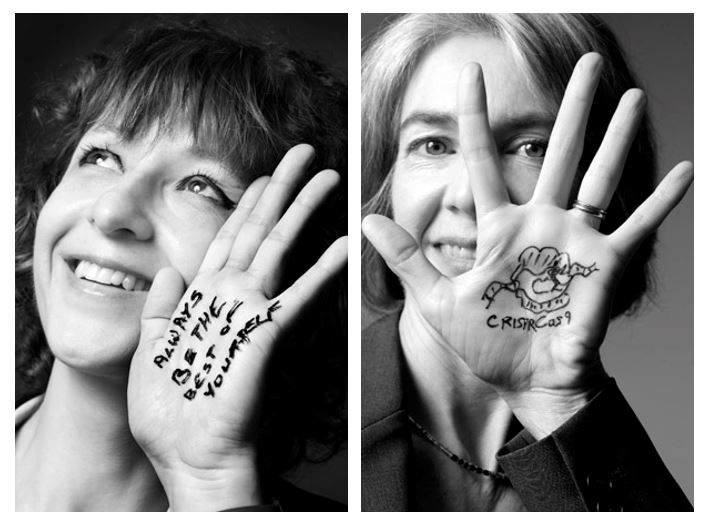
CRISPR inventors Emmanuelle Charpentier and Jennifer Doudna, portrayed by Herlinde Koelbl for the book Fascination of Science, which the photographer (famous for her work on Angela Merkel) dedicated to leading scientists. The photos, currently on display at the Koch Institute, capture “the connection between the personal & the pursuit of knowledge—between mind & hand—of pioneering scientists across the globe.”
A few months ago Nature Geneticspublished an article on “Genome-edited crops for improved food security of smallholder farmers”. It lists the applications being studied at the CGIAR consortium of agricultural research centers: “climate resilience in rice; disease resistance in banana, maize, potato, rice, wheat and yam; and nutrition improvement and consumer and environmental safety traits in cassava”. Additional traits include “brown streak virus resistance and haploid induction in cassava; nutritional quality and digestibility in bean; Striga resistance in sorghum; low phytate and high provitamin A in maize; reduced acrylamide, phytate and polyphenol oxidase in wheat; reduced aflatoxin in groundnut; delayed flour rancidity in pearl millet; reduced glycaemic index and apomixis in rice; and heat tolerance and apomixis in potato”. We emailed the CIMMYT’s scientist who leads theGenetic Resources work and is the first author of the NatGen article for an updated comment about the CGIAR’s vision of genome editing in agriculture.Kevin V. Pixleyanswers our questions below.
How long will we have to wait for the first wheat varieties genetically edited to resist drought? We asked geneticists gathered in Bologna to discuss the future of pasta.
The climate crisis threatens the grain that feeds the world. If you think this is an exaggeration, think again. Wheat scientists expect a 6-7% decline in yield for every degree increase in temperature. This a decrease we cannot take lightly, knowing that wheat is the most widely grown cereal in the world and provides two and a half billion people with 20 percent of their carbohydrates and protein.
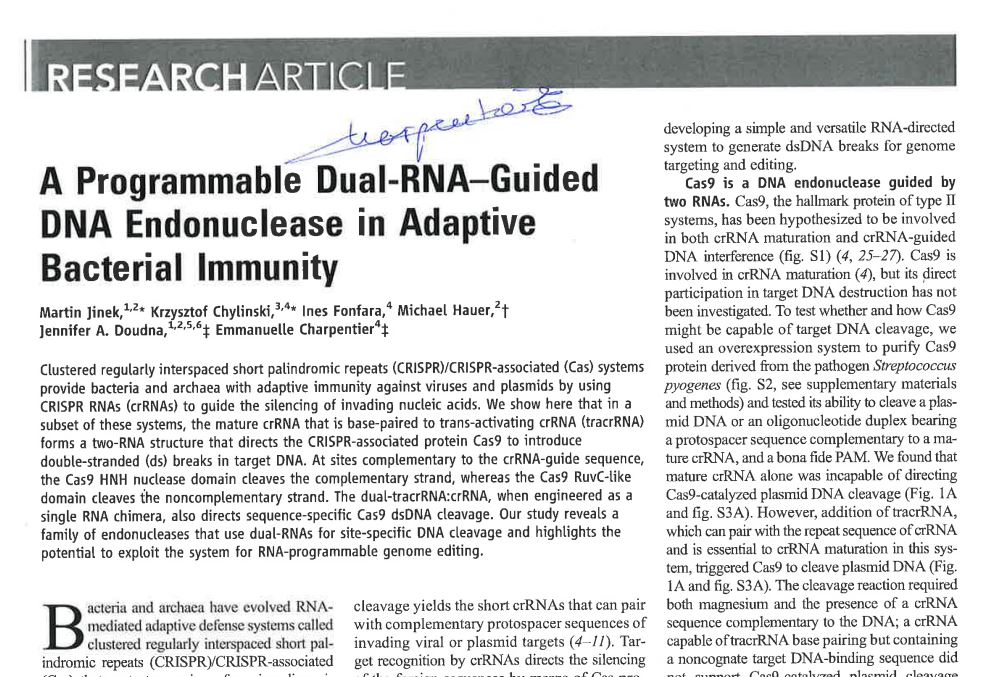
Here is my little haul from Vico Equense, where I coordinated Emmanuelle Charpentier’s award ceremony: the founding paper in Science and the most iconic cover of Nature, both autographed by the French side of CRISPR. Will I ever get the signature of the other half, Jennifer Doudna?
A timely update on durum wheat multidisciplinary research (and genome editing projects) towards a more sustainable and resilient durum wheat chain capable of enhancing food security while providing more nutritious grain and a healthier diet. See you in Bologna next week!
Pictured in the cake photo in order: Carla Ferreri, Anna Meldolesi, Enrico Alleva, CRISPR inventor Emmanuelle Charpentier and Umberto Celentano of the Capo d’Orlando Prize, awarded in Vico Equense on October 7, 2022.
Today is World CRISPR Day, let’s feel a bit of genomic vertigo by exploring CRISPR’s orders of magnitude with the help of the CRISPR Journal. The latest editorial (“Extreme Genome Editing”) goes from micro to macro, from phages to forests. Let’s give some numbers.
The size of edits spans from a single nucleotide to the removal of genomic islands greater than 100 kb (almost six orders of magnitude). The size of edited organisms varies between 10−7 m for submicroscopic viruses to over 10 m for trees (more than eight orders of magnitude). The range of genomes is tens of kilobases to tens of gigabases (seven orders of magnitude).
“Some of these theoretical combinations thus reach frightening orders of magnitude, from the modification of a single base in a 30 kb bacteriophage administered in a single 1 ml dose to 1 kb inserted in a 30 Gb tree genome scaled up to 100,000 hectares of a commercial forest” (here is the full text for more enjoyment of CRISPR vertigo).
The classic CRISPR system cuts DNA. Other variants cleave RNA. But now in the toolbox of new biotechnologies may come a tool that targets proteins: a CRISPR-driven caspase, already dubbed Craspase. What remains constant is that all these tools are programmable, thanks to the guide molecule that recognizes the desired target and directs the scissors there for editing. They are not paper shredders, rather they act like scalpels.
On April 29, the European Commission launched an online public consultation on whether the EU regulatory framework should be reformed to keep pace with scientific and technological advances. The results, released on the consultation website, show a clear majority in favor of rethinking the current rules, which were approved when New Genomic Techniques (NGTs) such as targeted mutagenesis (i.e., CRISPR) did not yet exist. Here are the highlights:
Rodger Novak is the president of CRISPR Therapeutics, a company he co-founded with Emmanuelle Charpentier in 2013. Jennifer Doudna was invited to join but declined.
The road from clinical trials to regulatory green light now appears to be downhill for the treatment for sickle cell anemia developed by CRISPR Therapeutics, the company co-founded by Emmanuelle Charpentier. We knew it as CTX001 but it has changed its name to exa-cel (which stands for exagamglogene autotemcel). It was one of the first CRISPR-based gene therapies to enter clinical trials, in 2019. It changed the lives of Victoria Gray and dozens of sickle cell anemia and thalassemia patients enrolled in several countries. Now it also leads the way in the late stage of the regulatory process, both in Europe and the United States, and could come to market first, in 2023. For more information see the press-release by Vertex, that collaborates at exa-cel manufacturing, regulatory and commercialization.





 CRISPeR FRENZY