Agricultural Sciences: Yesterday, Today, and Tomorrow

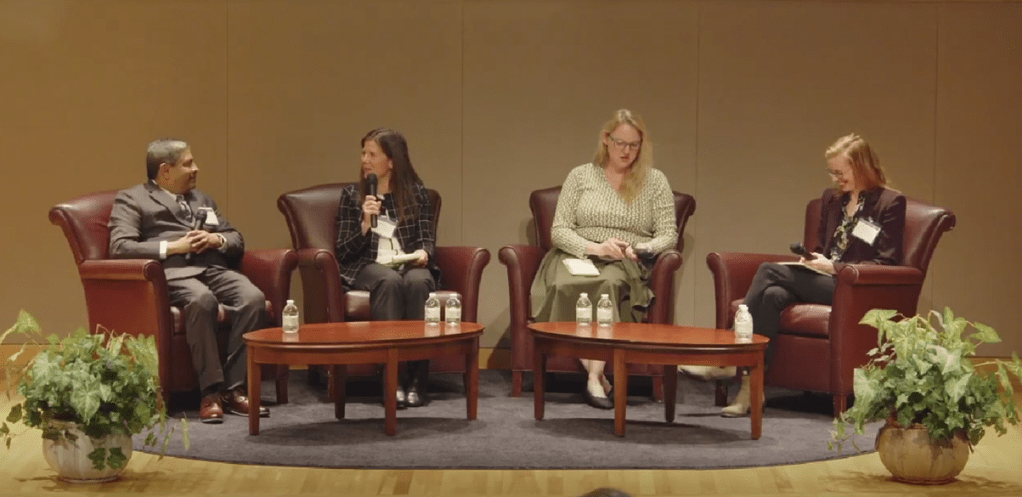
Charles Valentine Memorial Lecture, 20 Nov. 2024 (C.S. Prakash, Lisa Ainsworth, Anastasia Bodnar, and Kate Tully)

I want to highlight a lecture recently given by one of the most influential scientists in the international debate on GMOs and gene editing in agriculture. Born in India, C. S. Prakash lives and works in the U.S. and has been elected a fellow of the American Association for the Advancement of Science (AAAS). His lecture, delivered at the AAAS Center for Scientific Evidence in Public Issues, traces the progress made over the past sixty years in the field of global food security—i.e., meeting the growing demand for food from the world’s population.

Continue reading

CRISPR in Trump’s time

A wait-and-see atmosphere lingers in the biotech and pharma sector. Vice President-designate J.D. Vance recently spoke with enthusiasm on Joe Rogan’s podcast about the first CRISPR treatment to hit the market—the one for sickle cell anemia. However, there’s rising concern about RFK Jr., who could exert significant influence over health and food policies. His broad “natural = good” ideology is both philosophically and scientifically dubious, and his clear anti-GMO positions are worrisome. Listening to his conversation with anti-biotech activist Jeffrey Smith on the RFK Jr. podcast reveals a revival of the classic 1990s narrative—corporations as villains, a corrupt establishment, suppressed scientists, concealed health risks—all now repurposed to criticize CRISPR technology, which is portrayed as unreliable and uncontrollable.

Where ag genetics goes (in Italy and beyond)

Four intense days of talks and discussions on the present and future of agricultural genetics. We will be there at the round table “Social impact of plant biotechnologies: challenges and opportunities” (12 September afternoon). See the full program here.

Will edited foods appeal to consumers?

While the number of studies on this topic is limited, they generally align in indicating that genome-edited plants are more appealing to the public than GMOs. Supporting this assertion is an analysis set to be published in the June issue of Current Opinion in Biotechnology. Hans De Steur and his colleagues at the University of Ghent in Belgium conducted a review of data collected from various countries worldwide, including Europe, Asia, and the Americas.

Continue reading

A brief guide to the messy Italian debate on NGTs

There is great disorder under the heavens of new biotechnology. Judging by the Italian debate on genetic innovation in agriculture, it seems that we no longer know what to call what. We are waiting for the European Commission to present its proposal to regulate ‘new genomic techniques’ (NGTs) on 5 July (see the leaked draft here). But in the meantime, on 9 June, the Italian Parliament approved a regulation in favour of experimentation with ‘assisted evolution techniques’ (TEAs), which are the same thing. However, if you read the official wording (9 bis, drought decree law) this expression is missing: instead, it refers to the deliberate release into the environment for experimental purposes of ‘organisms produced by genome editing techniques through site-directed mutagenesis or by cisgenesis’.

Continue reading

Heritable Editing: Yes or No?

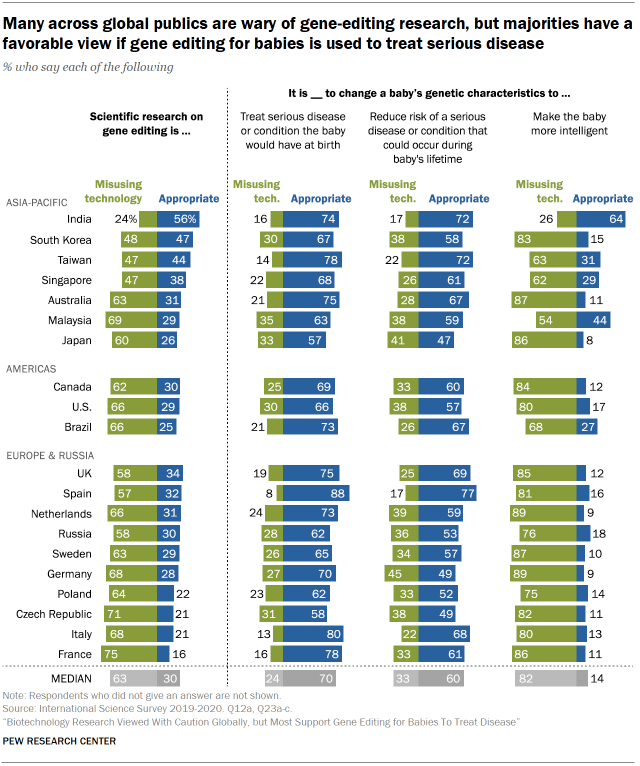
According to the survey conducted by Pew Research Center in 20 countries, people are positive about gene-editing if used to treat illnesses a baby would have at birth (support is particularly strong in Spain). People are also generally in favor of using human gene editing to reduce the risk of future health problems, but less so. India is the only country where the majority says the possibility of using human gene editing to make a baby more intelligent is also acceptable. See more data here.

A bold proposal and a cautious report

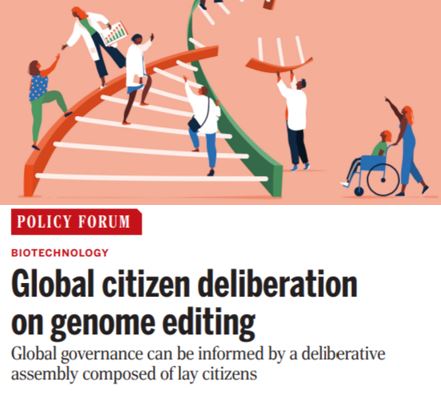
Let’s imagine a hundred or more citizens from all over the globe, selected to partecipate in a giant focus group aiming to represent world views. It would be an unprecedented social experiment, that’s for sure, but the call is worth considering. The bold proposal comes from a group of social scientists and a few geneticists (George Church included) writing today in Science. Fascinating as it is, this kind of assembly is probably easier said than done. However, the main problem, in my opinion, comes next: what should experts and politicians do with the assembly’s deliberations?

Continue reading

CRISPR & society, the dialogue resumes

CRISPRcon returns with a series of discussions exploring gene editing’s role in COVID-19 testing and treatment, racial disparities, strategies to address climate change, and more. The panel on gene editing and journalism opens the event, that is free and 100% virtual, on Sept 1. Speakers: Tamar Haspel (Washington Post Columnist), Antonio Regalado (Senior Editor for Biomedicine, MIT Technology Review), Elliot Kirschner (Executive Producer, Human Nature and the Wonder Collaborative). Moderator: Ting Wu (Professor of Genetics, Harvard Medical School).