A selection of news we missed during August. Reuters reports on the controversy surrounding horses edited by Kheiron Biotech to enhance their muscles. In Argentina, veterinary reproductive technologies are cutting-edge, and the use of cloning in horse breeding is accepted. Still, for now, genetically edited animals are not allowed to compete in polo.
Food for Thought is a coalition of 18 Italian associations in the agrifood sector, established in 2017 to promote innovation in agriculture. Today, nearly eight years after the first manifesto, a new one has been presented to address the challenges of both the present and the future, including the climate crisis, geopolitical tensions, and changing consumption patterns. The event was held yesterday in Rome at the initiative of Senator Bartolomeo Amidei, as part of the activities of the Parliamentary Intergroup on Made in Italy and Innovation. Among the key points is the inclusion of New Genomic Techniques — a clear sign that there is widespread awareness within the Italian productive sector of the importance of genetic improvement, and that there are voices in the national Parliament willing to advocate for “innovative and sustainable agriculture.”
A year after the European Parliament voted to ban patents, EU countries still seek a compromise on NGT regulation
The revision of the regulatory framework for genetically modified plants currently underway in Europe aims to keep pace with technological advances and support the development of sustainable agriculture. The scientific community, the seed industry, and major farmers’ associations view the overall framework positively, but the devil is still in the details.
Can you never remember all seven of Snow White’s dwarfs? Then try the seven traits studied in peas by Mendel. Smooth or wrinkled seeds, yellow or green seeds, white or purple flowers… I used to stop there until I read about the latest study in Nature. Joining forces, the John Innes Centre in Norwich, UK, and the Institute of Agricultural Genomics in Shenzhen, China, have identified Mendel’s remaining genes—solving a conundrum in the history of science and laying the groundwork for a leap forward in the genetic improvement of a food crop that is nutritious but too often overlooked by geneticists.
Comparing commonly grown species and native varieties is a winning strategy for making the former more resilient and the latter more productive.
You all know tomatoes and potatoes. African eggplants, maybe not—but when ripe, they turn red just like tomatoes. The lulo, for its part, is an orange fruit with citrusy notes, which is why in Ecuador it’s called naranjilla, or “little orange.” The Andean pepino, on the other hand, has juicy flesh that makes it resemble a melon. Their sizes, colors, and flavors may vary, but all of these plants belong to the same taxonomic group. In fact, they represent some of the species sequenced to produce a remarkable collection of related genomes—remarkable because it aims to span the entire Solanum genus.
Charles Valentine Memorial Lecture, 20 Nov. 2024 (C.S. Prakash, Lisa Ainsworth, Anastasia Bodnar, and Kate Tully)
I want to highlight a lecture recently given by one of the most influential scientists in the international debate on GMOs and gene editing in agriculture. Born in India, C. S. Prakash lives and works in the U.S. and has been elected a fellow of the American Association for the Advancement of Science (AAAS). His lecture, delivered at the AAAS Center for Scientific Evidence in Public Issues, traces the progress made over the past sixty years in the field of global food security—i.e., meeting the growing demand for food from the world’s population.
On the night of February 12-13, unknown vandals broke into a small experimental vineyard at the University of Verona in northern Italy to uproot Chardonnay vines that had been gene-edited to resist a fungal infection. Last September, the launch of this field trial was celebrated by researchers, producers, and prominent politicians—including Agriculture Minister Francesco Lollobrigida—because it was a point of pride for the country (the first field with gene-edited vines in Europe) and a step toward healthier, more sustainable viticulture, less reliant on fungicides. Anti-science belligerence strikes again: two experimental fields have been launched in Italy, and both have been attacked.
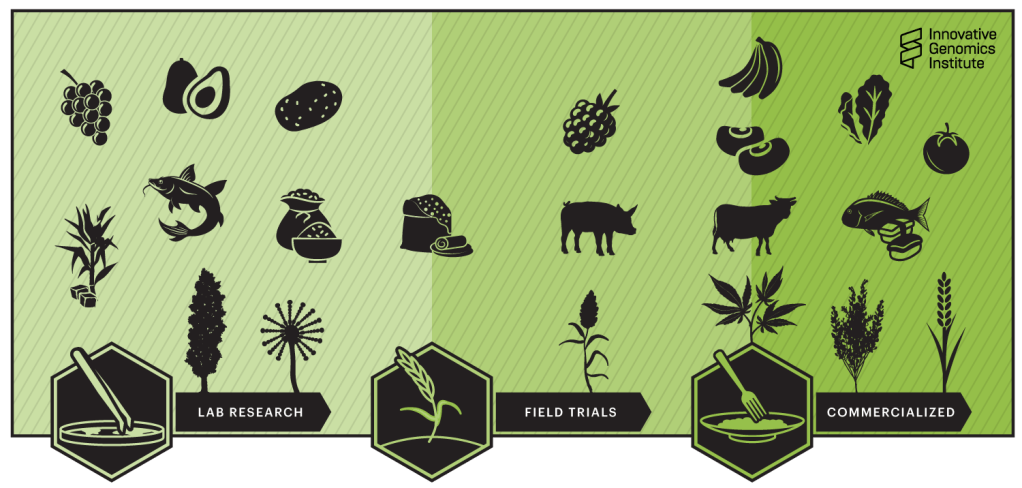
As 2025 starts, where does CRISPR stand in transforming agriculture? The Innovative Genomics Institute has provided a snapshot of the state of the art, and (despite the wait for new European regulations), things are moving forward. Let’s take a closer look.
Before the advent of genome editing and GMOs, mutagenesis was achieved through radiation. This technique was also used to modify varieties of durum wheat, which, through crossbreeding, contributed to the production of pasta consumed in Italy (see this old statement made by Norberto Pogna to Nature Biotechnology). The term “atomic spaghetti” is sometimes invoked in debates on agricultural biotechnology to highlight how modern techniques are vastly more precise than those of the past. However, few people are aware of the full complexity of this story.
Italy has long been one of the most hostile countries toward GMOs, to the point of shutting down research in this field. Today, however, it stands among the most active EU members in testing New Genomic Techniques. How did this transformation happen? EMBO Reports features insights from some of the Italian scientists who have championed the defense of GMOs and the revival of experimental fields. Happy reading!