Climate friendly livestock? Let’s try microbiome editing
Reply

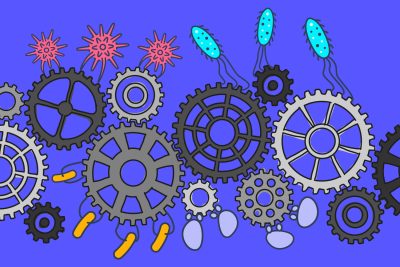
Jennifer Doudna’s Innovative Genomic Institute has received $70 million to explore a bold idea: combating climate change and other emergencies by modifying the microbial communities that live outside and inside us.
Bacteria are the true masters of the planet, for better or worse. Besides affecting our health in many ways, they are responsible for much of the methane emissions. This gas traps heat far more than carbon dioxide and is produced in large quantities by microbes that proliferate in environments associated with human activities (farms, landfills, rice paddies). The good news is that methane is short-lived, so reducing its emissions would have a rapid and substantial effect on global warming. What tools do we have at our disposal to try to pursue such an ambitious goal?
Continue reading
The Innovative Genomics Institute runs a program aiming to “supercharge plants and soils to remove carbon from the atmosphere” with the help of CRISPR and funding from the Chan Zuckerberg Iniziative. I asked Andy Murdock, communications director at IGI, three questions to update the picture. Please see his answers below.
Continue reading
How long will we have to wait for the first wheat varieties genetically edited to resist drought? We asked geneticists gathered in Bologna to discuss the future of pasta.
The climate crisis threatens the grain that feeds the world. If you think this is an exaggeration, think again. Wheat scientists expect a 6-7% decline in yield for every degree increase in temperature. This a decrease we cannot take lightly, knowing that wheat is the most widely grown cereal in the world and provides two and a half billion people with 20 percent of their carbohydrates and protein.
Continue reading
This week’s suggested reading is the paper “EU policy must change to reflect the potential of gene editing for addressing climate change” by Sarah Garland published in Global Food Security. Garland’s article is a welcome addition to the debate and also a suggestion on how to get out with the impasse of the European Court of Justice ruling on genome editing. Here are a few excerpts:
Continue reading
Danielle Nierenberg is President of Food Tank and an influential voice on food issues. She interviewed hundreds and hundreds of farmers, researchers, government leaders, NGOs and journalists in 50 plus countries in sub-Saharan Africa, Asia, and Latin America over the last several years. We asked her three questions for an article on sustainable innovations to be published in Italy.
Continue reading CRISPR gets a mention in the latest IPCC report as a potentially useful tool to cope with climate change. However, some people believe that biotech crops are safe and that climate change is not real (let’s call them libertarian capitalists, for convenience). Many ecological activists conversely think that genetically modified plants are evil and global warming threatens life on the planet. These stances could not be more different, yet they have something in common: they are both half right and half wrong. They are both examples of “selective science denial.” Continue reading
 CRISPeR FRENZY