The fence bounds twenty-eight square meters of bare land in the middle of the Lombard countryside. Inside it a dozen researchers from the University of Milan are busy. The laptop resting on the ground shows the layout of the plots. A meter is unrolled to mark the coordinates on the ground. Yellow tags are ready to be stuck into the clods: the inscription TEA (the Italian equivalent of New Genomic Techniques is “Assisted Evolution Techniques”) is used to mark rice that has been genetically edited for resistance to a fungal disease (rice blast), while the abbreviation WT indicates wild-type plants, which have not been modified and serve as a control group.
Continue readingTag Archives: rice
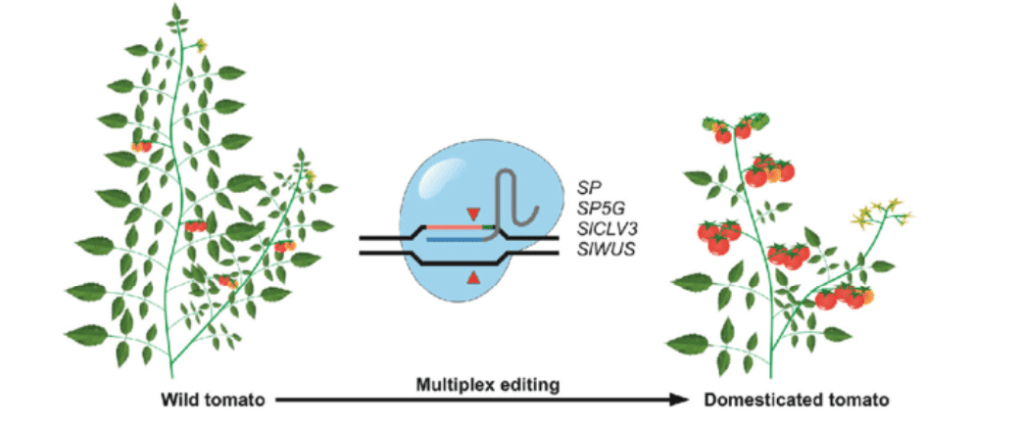
Domesticaton in the CRISPR era

The world’s food supply depends on about 150 plant species, but this number could increase, even considerably. In fact, 250 species are considered to be fully domesticated, while 7,000 are semi-domesticated and 50,000 are edible. In the genomic era domestication may not require centuries and millennia, as was the case in the early days of agriculture. The process could happen at an accelerated pace, within a few years, taking advantage of modern knowledge about useful traits and new tecnologies such as gene editing.
Continue readingCRISPR seeds: the asexual revolution is now

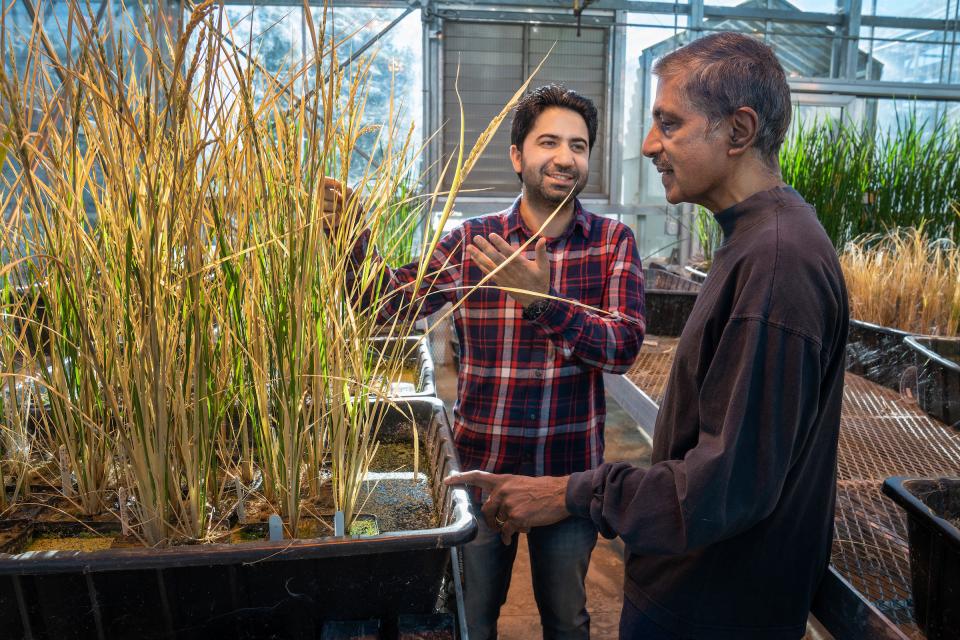
Imtiyaz Khanday (left), Venkatesan Sundaresan (right) with their apomictic rice (credit: KARIN HIGGINS/UC DAVIS)
“To make a seed it takes a fruit,” pupils use to sing in Italy. Then students learn that there is an embryo inside seeds and it takes a pollen fertilized egg to make it. The dream of plant scientists, however, has always been to be able to produce seeds using only the cell egg. This dream has finally come true: a group led by Venkatesan Sundaresan, at UC Davis, has developed a rice variety capable of cloning its seed. Continue reading