Italian Food for Thought

Food for Thought is a coalition of 18 Italian associations in the agrifood sector, established in 2017 to promote innovation in agriculture. Today, nearly eight years after the first manifesto, a new one has been presented to address the challenges of both the present and the future, including the climate crisis, geopolitical tensions, and changing consumption patterns.
The event was held yesterday in Rome at the initiative of Senator Bartolomeo Amidei, as part of the activities of the Parliamentary Intergroup on Made in Italy and Innovation.
Among the key points is the inclusion of New Genomic Techniques — a clear sign that there is widespread awareness within the Italian productive sector of the importance of genetic improvement, and that there are voices in the national Parliament willing to advocate for “innovative and sustainable agriculture.”

First CRISPR treatments in Italy

Italy has begun administering the first CRISPR-based treatment. The therapy for sickle cell disease and beta thalassemia (Casgevy) has already been delivered to four patients across three clinical centers within a month. The announcement was made during the conference “Italian Primacy in the Treatment of Hemoglobinopathies” held yesterday at the Senate.
For more information, we recommend Francesca Ceradini’s article in Osservatorio Terapie Avanzate.

Eco-vandals target gene-edited Chardonnay in Italy

On the night of February 12-13, unknown vandals broke into a small experimental vineyard at the University of Verona in northern Italy to uproot Chardonnay vines that had been gene-edited to resist a fungal infection. Last September, the launch of this field trial was celebrated by researchers, producers, and prominent politicians—including Agriculture Minister Francesco Lollobrigida—because it was a point of pride for the country (the first field with gene-edited vines in Europe) and a step toward healthier, more sustainable viticulture, less reliant on fungicides. Anti-science belligerence strikes again: two experimental fields have been launched in Italy, and both have been attacked.

Continue reading

Atomic spaghetti and mutagenesis B.C. (before CRISPR)

Before the advent of genome editing and GMOs, mutagenesis was achieved through radiation. This technique was also used to modify varieties of durum wheat, which, through crossbreeding, contributed to the production of pasta consumed in Italy (see this old statement made by Norberto Pogna to Nature Biotechnology). The term “atomic spaghetti” is sometimes invoked in debates on agricultural biotechnology to highlight how modern techniques are vastly more precise than those of the past. However, few people are aware of the full complexity of this story.

Continue reading

Fall and Rise: Italy’s Journey from GMOs to CRISPR

Italy has long been one of the most hostile countries toward GMOs, to the point of shutting down research in this field. Today, however, it stands among the most active EU members in testing New Genomic Techniques. How did this transformation happen? EMBO Reports features insights from some of the Italian scientists who have championed the defense of GMOs and the revival of experimental fields. Happy reading!

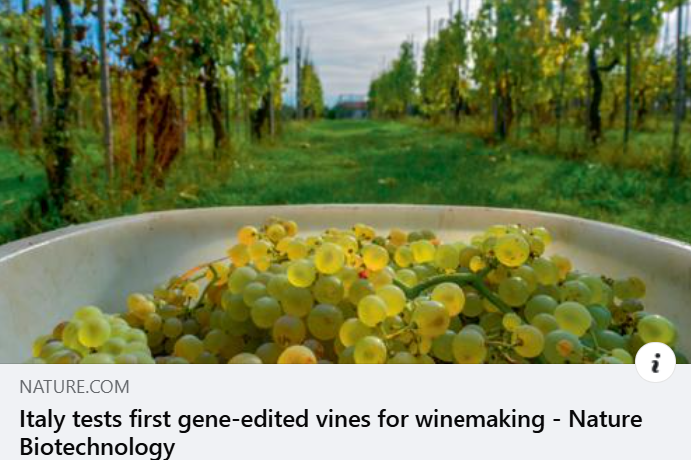
CRISPR Chardonnay – Italy Doubles Up

The University of Verona’s edited vines are already in the field, and soon it could be the turn of the Edmund Mach Foundation and CREA-CNR. Once again, the focus is on Chardonnay, edited to resist downy mildew (with a double knock-out approach) or powdery mildew. I spoke with the key figures of this new chapter in Italian research: Mario Pezzotti, Sara Zenoni, Umberto Salvagnin, Riccardo Velasco, and Vittoria Brambilla. Returning to write for Nature Biotechnology is a joy for me, especially because this time, Italy is leading the way in innovation rather than holding it back, as in the past. Prosit!

Wishing you the best, Kendric!

This photo shows the first American “non-experimental” patient leaving the hospital after completing the CRISPR-based treatment for sickle cell anemia (Casgevy). The New York Times detailed this “official first,” which followed the success of a clinical trial involving dozens of patients like Victoria Gray. We still know little about the first person who is beginning treatment in Europe since this therapy became an “approved drug”. According to Osservatorio Terapie Avanzate he is a young adult (23 years), who arrived in Italy in 2014 and living in the Umbria region, where is being also treated. Undergoing cell extraction and reinfusion of edited cells is an invasive and exhausting process, but now the American Kendric Cromer (12 years old) and other “first patients” can hope to lead full lives—without painful crises or blood transfusions. Best of luck!

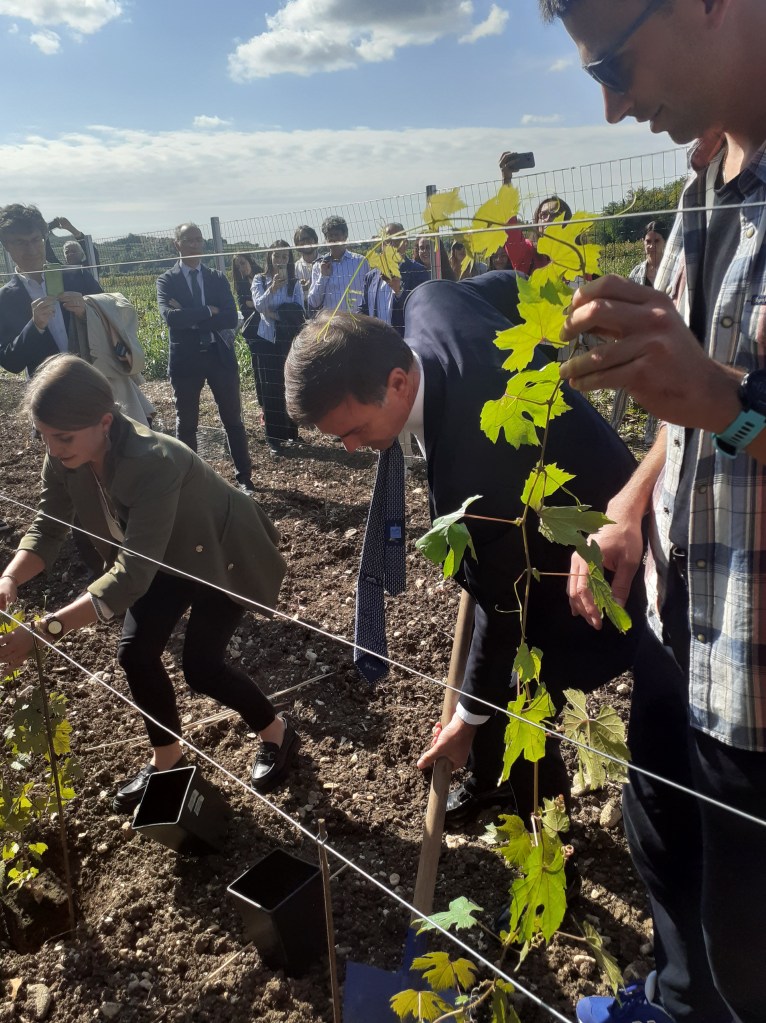
CRISPR vines make their field debut in Italy

Testing of Chardonnay edited to resist downy mildew starts today near Verona, while the prosecco variety awaits its turn in the greenhouse

The president of the influential farmers’ association Coldiretti, Ettore Prandini, formerly very hostile to GMOs, as he plants an edited vine with his own hands in the Verona experimental field on Sept. 30, 24
Continue reading

A very special day for NGTs in Italy

The fence bounds twenty-eight square meters of bare land in the middle of the Lombard countryside. Inside it a dozen researchers from the University of Milan are busy. The laptop resting on the ground shows the layout of the plots. A meter is unrolled to mark the coordinates on the ground.  Yellow tags are ready to be stuck into the clods: the inscription TEA (the Italian equivalent of New Genomic Techniques is “Assisted Evolution Techniques”) is used to mark rice that has been genetically edited for resistance to a fungal disease (rice blast), while the abbreviation WT indicates wild-type plants, which have not been modified and serve as a control group.

Continue reading

Italian CRISPR rice on its way to the field!

Early in the morning on Monday, May 13, Vittoria Brambilla will open her technological treasure chest at the Department of Agricultural and Environmental Sciences at the University of Milan. In jargon it is called a phytotron and is an air-conditioned room. Here are kept 400 precious plantlets, ready to be transferred to Italy’s first experimental field of the CRISPR era, with the blessing of the Ministry of Environment and Energy Security. Fertile soil awaits them in which to sink their delicate roots, and then sun, wind, rain and perhaps drought and pests. All that changeable stuff happens when you grow outdoors instead of inside a laboratory.” To learn all about this field debut (the first after a 20-year wait in Italy), the trial that is about to begin and who made it possible, there is my new piece for Le Scienze, with comments from Vittoria Brambilla, Roberto Defez, Elena Cattaneo, Roberto Schmid and Federico Radice Fossati, the ag entrepreneur who offered his land for the trial. For more technical details on this fungus-resistant rice there is the article I had published in Nature Italy. In the gallery above, meanwhile, you will find: the researchers of the laboratories directed by Vittoria Brambilla and Fabio Fornara, the sign posted outside the experimental field, the climate-controlled chamber holding the edited seedlings until next week, one of the trays in which they will be transported, the cage delimiting the experimental field, yet to be completed with the upper part (28 square meters in Mezzana Bigli, in the province of Pavia, northern Italy).