Eco-vandals target gene-edited Chardonnay in Italy

On the night of February 12-13, unknown vandals broke into a small experimental vineyard at the University of Verona in northern Italy to uproot Chardonnay vines that had been gene-edited to resist a fungal infection. Last September, the launch of this field trial was celebrated by researchers, producers, and prominent politicians—including Agriculture Minister Francesco Lollobrigida—because it was a point of pride for the country (the first field with gene-edited vines in Europe) and a step toward healthier, more sustainable viticulture, less reliant on fungicides. Anti-science belligerence strikes again: two experimental fields have been launched in Italy, and both have been attacked.

Continue reading

CRISPR vines make their field debut in Italy

Testing of Chardonnay edited to resist downy mildew starts today near Verona, while the prosecco variety awaits its turn in the greenhouse

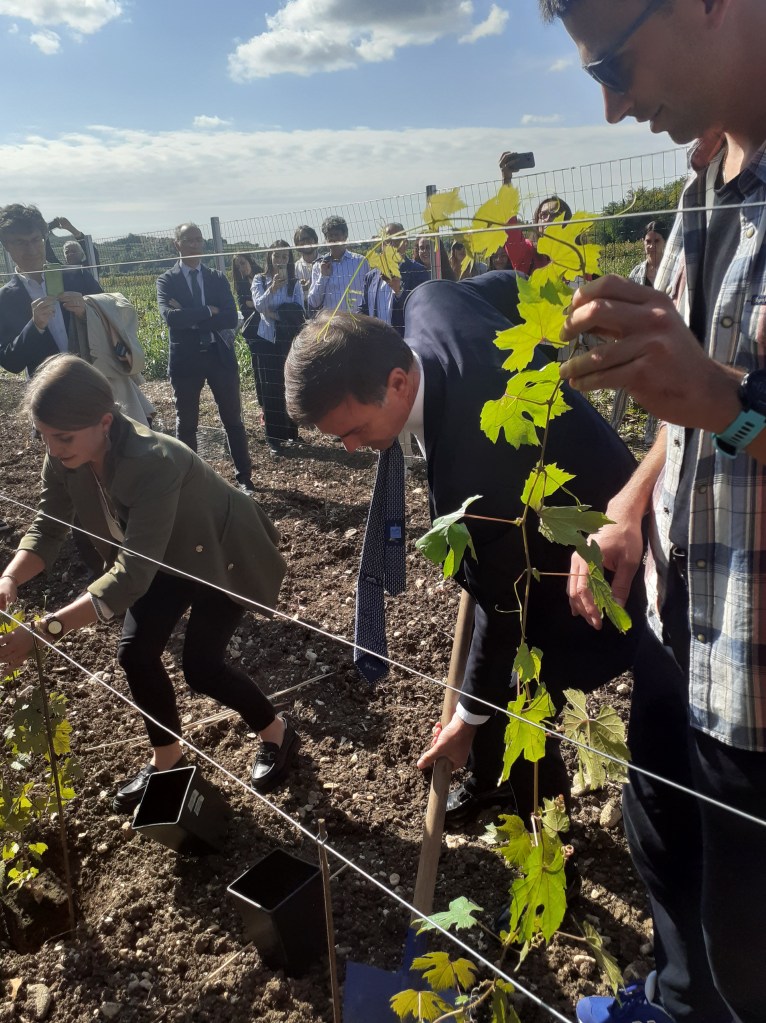
The president of the influential farmers’ association Coldiretti, Ettore Prandini, formerly very hostile to GMOs, as he plants an edited vine with his own hands in the Verona experimental field on Sept. 30, 24
Continue reading

Shock and sadness after destruction of Italy’s first CRISPR field

Having attended the festive launch of the first field trial of a CRISPR plant developed in Italy on May 13, we share the dismay of the scientists behind the project – Vittoria Brambilla and Fabio Fornara of the State University of Milan – over the destruction tonight by unknown ecoterrorists of the harmless seedlings, which represented hope for sustainable agriculture and innovative research in our country. The official press release follows. Here are a few links for further reading.

Continue reading

A very special day for NGTs in Italy

The fence bounds twenty-eight square meters of bare land in the middle of the Lombard countryside. Inside it a dozen researchers from the University of Milan are busy. The laptop resting on the ground shows the layout of the plots. A meter is unrolled to mark the coordinates on the ground.  Yellow tags are ready to be stuck into the clods: the inscription TEA (the Italian equivalent of New Genomic Techniques is “Assisted Evolution Techniques”) is used to mark rice that has been genetically edited for resistance to a fungal disease (rice blast), while the abbreviation WT indicates wild-type plants, which have not been modified and serve as a control group.

Continue reading

Italian CRISPR rice on its way to the field!

Early in the morning on Monday, May 13, Vittoria Brambilla will open her technological treasure chest at the Department of Agricultural and Environmental Sciences at the University of Milan. In jargon it is called a phytotron and is an air-conditioned room. Here are kept 400 precious plantlets, ready to be transferred to Italy’s first experimental field of the CRISPR era, with the blessing of the Ministry of Environment and Energy Security. Fertile soil awaits them in which to sink their delicate roots, and then sun, wind, rain and perhaps drought and pests. All that changeable stuff happens when you grow outdoors instead of inside a laboratory.” To learn all about this field debut (the first after a 20-year wait in Italy), the trial that is about to begin and who made it possible, there is my new piece for Le Scienze, with comments from Vittoria Brambilla, Roberto Defez, Elena Cattaneo, Roberto Schmid and Federico Radice Fossati, the ag entrepreneur who offered his land for the trial. For more technical details on this fungus-resistant rice there is the article I had published in Nature Italy. In the gallery above, meanwhile, you will find: the researchers of the laboratories directed by Vittoria Brambilla and Fabio Fornara, the sign posted outside the experimental field, the climate-controlled chamber holding the edited seedlings until next week, one of the trays in which they will be transported, the cage delimiting the experimental field, yet to be completed with the upper part (28 square meters in Mezzana Bigli, in the province of Pavia, northern Italy).

CRISPR crops – Italy fires the starting gun

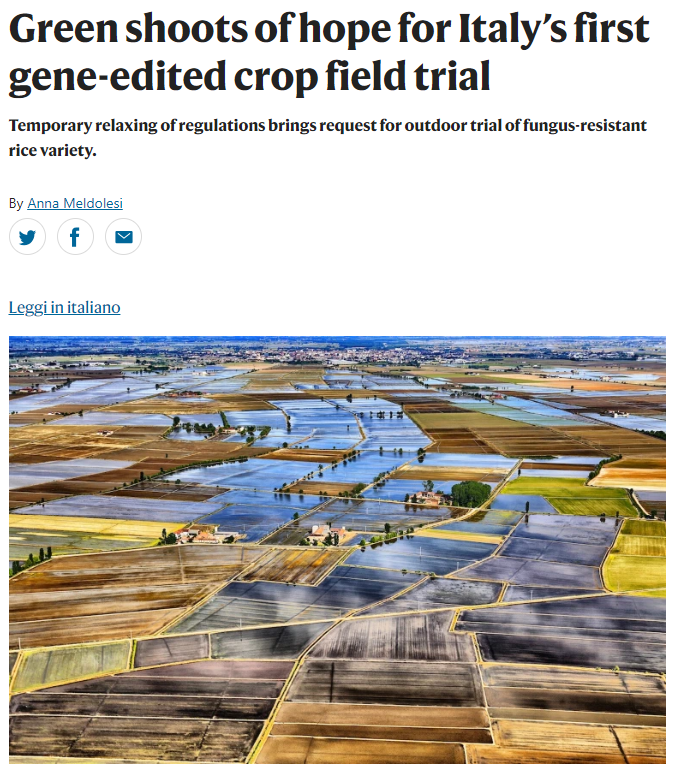
A CRISPR/Cas9-modified rice variety may be planted in a test field in northern Italy as soon as this spring after a government rule change introduced in 2023. A University of Milan team was the first research group in the country to apply for a field test under a law change that streamlines procedures for field trials of plants developed through genome editing or cisgenesis. With several other groups also planning proposals, a new wave of agricultural genetics in Italy could follow. [Please see the details in my article for Nature Italy]

Genetic gain is a team game

[The number of studies investigating the impact of modifying one or a few genes on the yield of a crop]

Some champions can make a difference, but to win matches and tournaments, there must be chemistry among the players. The same happens for the effort to increase the productivity of crop plants. Hunting down the single key gene, hoping it will work the miracle, is not enough. One must focus on the harmony of genetic combinations, through approaches that marry the most advanced technologies with agronomic knowledge. In short, handling DNA and test tubes is fine, but it is equally important to know what actually works when the plants reach the field. That’s the message a group of influential researchers such as Pamela Ronald of the University of California at Davis delivered to the pages of Nature in a commentary provocatively titled “Genetic modification can improve crop yields – but stop overselling it”.

Continue reading

Field of CRISPR dreams in Italy

You may have heard of the recent European Commission report on the New Genomics Techniques. But you probably don’t know how member states answered the related questionnaire. ““Could NGT-related research bring opportunities/benefits to science, to society and to the agri-food, medicinal or industrial sector?”. This and more in my news feature for Nature Italy.