CRISPR & cancer – small steps forward

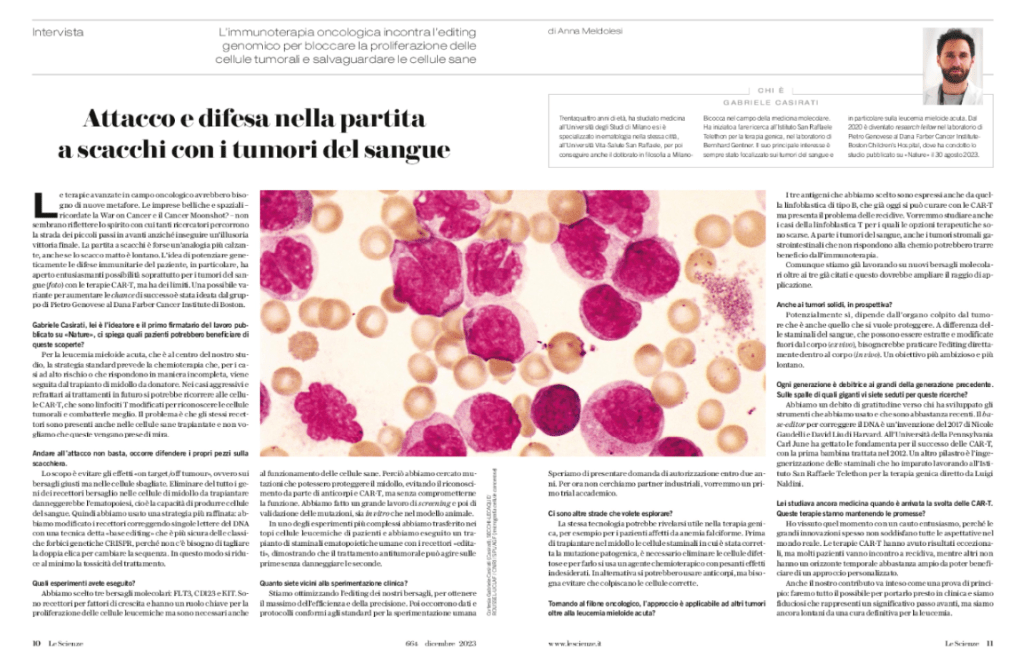
Advanced cancer therapies would need new metaphors. War and space efforts – do you remember the War on Cancer and the Cancer Moonshot? – do not seem to reflect the spirit with which so many researchers pursue the strategy of small steps forward rather than chasing an illusory ultimate victory. The game of chess is perhaps a more fitting analogy, although checkmate is a long way off. The idea of genetically enhancing a patient’s immune defenses, in particular, has opened up exciting new possibilities especially for blood cancers (Car-T therapies) but is not without its limitations. One possible variant to increase the chances of success has been devised by Pietro Genovese’s group at the Dana Farber Cancer Institute in Boston and described in Nature a few months ago. If you can read Italian, please see also the December 2023 issue of Le Scienze, with my interview to Gabriele Casirati, first author of the Nature’s paper.

Editing down cancer risk in our favourite foods

I bumped into this video of Nigel Halford brilliantly explaining what the problem is with acrylamide in our food and how he recruited CRISPR to lower its content in wheat. Acrylamide is a highly undesirable processing contaminant discovered in 2002. “It’s a big issue for the food industry because it’s carcinogenic, at least in rodents, and probably also in humans, and has also effects on development and fertility”, he says when interviewed at the Euroseeds Congress 2022. 

Continue reading

CRISPR tracks metastatic progression

Phylogenetic trees of tumors and metastases can reveal key features such as the clonality, timing, frequency, origins, and destinations of metastatic seeding. Each color in the image above represents a different location in the body. A very colorful tree shows a highly metastatic phenotype, where a cell’s descendants jumped many times between different tissues. A tree that is primarily one color represents a less metastatic cell. Credit Jeffrey Quinn/Whitehead Institute

CRISPR-based techniques allow the reconstruction of the “family tree” of the cells that compose an animal’s body by marking them with a pattern of deletions and insertions. This kind of barcoding has already helped trace embryo growth and organoid development and is shedding light on essential oncology questions by catching cancer in the act. Read how “Single-cell lineages reveal the rates, routes, and drivers of metastasis in cancer xenografts” in this Science paper and the news from Whitehead Institute.

CRISPR draws the first genomic map of cancer vulnerabilities

If you know the enemy and know yourself, you need not fear the result of a hundred battles. The military strategist Sun Tzu wrote it over two thousand years ago, but this quote could also apply to oncology research in the CRISPR era. Identifying the weak points of cancer cells is the first step to hit new molecular targets with the next generation of drugs.

The good news is that the Wellcome Sanger Institute has taken a giant leap toward this goal, drawing up a list of 600 candidate genes. The study just published in Nature by Mathew Garnett’s team comes with a twin paper by the Broad Institute, confirming the results by following an alternative approach. In a four-year tour de force of functional genomics, Sanger’s researchers used CRISPR to disrupt every gene in over 300 cancer models from 30 cancer types. From this amount of data, they developed a prioritization system which will guide big pharma’s hunt for new drugs.