

Imtiyaz Khanday (left), Venkatesan Sundaresan (right) with their apomictic rice (credit: KARIN HIGGINS/UC DAVIS)
“To make a seed it takes a fruit,” pupils use to sing in Italy. Then students learn that there is an embryo inside seeds and it takes a pollen fertilized egg to make it. The dream of plant scientists, however, has always been to be able to produce seeds using only the cell egg. This dream has finally come true: a group led by Venkatesan Sundaresan, at UC Davis, has developed a rice variety capable of cloning its seed. Continue reading

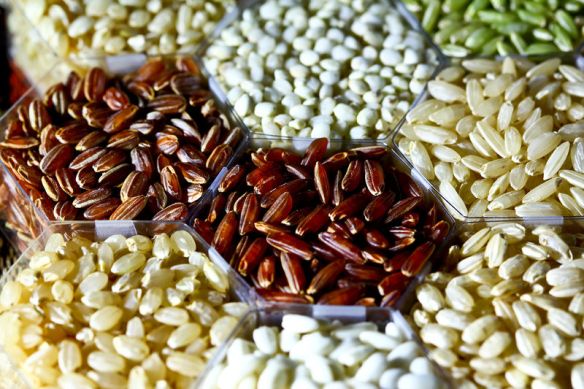 Just imagine you could find them all on the supermarket shelves, would you buy rice labeled as CRISPR or GMO, or stick to conventional non-genetically modified rice? And what price would you consider fair? Aaron Shew and colleagues from the University of Arkansas conducted a multi-country assessment of willingness-to-pay for and willingness-to-consume a hypothetical CRISPR-produced food and published their findings in Global Food Security.
  The European Commission’s Group of Chief Scientific Advisors has published a
  A proposal from the Netherlands Ministry of Infrastructure and the Environment points the way out of the GM regulatory impasse for most CRISPR crops in Europe. Rather than trying to clarify ambiguous definitions, the EU could simply amend Annex B1, that is the list of technologies that are excluded from regulation by the directive on GMOs (2001/18/EC).
  “Agricultural research, or a new bioweapon system?”. This is the question asked by Guy Reeves et al. in a policy forum published in


 CRISPeR FRENZY