
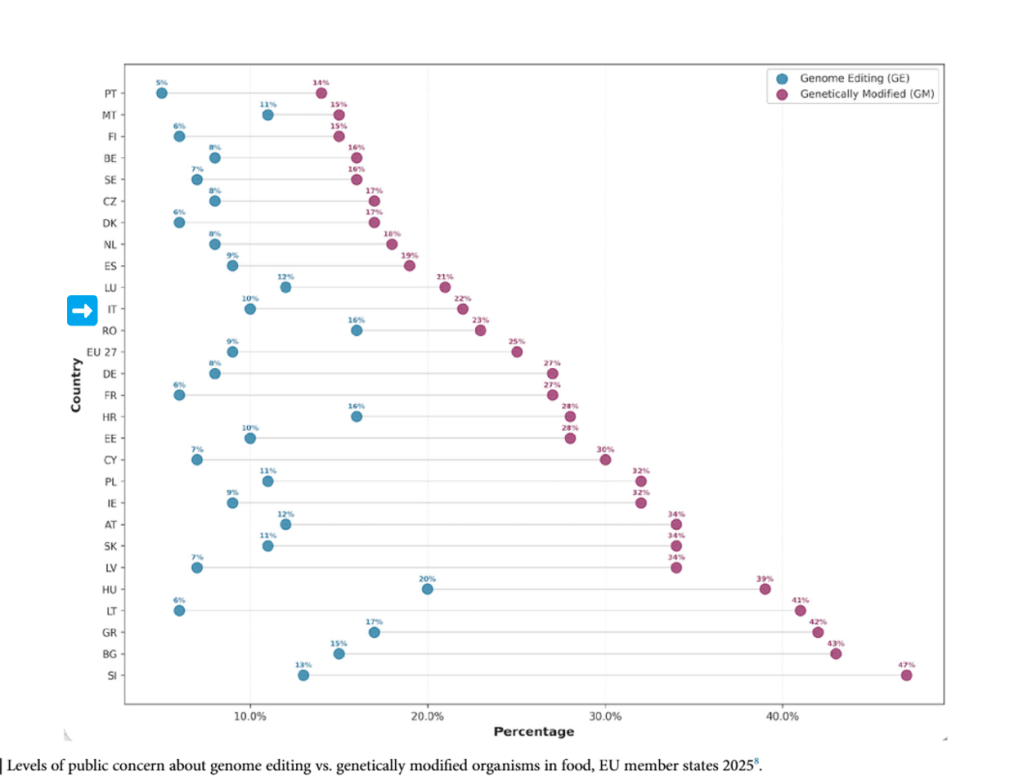
It won’t be long now: around the middle of the month we will find out whether the new European regulation on new genomic techniques (NGTs) will be approved in its current form or whether further compromises will be needed. This makes it a good moment to assess public perceptions of these technologies in agri-food applications. Are Europeans more open to NGTs than to traditional GMOs? The answers can be found in a survey commissioned by the European Commission at the request of the European Food Safety Authority (Eurobarometer 2025). The topic has returned to the spotlight thanks to an article published a few days ago by a group of experts on public perceptions of biotechnology in a journal of the Nature group devoted to sustainable agriculture.
It is worth noting that the signatories include a couple of experts from Austria, a country that has historically opposed GMOs. Representing Italy is Agnes Allansdottir, a social psychologist at the University of Siena, alongside colleagues from Germany, Spain, and the United Kingdom. According to the authors, “Apart from a few countries in Eastern Europe, current media coverage, the interests of environmental organizations, and public opinion point to a favourable reception of NGTs in the majority of European countries.” Hungarians appear to be the most concerned, while the Portuguese are the least worried. Italy, as shown in the opening figure, is broadly in line with the EU average (concern about genome editing, the most prominent NGT, is represented by the light blue dots, while the purple dots refer to GMOs).
When presented with a list of potential food-related risks, only a small fraction of the 26,370 European citizens surveyed identified genome editing as a source of concern, focusing instead on more concrete issues such as pesticides, antibiotics and hormones in meat, additives, microplastics, microbiological contamination, and other risks. I cannot say whether this will prove predictive of the outcome of the ongoing political negotiations, but it is certainly reassuring from the standpoint of common sense.
Ultimately, according to George Gaskell et al., pockets of resistance remain, but there are also “grounds for optimism regarding the future of NGTs if the following conditions are met. First, NGTs are introduced openly and transparently, accompanied by proactive, agenda-setting public information campaigns […]. And secondly, NGTs are seen to deliver benefits for farmers, the public, and contribute to sustainable agri-culture in developed and developing countries.”

