
It had never happened before that a company decided to submit a commercial authorization request for a therapy tested on only two people.
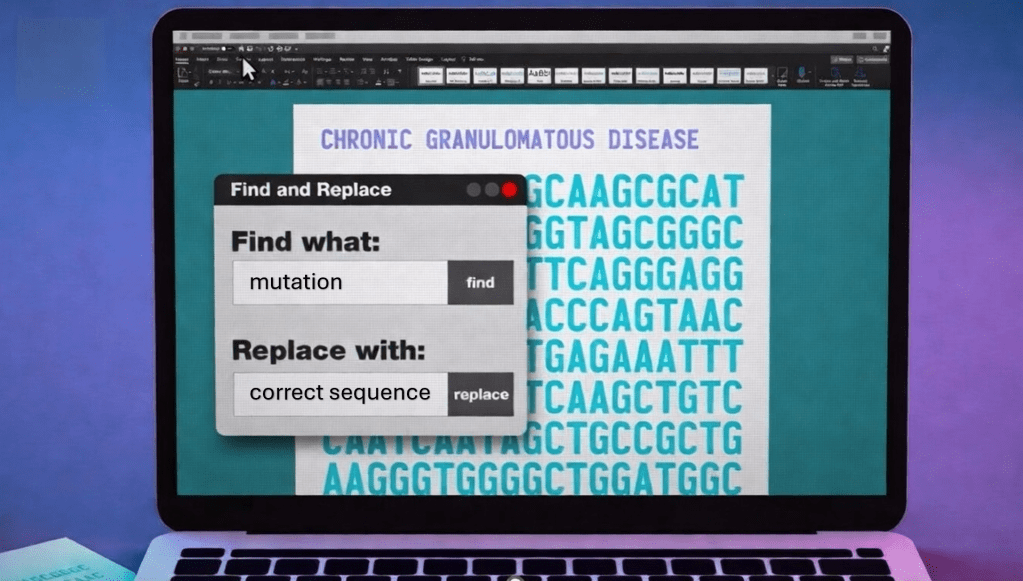
We do not know the name of the teenager from Vancouver who, a year ago, became the first person in the world to receive a treatment based on a genetic correction approach similar to Word’s “find and replace.” What we do know is that before becoming a pioneer patient, even a common cold represented a serious threat to him. The father of the technique known as prime editing, David Liu, now describes him as “healthy, stable, and living with a functioning immune system.” Seeing him on skis in the the snow in the photo published by the Canadian Institutes of Health, is worth more than many words. The American National Institutes of Health, for their part, confirm that the second patient treated is also doing well.
The eighteen-year-old Canadian and the fifty-seven-year-old man from Nebraska, a software developer named Tracy Atteberry, were born with the same severe immunodeficiency, chronic granulomatous disease (CGD). Until the 1960s it was considered a fatal childhood illness, because affected children rarely lived past the age of ten. People with the disease still have a reduced life expectancy, face frequent hospitalizations, and must avoid places where bacteria, fungi, and other infectious agents might lurk. “There’s no living in the basement. No doing yard work or gardening or swimming in a bayou or cave exploring. There’s no scuba diving or live Christmas trees or house plants. No petting iguanas,” is the bizarre list Atteberry provides to explain what his life used to be like and how it is now beginning to change. “Now that those restrictions are lessened a bit, I plan on getting a houseplant. If I’m feeling particularly daring, maybe I’ll dash into Trader Joe’s without wearing a mask. Just for the daredevil feel of it.”
The two patients were treated a few months apart, respectively at CHU Sainte-Justine in Montreal and at the NIH Clinical Center in Bethesda. In both cases, however, the genetic correction step took place at the specialized laboratory of Prime Medicine in Cambridge, Massachusetts. With a follow-up of just under a year it would be risky to speak of a “cure,” but the results published in the New England Journal of Medicine ten months after the first intervention appeared more than encouraging.
Chronic granulomatous disease is a very rare genetic condition caused by a malfunction of the NADPH oxidase complex, an enzymatic system that is key to phagocytes and plays a fundamental role in the immune defense mechanism against pathogens. The treatment developed by Prime Medicine is designated PM359 and specifically corrects a deletion of two letters (delGT) in the NCF1 gene, thanks to an advanced CRISPR model that does not cut the double helix but can rewrite short stretches of DNA. The correction takes place ex vivo in the patient’s stem cells, which are first collected and then reintroduced into the body after making space for them with a chemotherapy treatment. Until it becomes possible to intervene in vivo, directly in the body, the high costs and advanced expertise required will make the procedure extremely expensive, perhaps too expensive to become a commercial reality.
The economic sustainability of advanced therapies is a recurring obstacle in the field of rare and ultra-rare diseases, and CGD is certainly no exception. According to the New York Times, in the United States only about fifty people would be eligible for this editing-based therapy, roughly a quarter of those affected by the disease. Prime Medicine had planned to treat between six and twelve of them at a cost of 20–30 million dollars, but its funds were depleted earlier than expected, and the company has warned that, in the absence of new financing, the trial should be considered concluded. Will data from just two patients observed for only a few months be enough to persuade the Food and Drug Administration to approve the product?
Clinical trials generally involve a larger number of people who are followed for longer periods, even when the diseases involved are rare. But Prime Medicine hopes that the CGD treatment may be among the first to benefit from a simplified procedure and intends to submit a request for commercial authorization. For several months now, in the wake of the Baby KJ case, the relevant U.S. agency has been sending signals in favor of greater flexibility in the authorization process for treatments targeting rare diseases. The Food and Drug Administration’s commissioner Marty Makary and the head of biologics Vinay Prasad outlined the possible new regulatory philosophy in an article published in November 2025 in the New England Journal of Medicine. A few days ago, on February 23, the first official step was taken with the publication of a 22-page guidance document that should help turn these good intentions into concrete and applicable recommendations. According to STAT News, comments from experts are generally positive, although in recent times the agency’s policies have sometimes appeared contradictory, and finding the right balance between speed and safety will not be easy.
(translated and adapted from Osservatorio terapie Avanzate)
 CRISPeR FRENZY