
Anyone who has ever stood beside a sunflower knows the quiet astonishment of being matched, petal for head, by a flower. Now imagine weaving your way through tens of thousands of stems at eye level, each one tethered to the transparent ceiling by a white cord, as if suspended between earth and sky. Overhead stretches a vision in perfect symmetry: thousands of threads rising in parallel, anchoring a forest of blossoms veiled like brides at the altar, their vivid yellow only just shimmering through the gauze. It could be a contemporary art installation, but this is the greenhouse of the world’s most advanced sunflower research center. We are not at the Venice Biennale nor at Documenta in Kassel, but just outside Seville, at the Centro Tecnológico de Investigación de La Rinconada.
Visiting Corteva’s main European hub (the seed company that inherits the legacies of Dow, DuPont, and Pioneer) is a visual experience as much as a scientific one, a crash course in botany disguised as spectacle. Here, the cycle of life runs uninterrupted, from pollination to ripening and back again, allowing researchers to identify the most promising combinations of traits in their search for sustainable solutions to modern agriculture’s demands: drought tolerance, disease resistance, high yields, and superior quality. Andalusia’s relentless sun makes this the ideal testing ground for evaluating how plants withstand water stress, and for operating more than 10,000 square meters of low-energy greenhouses.
Attracting talent in this city has proved effortless: partnerships with the university are strong, the culinary scene outstanding, and Seville itself offers an inspiring setting, from its Gothic cathedral to landmarks such as Plaza de España. The sunflower greenhouse now stands as a new emblem of the city of flamenco.
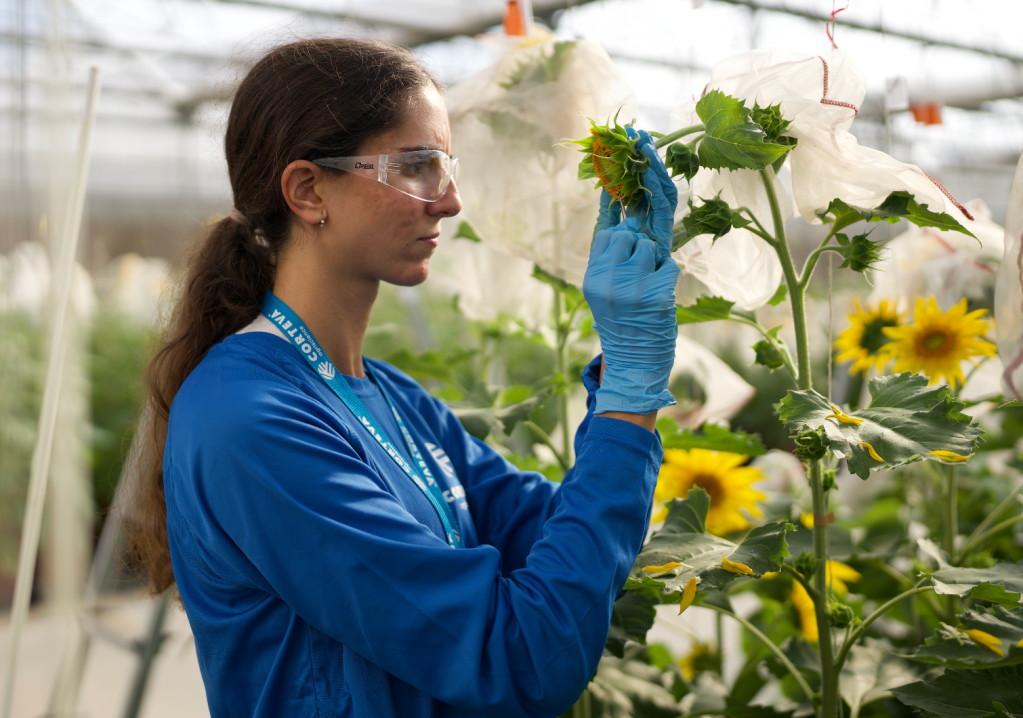
What we call a sunflower is in truth a composite inflorescence: hundreds of hermaphroditic florets, spiralling in mathematically perfect patterns to form the central disk. In the greenhouse, a young woman in a lab coat leans in with tweezers to remove the male parts from the florets. A light veil will be draped over the disk to block stray pollen, ensuring fertilization is deliberate and controlled. Many of the researchers here are women, because men tend to be less adept at the precise, unerring movements required for delicate work such as rescuing immature embryos.
The sunflower heads move from greenhouse to “dirty” lab, where they are sterilized, and then into “clean” lab space, where every safeguard is in place against pathogenic microorganisms. In this chlorophyll-rich nursery, advanced cultivation techniques speed the pace of crossbreeding, compressing an entire growing cycle into a quarter of the time. Four generations can be produced in a single year—over thirty thousand new sunflower lines—each carefully evaluated for its genetic potential. Those that meet the mark return as mature plants to the very greenhouses they once left as seeds, to contribute to the next generation. Artificial intelligence and robotics handle whatever can be automated; the rest remains in the realm of human hands, tending the fragile beginnings of plant life. Every time they start again: new crossbreeds, new combinations of traits, new chances to pick a winning ticket in this never-ending game called “accelerated breeding”.
Breeding is the term used to describe the science and art of developing new plant varieties, a task that has been ongoing for thousands of years using the knowledge and tools that have gradually become available. Innovations often make their way quietly, and you don’t realize you’re in the middle of a revolution until it’s happened and you can look back. Just think of the invention of agriculture: there was no year when our ancestors were all hunter-gatherers and the next year they said, “Let’s start farming!” Even now that genetic improvement is advancing thanks to new technologies, its incremental progress can go unnoticed. The results will never be plants with superpowers, but cultivars that are a little better suited to a changing world. Only by accelerating can we keep pace with climate change, the spread of new pests, and the growing expectations of consumers who want good, healthy products at affordable prices, also when it comes to seed oil.
Sunflowers have yet to be shaped by the new genomic tools such as CRISPR. But just beyond the greenhouses that Vincent van Gogh might have painted, an open-air demonstration field grows maize of two kinds: conventional and gene-edited. Labels mark each row. Next to landraces from distant regions stand commercial cultivars bred to resist diseases such as rust through minimal genetic adjustment. Another row hosts waxy maize, whose starch composition has been altered by mimicking a natural mutation, producing kernels suited to certain industrial uses and to making quicos, the toasted corn snacks that accompany an aperitif. None of these maize plants contains foreign DNA, meaning that under the new EU rules now under review, they would be treated no differently from conventionally bred crops once approved. For now, however, they wait in a kind of regulatory limbo. The sunflowers produced through accelerated breeding, by contrast, already meet the definition of “conventional.”
Technologies evolve and legal frameworks shift, yet the purpose remains the same: to produce more, and above all, to produce better, lightening the environmental footprint of intensive agriculture. A plant that can fend off disease requires fewer pesticides; one that uses natural resources efficiently yields a more sustainable harvest. Leaving Seville, one carries the sense that walking through the greenhouse of veiled sunflowers and stepping into the green rectangle of maize for the future are chapters of the same story. A journey into a world unfamiliar to most consumers, where every seed we grind, press, or bite into carries and quietly passes on a grain of human knowledge.
[This article by Anna Meldolesi was published in Italian in the weekly magazine 7 of Corriere della Sera, together with a piece on sunflowers in art history]
 CRISPeR FRENZY