
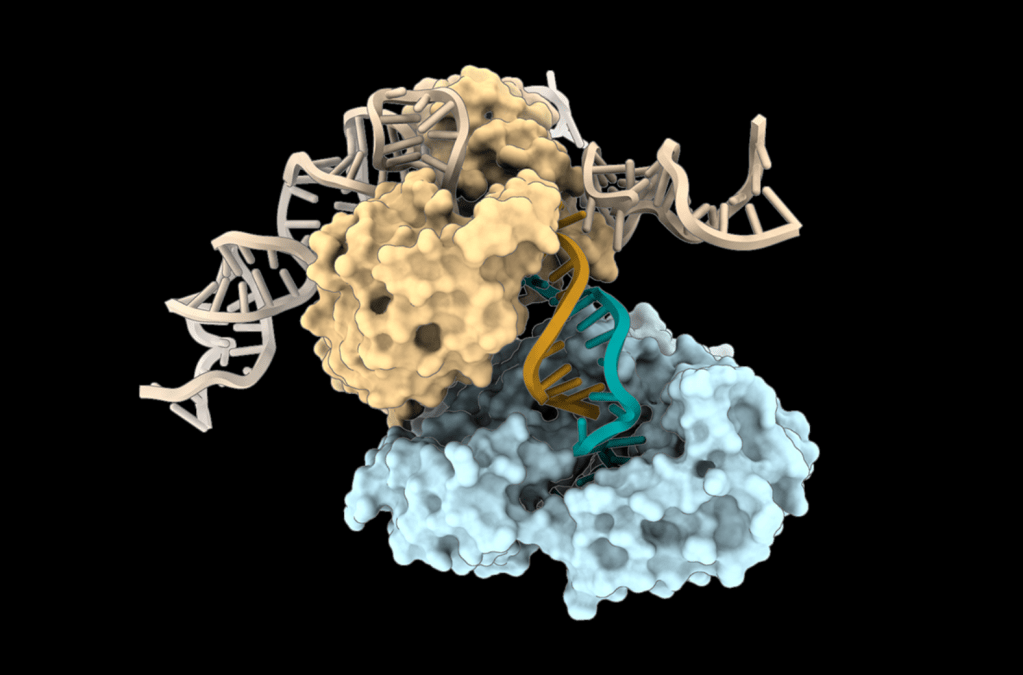
Perhaps you came across a Science news piece published last week, presented with a fair amount of hype. Title: “Scientists stunned by ‘fundamentally new way’ life produces DNA.” Subtitle: “Newly discovered bacterial defense system challenges genetic code’s central dogma.”
As explained by reporter Richard Stone (who doesn’t usually cover molecular biology, focusing instead on field reporting in difficult countries), it sounds as though a bacterial enzyme (DRT3b) has been discovered that can synthesize DNA in an unusual way, using the chemical structure of its own amino acids as a template, rather than a genomic one.
Before letting our imaginations run wild about possible applications in synthetic biology, though, it’s worth taking a look at the paper itself, also published in Science. Right from the title (“Protein-templated synthesis of dinucleotide repeat DNA by an antiphage reverse transcriptase”) it’s clear that the news piece was missing a key detail: all the enzyme actually does is assemble two letters (AC) and repeat only those. To be clear, the phenomenon is intriguing, and the discovery by the Stanford group led by Alex Gao certainly deserves attention. But the way it has been presented can be misleading.
So yes, long live microbiology, which keep surprising us with new molecular toolkits; long live the competition between bacteria and viruses that underpins the evolution of CRISPR and other marvels; and long live the newcomer DRT3b, which appears to have evolved precisely as a defense mechanism, even though the way it blocks phages (viruses that infect bacteria) is still unclear.
Still, no dogmas have been shattered here, first of all because the central dogma of DNA is, by now, more of a rhetorical device than anything else (just think of all the things RNA can do beyond acting as a messenger!). And also because there are other known cases of specialized molecules capable of adding a few letters to a nucleotide sequence, as Nikolai Slavov of Northeastern University pointed out in commenting on the story.
“This is not a protein ‘reading’ itself to create a complex message; rather, it is a highly specialized structural constraint. The protein is essentially a ‘stuttering’ machine, physically keyed to produce a simple, repetitive sequence. The ‘information’ is hard-coded into the protein’s fold to perform a single, specific defensive task, rather than acting as a general-purpose template for diverse genetic messages”, he says.
In the end, life (at least as we know it) continues to synthesize DNA using a complementary DNA template, through the elegant mechanism described by Watson and Crick in their historic paper on the double helix (“It has not escaped our notice that the specific pairing we have postulated immediately suggests a possible copying mechanism for the genetic material”). Of course, in the case of retroviruses such as HIV, the template is RNA rather than DNA, but it is still a nucleic acid.

