
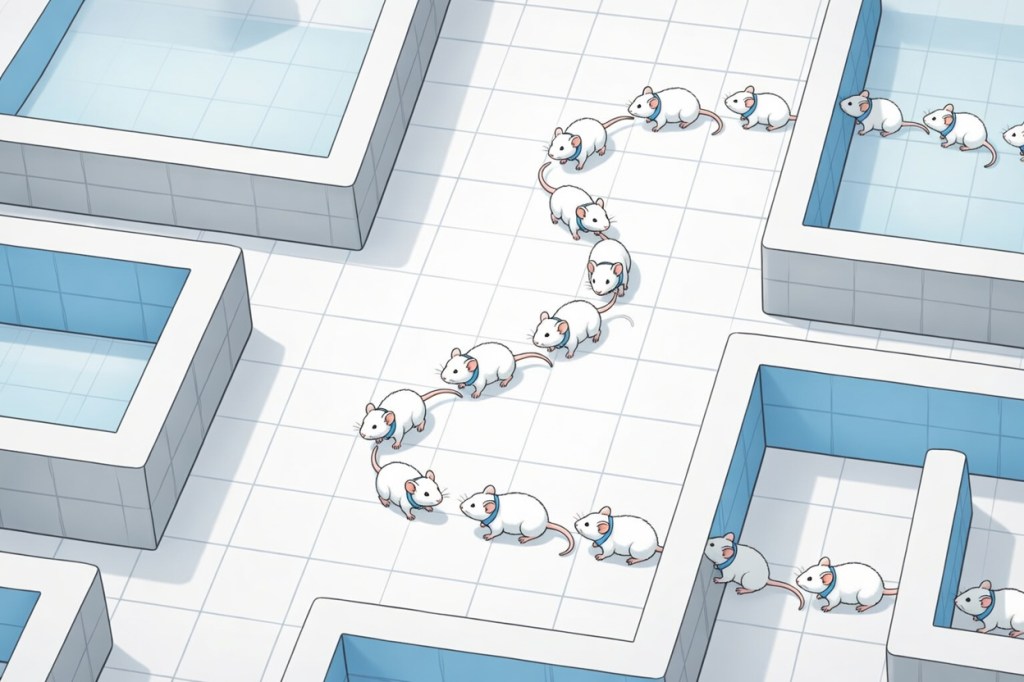
A team led by Teruhiko Wakayama at the University of Yamanashi generated more than 1,200 cloned mice from a single original donor, across over 30,000 cloning attempts, using the classic technique that produced Dolly the sheep: nuclear transfer (please see their paper in Nature Communications). Up to the 25th generation, things proceeded largely smoothly: the clones were normal, lived as long as conventionally bred mice, and the line appeared indefinitely sustainable. But from the 27th generation onward, the success rate began to decline. By the 58th generation it had collapsed, and the few pups that were born died shortly after birth, despite showing no obvious abnormalities. A discovery that may prompt a reassessment of certain lines of research involving genome editing.
Genomic analysis revealed an unexpected accumulation of mutations, both small and large. Deletions, inversions, chromosomal translocations, and even the loss of an entire chromosome, occurred at a markedly higher frequency than in sexually reproduced mice. In short, the study exposes a fundamental limit of pure cloning, one that plausibly extends beyond mice to mammals more broadly.
It is worth noticing that cloning is often the method of choice for faithfully multiplying animals with genomes “optimized” through genome editing, whether for basic research or for biomedical, agricultural, or conservation applications. However, Wakayama’s work suggests that the “editing + repeated serial cloning” paradigm is not a viable long-term strategy, because the accumulation of mutations would ultimately undermine the gains of precision editing.
In livestock breeding, where elite individuals modified with CRISPR might be cloned, one possible workaround is to rely on large banks of modified somatic cells that can be repeatedly used as nuclear donors, thereby reducing the number of serial cloning cycles. Hybrid strategies, combining editing with occasional rounds of sexual reproduction, are already advisable for genetically modified animals used as disease models or in efforts to conserve endangered species.
Published on March 24, 2026, the study closes a chapter opened by Wakayama himself in 2013, when results up to the 25th generation had suggested that cloning might continue for much longer. We now know this is not the case, and that insight is crucial for anyone working at the intersection of genome editing and reproductive technologies.
 CRISPeR FRENZY