
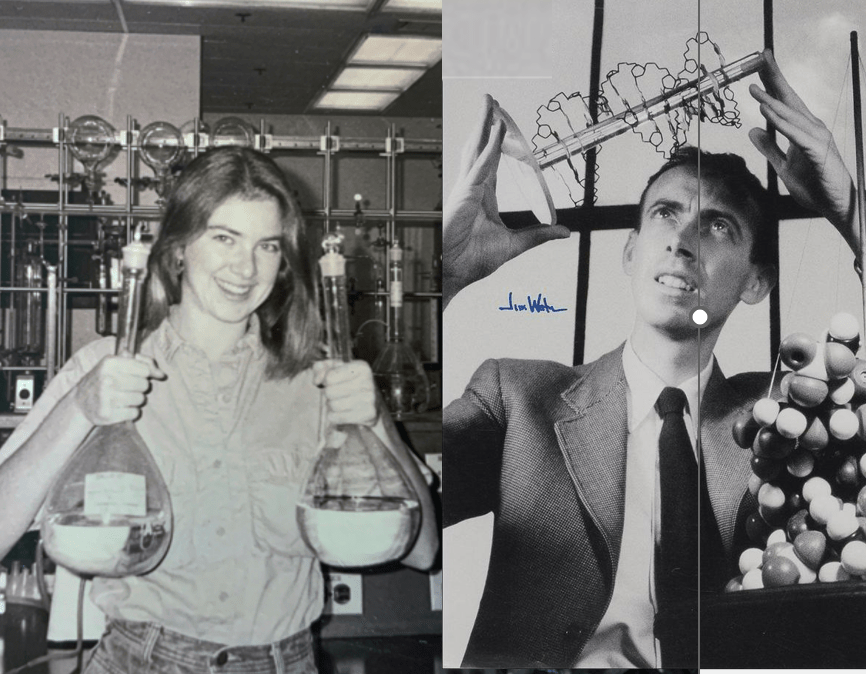
The fascination with biochemistry sparked by The Double Helix, the thrill of her first invitation to Cold Spring Harbor, and the melancholy of her last visit to the disgraced genius.
While we wait for Nathaniel Comfort’s upcoming biography of James Watson, Jennifer Doudna’s story in The Code Breaker by Walter Isaacson offers a revealing lens on the scientist whose outstanding legacy is overshadowed by his offensive claims about intelligence and race. Doudna crossed paths with Watson three times — moments that shaped both her imagination and her opinion of the man who helped discover the structure of DNA.
The first scene takes place in 1976. At age twelve, Doudna comes home from school and finds a second-hand copy of The Double Helix on her bed, left there by her father. The book captivates her: the characters, the race to uncover the secrets of life, the idea that science could be logical, beautiful, and fun. She also senses the condescension toward Rosalind Franklin, but what stays with her is something else: “What mainly struck me was that a woman could be a great scientist. It may sound a bit crazy. I guess I must have heard about Marie Curie. But reading the book was the first time I really thought about it, and it was an eye-opener. Women could be scientists.” The revelation pushes her to pursue chemistry despite a counselor telling her “science is not for girls.” She will become a structural biologist and eventually win the Nobel.
The second meeting is in 1987, at Cold Spring Harbor. Doudna, 23, is invited to present research on self-replicating RNA. The invitation letter signed by Watson ends up framed. She is “incredibly nervous” that day, but Watson congratulates her afterwards. Over the years he becomes increasingly controversial, yet many outstanding women in his lab described him as a strong mentor. Doudna mentions this to Isaacson, and Comfort confirms it: while Watson held “very old-fashioned” ideas about women, he treated top female scientists as equals.
The last scene is in 2019. After the documentary Decoding Watson, his portrait is removed from the wall at Cold Spring Harbor, his titles revoked, and he is effectively exiled inside the campus. He can no longer attend meetings and asks Isaacson to bring Doudna to him privately. He jokes about Photograph 51: “Ah, that image will haunt me forever.” Watson tells her: “The reason that CRISPR is the most important discovery since the DNA’s structure is that it not only describes the world, as we did with the double helix, but makes it easy to change the world.” His wife steps in at times to steer him away from inappropriate remarks.
The visit is brief and leaves Doudna with “a poignant and sad” impression. Looking back, she says: “Here’s a person who had this incredible career and this potential to be a real figure of respect in the field, and it was all squandered because of these views that he holds. Some people may say you shouldn’t have met with him. But for me it’s not so simple.”

