

Future space exploration will depend in large part on using organisms capable of surviving in extreme conditions. One source of inspiration for achieving this goal is the tardigrade, a tiny invertebrate that is a champion of endurance and could lend its genes (and perhaps some superpowers) to other species designed to feed astronauts and provide useful substances.
The European Space Agency is specifically funding the Yeast TardigradeGene experiment, which investigates the possible role of an enzyme (mitochondrial alternative oxidase, AOX) that is crucial for the functioning of the energy powerhouses of cells. The idea is to use genetic editing to equip a model organism with the variant of the enzyme that is native to tardigrades. The choice fell on the yeast Saccharomyces cerevisiae, a favorite among geneticists and widely used as a biofactory in industrial applications.
In the future, such an approach could also be applied to crops (if you want to get a general idea of the challenges of futuristic Martian agriculture, including the removal of toxic substances in the red planet’s soil, we recommend this detailed piece from MIT Technology Review). And there is no shortage of more reckless thinkers, ready to imagine a sci-fi future in which humans will be able to thrive on Mars by modifying their own genome (astronomer royal Lord Martin Rees and space exploration advocate Robert Zubrin discussed this at a British Interplanetary Society event).
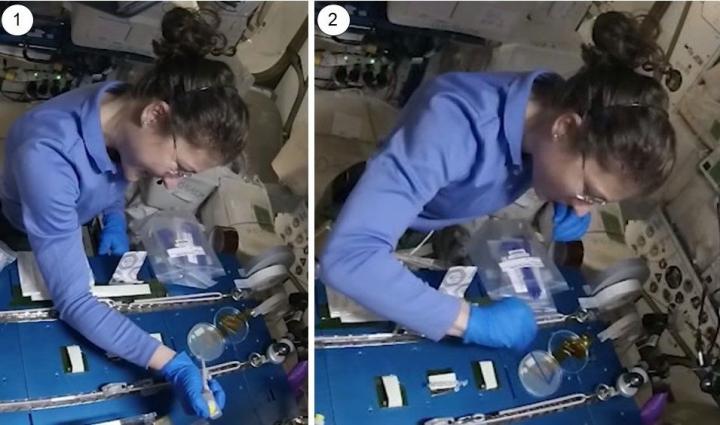
The space age of CRISPR began in May 2019, with the first extraterrestrial editing experiment performed by NASA astronaut Christina Koch (pictured here). As for tardigrades, CRISPR already allows them to be studied in terrestrial laboratories, turning their genes on and off for the purpose of deciphering their functions (see in this regard the University of Tokyo paper published in Plos Genetics in June 2024).
The researchers used an approach called “direct parental CRISPR” (DIPA-CRISPR), in which the genetic correction is passed on to the offspring without the need for mating. It was enough to inject the solution with CRISPR into the animals just before they released the unfertilized eggs. The ability to reproduce asexually (by parthenogenesis) means that each gene can be present in two identical copies, making life easier for geneticists. Among the many interesting genes is one that allows trehalose sugar to make the watery interior of cells gummy. Tardigrades need this trick to survive desiccation, but who knows, it may find useful applications in humans as well, perhaps for organ transplants.
With their round, segmented bodies, flattened heads, and eight little legs, tardigrades might look ugly, but the more we learn about them, the more they appear to us as incredibly fascinating creatures, at once primordial and science fiction. “They live pretty much everywhere, from mountain peaks to beneath glaciers and oceans and lakes, under the leaf carpet of forests, along logs and stones. To see them, collect a bit of lichen or moss and soak it overnight, then squeeze it onto a light microscope slide,” Ricki Lewis advises in the blog DNA Science.
Returning to the topic of space, it’s worth noting that these invertebrates have already had the honor of visiting the International Space Station in 2011. Then in 2019 an Israeli mission took them to the Moon, but the probe crashed on the surface and it seems unlikely that its tiny passengers survived. Alejandra Traspas, of Queen Mary University of London, made the calculations, thanks to an ingenious terrestrial experiment in which the tardigrades were put “to sleep” for ethical reasons before simulating crash-like conditions (the paper came out in Astrobiology).
Their name means “slow walkers,” and they are the size of a dot, but they possess qualities that are nothing short of amazing. They can reproduce even with radiation a thousand times the doses fatal to humans because they possess extraordinary DNA repair capabilities. When the going gets tough, they enter a quiescent state (cryptobiosis) and can stay there for years. In short, they survive extreme conditions of dehydration, as well as extreme temperature changes. The shock pressure generated by the probe’s metal structure in the ill-fated moon landing, however, seems to have exceeded even their limit which is 1.14 gigapascals. Perhaps we should say fortunately, because it would have been a gamble to take terrestrial life off Earth like that without general consensus. But the sorrow a little remains: RIP.
 CRISPeR FRENZY