
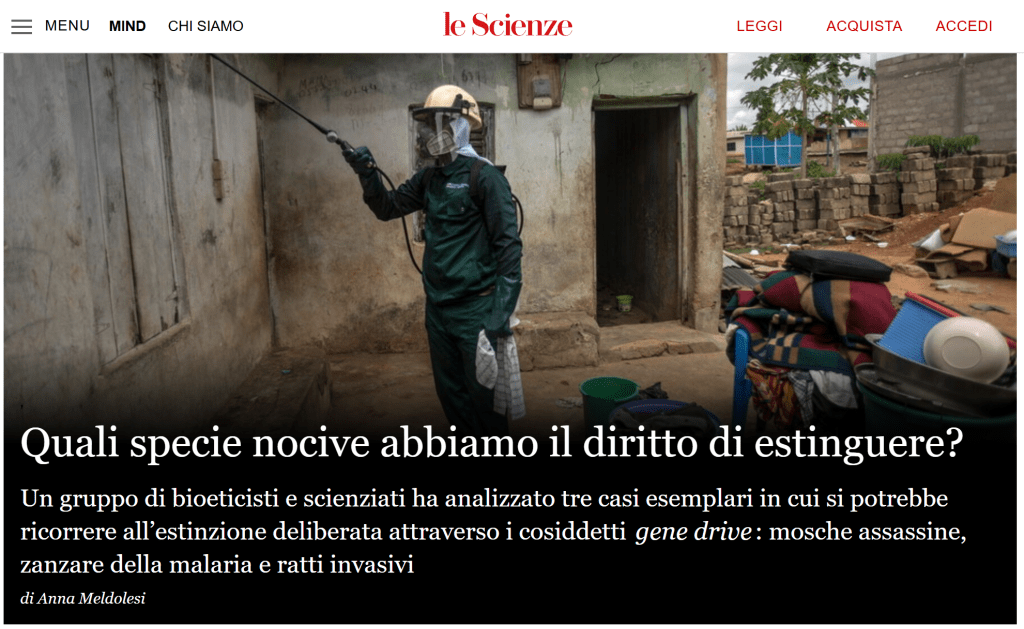
Since its origins, Homo sapiens has driven many species to the brink of extinction—and sometimes irreversibly beyond it. We have done so to feed, defend, colonize, cultivate, and enrich ourselves—often without fully realizing it. To do so today, deliberately, in an era of biodiversity treaties and conservation efforts, might seem absurd or extreme. Yet there is no shortage of organisms deemed highly harmful to human health or the environment. Under what conditions might it be justifiable to eliminate them using genetic technologies? Do we have the right to erase another life form from the face of the Earth?
These questions likely have no single correct answer. A group of biologists, ecologists, naturalists, bioethicists, and social scientists recently convened a workshop to discuss them, and published their reflections in Science, focusing on three concrete cases: the New World screwworm (Cochliomyia hominivorax) in South America, the malaria mosquito (Anopheles gambiae) in Africa, and invasive mice and rats (Mus musculus, Rattus rattus, Rattus norvegicus) on the islands of Oceania.
In all three cases, there are strong arguments in favor of intervention, but Gregory Kaebnick and colleagues reach different conclusions. For screwworms, even total extinction may be justifiable. In the case of malaria, it would be preferable to use gene drives to spread mosquitoes that are refractory to the Plasmodium parasite, rather than drive the species to extinction. As for the rodents, the risk of them escaping from the islands is too great—no one wants to risk triggering a global extinction of mice and rats.
One of the key points raised concerns public perception of the technologies used to eliminate pest species. Compared with environmental modifications, traps, or poisons, genetic solutions offer clear advantages—yet they provoke greater distrust. It’s as if genomes carry a moral status, tied to an organism’s very identity.
Sterile insect techniques meet with less resistance than genetic engineering or gene drives, yet irradiation works by altering DNA. The difference is that those mutations are random, not targeted. So why, then, do people tend to prefer the less precise methods? Kaebnick and colleagues wonder whether it is the lack of control we exercise over older techniques that makes us feel less accountable for the results.
[To learn more, you can read the piece I wrote on this topic for Le Scienze, the Italian edition of Scientific American]
 CRISPeR FRENZY